Iraqi Arabic | Ancient, Warm, and Closer to Fusha Than You Think

Iraqi Arabic preserves sounds and words that other dialects have let go. When an Iraqi speaks Classical Arabic, you cannot tell where the dialect ends and the language begins.
← Previous: Levantine Arabic | The Language of Drama and Poetry
In the mid-1990s, millions of Arab children sat in front of their televisions watching the dubbed Arabic version of the Japanese anime series Adnan and Lina. The voices spoke Classical Fusha — but with a different quality: warm, natural, nothing like a textbook recitation. A Lebanese girl once asked her mother: “Why do the people in this cartoon speak like schoolbooks but it doesn’t feel like a schoolbook?”
The answer: because the voices were Iraqi.
The Iraqi dubbing of Classical Arabic achieved something no other dialect managed as consistently: it made the formal language feel human. This is not an individual gift — it is the product of a dialect that sits close to Fusha from the start, close enough that moving between the two is like moving between two rooms in the same house.
Where the Dialect Ends and the Language Begins
Listen to Kazem Al Saher in a television interview — speaking in his steady, unhurried way — and you may need a full minute before you can decide: is this Classical Arabic or Iraqi dialect?
The honest answer is: there is not much difference. And this is the heart of what this article is about.
Iraqi Arabic — especially in its formal urban register — preserves sounds that other dialects have largely abandoned:
- The qāf is pronounced as a full qāf in many regions — it does not shift to a glottal stop as in Egyptian and Levantine
- The points of articulation remain close to what Classical phonology established
- Iraqi vocabulary frequently resembles Classical vocabulary in its root or sound — bājir (tomorrow) is closer to Classical bukra than it is distant from it
- When an Iraqi speaks Fusha, it does not sound like translation — it sounds like a natural extension of their everyday speech
This is why the Iraqi broadcaster and actor was a reference for spoken Classical Arabic in Arab radio and television for decades — not because they studied more, but because their dialect gives them half the distance for free.
When an Iraqi or a Levantine speaker uses Classical Arabic, you do not feel they have put on a formal suit — you feel they have put on their usual clothes, slightly more neatly.
The Land of the First Writing — Layers Without End
Iraq is the land of the world’s first known writing — Sumerian cuneiform script, dating to approximately 3200 BCE. And the first literary text in the history of any human language was written here too: The Epic of Gilgamesh — the story of a king searching for immortality who loses his companion and returns empty-handed, and learns that living is the answer, not immortality. A text five thousand years old that still feels as if it was written this year.
This land was never home to one language — it held a succession of languages, each leaving its mark on modern Iraqi Arabic:
| Language | Period | Trace in Iraqi Arabic Today |
|---|---|---|
| Sumerian | ~3500 — 2000 BCE | The oldest layer — place names and deep earthly vocabulary |
| Akkadian (Babylonian / Assyrian) | ~2500 — 600 BCE | “shlōnak” (how are you) — root traced to ancient Akkadian |
| Aramaic | ~800 BCE — 700 CE | Deep pre-Islamic layer — certain everyday expressions |
| Persian | Continuous to the present | The ch sound — “chāy” (tea) — “parda” (curtain) — household vocabulary |
| Classical Arabic | From the 7th century CE | The core structure — landing on a land already deeply linguistic |
From these layers comes the most distinctive sound in Iraqi Arabic: «ch» — the sound between a hard j and a ch, a direct Persian-Akkadian trace found with this frequency in no other Arabic dialect. Chān (was), chēf (how) in some regions — every ch carries at least two thousand years of history.
Badr Shakir Al-Sayyab — When the Rain Wept in Arabic
Badr Shakir Al-Sayyab was born in 1926 in the village of Jaykur, near Basra, on the banks of the Buwayb river. A green land between two rivers that knew rain and knew drought, knew fertility and knew loss. He died in 1964 at thirty-eight years of age — ill, far from his village.
But in those few years he wrote enough to make him one of the founders of Arabic free verse — poetry that freed itself from the constraints of fixed metre and unified rhyme without abandoning internal music. His poem “Unshudat al-Matar” (Song of the Rain, 1954) is among the greatest Arabic poems of the twentieth century — and perhaps of any era:
“Your eyes are two palm-grove forests in the hour of dawn / or two balconies from which the moon withdraws / your eyes, when they smile, the vineyards blossom / and lights dance like moons in a river.”
Rain in his poem is not merely water — it is the voice of life and grief and fertility and death simultaneously. This can only come from a poet who grew up between two rivers, where rain means the difference between hunger and fullness, between a living river and a dead earth.
Al-Sayyab wrote in Classical Arabic — but his Fusha is saturated with the spirit of Iraqi: with sensory vocabulary, with the sound of Basra, with the palms of Buwayb. This capacity to load Classical Arabic with the soul of a place is what distinguishes great Iraqi poetry.
Kazem Al Saher — When Classical Arabic Sang with an Iraqi Voice
If Al-Sayyab proved that Fusha can carry an Iraqi spirit in written poetry, Kazem Al Saher proved it can do the same in a song that is sung.
Kazem is Mosul-born and Baghdad-formed. He began his artistic career early, but the decision that defined his identity was a bold one for its time: to sing the poems of Nizar Qabbani — the Damascene poet who wrote almost entirely in Classical Arabic. And rather than dressing those poems in the heavy traditional arrangements that Classical sung poetry had known, Kazem chose modern, light, contemporary compositions — so the Classical poem was heard as a song of its own era, not a heritage being revived.
“Risāla ilā Ummī”, “Zīdīnī ʿIshqan”, “Qūlī Uḥibbuk” — Qabbani’s Classical verse set to Al Saher’s compositions — were heard by an entire Arab generation without any of them realising they were listening to Fusha. That is the real achievement: hiding the formality behind the beauty.
Sung Fusha — A Phenomenon Larger Than Kazem
Kazem is not alone in this direction — but he is among those who most firmly established it. Singing Classical poetry to contemporary compositions is a living tradition across the Arab world, and audiences receive it warmly: Fairouz sang for Al-Bayyati and Saeed Aql; Abdel Halim Hafez set Nizar Qabbani to music too; Majida Al Roumi has sung Classical texts with modern Arab arrangements.
What all these share is that they are fundamentally different from an older and more formalised tradition known as Andalusian Muwashshahat — the classical vocal art with strict rules of metre, maqam, and performance, whose greatest modern champion was the Syrian artist Sabah Fakhri. The Muwashshah is the art of preservation. Sung Fusha with contemporary composition is the art of renewal — the difference between classical ballet and a contemporary dancer performing to a new orchestral score.
Kazem Al Saher chose renewal — and in that lies a genuine courage. Arab audiences have often been unforgiving of those who touch heritage with a different hand. He succeeded because he did not break the beauty — he repackaged it.
When you hear Kazem sing Nizar, you feel that the Damascene Syrian’s poem found its fullest voice in the throat of the Mosuli Iraqi — as if the Arabic language had been waiting for this marriage all along.
Iraqi Drama and Dubbing — A Quiet Presence, A Large Memory
Iraqi drama never achieved the pan-Arab presence of Egyptian or Syrian production — and the reason is not an absence of talent but the full weight of political history. Four decades of wars, siege, and invasion left no room for cultural production to accumulate and spread.
But what Iraq produced before that left a permanent mark. Iraqi television in the 1970s and 80s was among the strongest in the region, producing serious social drama in a rooted Baghdad register. Yet the deepest memory Iraq left in the Arab imagination was not its local drama — it was its dubbing.
The Iraqi dubbing actor gave an entire Arab generation Classical Arabic that they loved without finding it heavy. Adnan and Lina, Sinan and Sino, and dozens of other dubbed works — return to their clips today after thirty years and that Iraqi warmth is still there, making Fusha feel close.
There is something dubbing achieves without intending to: the Arab child who grew up with these voices came to associate Classical Arabic with warmth rather than with intimidation. From the perspective of language education, that is a gift beyond measure.
Then What Came, Came
Iraq lived under the rule of Saddam Hussein for nearly four decades. Then came the American invasion of 2003. Then came years that we cannot describe in this article — and do not wish to.
We wish only to say one thing: a land that wrote the Epic of Gilgamesh — the first story in history of a human being who refuses to accept extinction — will not fall silent. Today in Iraq, music and poetry and drama and theatre are returning with force, in the voices of a generation that chose none of what happened to them but chose to remain.
And the language — as the Akkadians and Sumerians and Babylonians taught us — is harder than everything else.
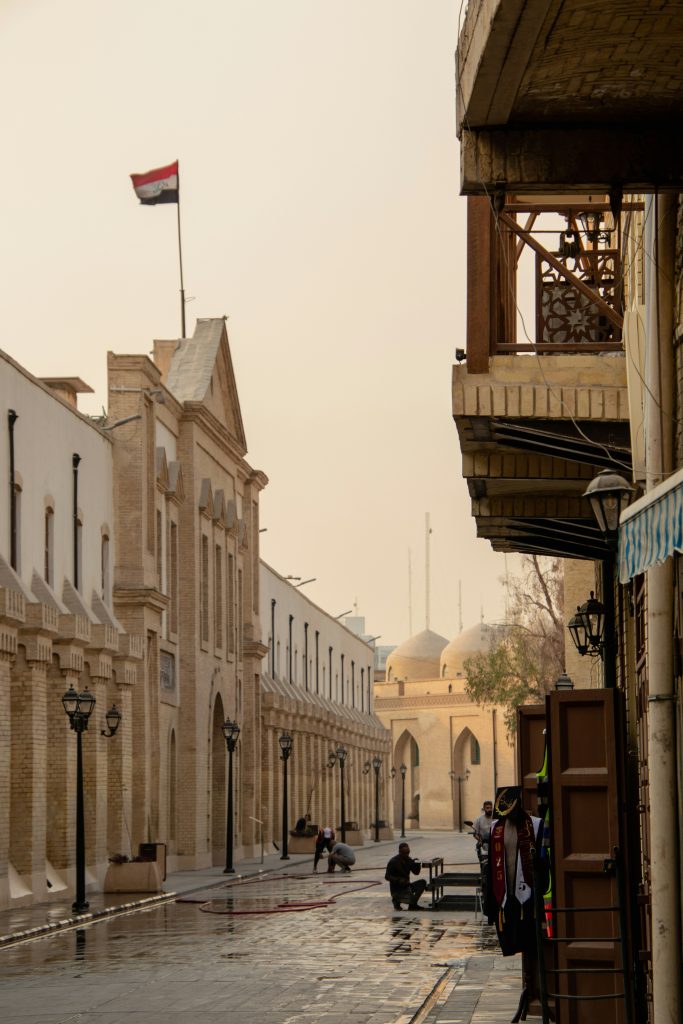
Iraqi Arabic in the Table — A Comparison
| Meaning | Classical | Iraqi | Levantine | Egyptian |
|---|---|---|---|---|
| How are you? | kayfa ḥāluk? | shlōnak? | kīfak? | izzayyak? |
| What’s there / what’s up? | mādhā yūjad? | shūku māku? | shū fī? | fī ēh? |
| Tomorrow | ghadan | bājir | bukra | bukra |
| Now | al-āna | hassa / hassat | hallaʾ | dilwaʾti |
| Good | jayyid | zayn / tamām | mnīḥ | kuwayyes |
| I want | urīd | urīd (used as-is!) | biddī | ʿāyiz |
| Why? | limādhā | lēsh / shbīh | lēsh | lēh |
Note in the table: Iraqi uses urīd (I want) exactly as Classical Arabic does — Levantine changed it to biddī and Egyptian to ʿāyiz. This is one example of a pattern that repeats across dozens of words: what other dialects reshaped, Iraqi often kept closer to its Classical source.
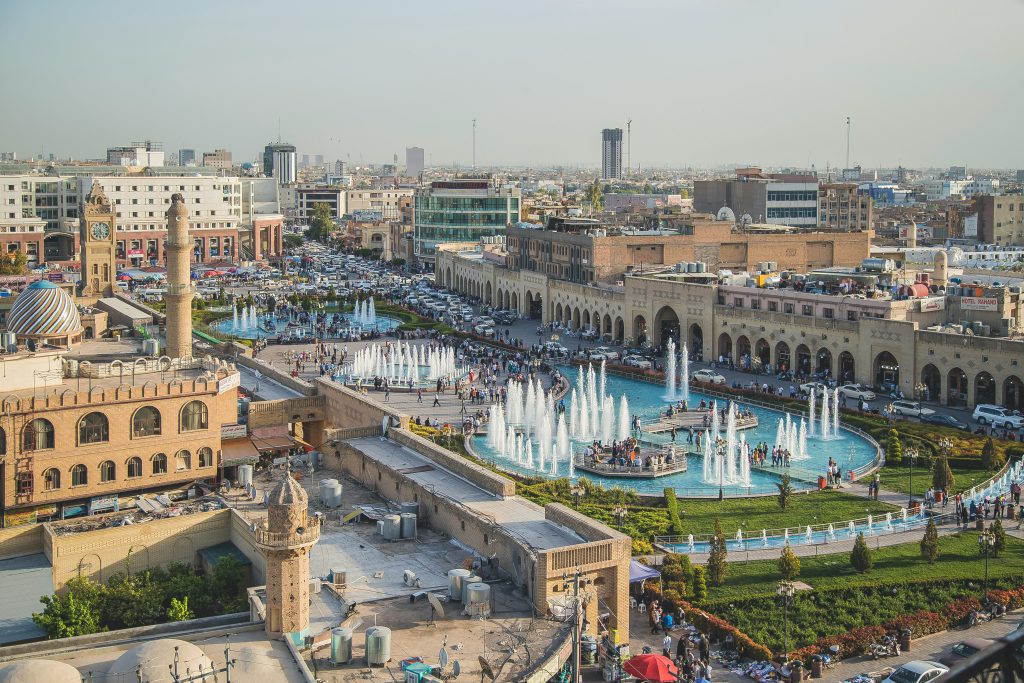
Words That Open Iraqi Doors
- “shlōnak?” — how are you? When the Iraqi replies “zayn, al-ḥamdu lillāh” you will feel you heard Fusha in comfortable clothes.
- “shūku māku?” — the most famous phrase in Iraqi Arabic. It means: what is there and what is not there — what’s the news, what’s going on? No other Arabic dialect compresses this meaning into three words in quite this way.
- “hassa” — now. Short, comfortable, fits every context.
- “yābe” — a tender address, literally “my father” — but used with warmth toward anyone older or close.
Next in this series: Gulf Arabic | The Most Ancient Arabic Still Spoken. If Iraqi Arabic preserved Classical Arabic through historical continuity, Gulf Arabic preserved vocabulary that people assumed had disappeared — words found in the pre-Islamic poetry of Imruʾ al-Qays and in Dubai coffee shops at the same time.
← Previous: Levantine Arabic | The Language of Drama and Poetry | Next: Gulf Arabic | The Most Ancient Arabic Still Spoken →