Levantine Arabic | The Language of Drama and Poetry

Levantine Arabic carries layers of Aramaic, Phoenician, Greek, and Arabic. A guide to the softest Arab dialect — and the heaviest in history.
← Previous: Egyptian Arabic | The Dialect Everyone Understands
A Japanese student learning Arabic was once asked what he noticed first when he heard a Levantine speaker. He thought for a moment and said: “It sounds like they are singing, not speaking.”
This is not an unusual observation — many people say the same thing on first hearing. But the real question is: why this impression, specifically? What is it in Levantine Arabic that makes sentences seem to descend rather than rise, to end softly rather than cut off?
The answer is not in the present. It is in thousands of years of languages that passed through this land and each left a trace that cannot be erased.
Where Civilisation Began — The Oldest Competition in History
There is an ancient rivalry that history has not yet resolved: where did the first settled human civilisations arise? In the Nile Valley, where Pharaonic Egypt was born? Or in Mesopotamia — the region geographers today partly call the «Syrian Jazira» — where the Euphrates and Tigris converged to water an earth that nourished Sumerians, Akkadians, Babylonians, and Assyrians in succession?
Both regions offer archaeological evidence that keeps the question open — and this is itself good news. It means that humanity took its first steps toward settlement, writing, and the city in two geographically neighbouring places that were closely connected by culture, trade, and language.
This enormous civilisational accumulation is what explains a single thing: why Levantine Arabic carries in its linguistic body layers that no other Arabic dialect contains with the same density and variety.
Ugarit — When the Syrian Coast Invented Writing
In 1928, a Syrian farmer ploughing his field near Latakia struck a large stone mass buried in the soil. The French Mandate authorities sent an archaeological team led by Claude Schaeffer, and after just five days of digging the first clay tablet appeared. They had discovered the ancient city of Ugarit — modern Ras Shamra — buried for some three thousand years.
What they found changed humanity’s understanding of the history of writing: clay tablets inscribed with a cuneiform script unlike any known cuneiform writing. When the German orientalist Hans Bauer decoded the script — just five days after receiving copies, drawing on his experience as a code-breaker from World War One — it became clear that these letters were alphabetic, not syllabic. Each sign represented a single sound, not a syllable.
The Ugaritic alphabet consists of 30 letters, and some researchers consider it the world’s first complete alphabet, dating to between the fifteenth and thirteenth centuries BCE. More importantly: the sequence and pronunciation of its letters closely resembles modern Arabic more than any other writing system — making extinct Ugaritic, spoken by no one for three thousand years, linguistically closer to Arabic than the Aramaic language that came after it and survived until today.
Most striking of all: the Ugaritic alphabet gave rise to the Phoenician alphabet, which gave rise to Greek, which gave rise to Latin, and from Latin came every modern European alphabet. When you write in English, Italian, or French, the origin of those letters traces back to this specific Syrian coast.
This is the depth of the earth from which Levantine Arabic grows.
The Semitic Family — Arabic Is Not Alone
Arabic is a Semitic language — a term referring not to ethnicity but to a wide language family, most of whose members arose in or migrated from the same general region. The family includes many languages, some living and some extinct:
| Language | Status | Note |
|---|---|---|
| Arabic | Living — 400 million speakers | The most widely spoken in the family |
| Hebrew | Living — revived in the twentieth century | The only language successfully returned from near-total extinction |
| Amharic and Tigrinya | Living — Ethiopia and Eritrea | The southern branch of the family |
| Aramaic / Syriac | Near-extinct — a few thousand speakers | Language of Christ and Eastern churches — still used in liturgy |
| Ugaritic | Extinct since ~1200 BCE | The closest extinct language to Arabic |
| Phoenician / Canaanite | Extinct | Mother of Western alphabets — via Greek and Latin |
| Akkadian (Babylonian / Assyrian) | Extinct | The oldest written Semitic language — influenced Iraqi and Gulf dialects |
To speak Levantine Arabic today is to carry — without knowing it — echoes of all these languages in the way you pronounce, structure your sentences, and use your everyday vocabulary.
When Greece Came to the Levant — The Hellenistic World
In 333 BCE, Alexander the Great crossed the Taurus Mountains, entered Syria, and shattered the Persian armies at the Battle of Issus. This began a period that changed the Levant not merely politically — it dissolved it into an entirely new compound.
What followed Alexander was called the Hellenistic era — from a Greek word meaning “in the Greek manner.” But Hellenism was not pure Greek. It was a unique fusion between Greek civilisation and the cultures of the East: Greek became the language of the elite and of commerce, but local worship, Levantine arts, and Eastern philosophies did not disappear — they blended with the Greek and produced something that was neither purely Greek nor purely Levantine, but a third thing entirely new.
Antioch on the Orontes (modern Antakya) became the third city of the Hellenistic world after Alexandria and Rome — a centre of philosophy, literature, and trade. The Levant in this period was not a peripheral territory at the edge of history but a civilisational reference point at its centre.
The trace of Hellenism is still alive in Levantine openness to the stranger — an inherited curiosity from two thousand years of being the meeting point of the world.
When Syrians Ruled Rome
When people hear “Roman emperors” they imagine Italians — but history is more surprising than that. In the second and third centuries CE, Syria produced an entire dynasty of Roman emperors and empresses.
Julia Domna was born in Emesa (modern Homs) around 160 CE, daughter of the high priest of the deity El-Gabal. She married Emperor Septimius Severus and became one of the most powerful women in Roman history — receiving the title “Mother of the Army Camps, the Senate, and the Fatherland”. She administered large portions of the empire while her husband and son Caracalla were on campaign, and cultivated a philosophical circle in Rome that made her household a cultural institution in its own right.
After her came Elagabalus — Julia Domna’s grandnephew — who ascended Rome’s throne in 218 CE at age fourteen, a priest of the Syrian sun god. Then his cousin Severus Alexander, who ruled with remarkable religious tolerance: ancient sources record that he kept an image of Jesus of Nazareth alongside Abraham and Orpheus in his private chapel — a pluralism that reflected Syria’s cultural depth.
In the mid-third century came Philip the Arab — from the region of Shahba in southern Syria (modern Sweida) — who became the first and last Arab emperor of Rome, ruling from 244 to 249 CE. He presided over the celebrations marking Rome’s one thousandth anniversary in 248 — an Arab Syrian standing at the centre of the ancient world’s greatest occasion. His image appears today on the Syrian hundred-pound banknote.
This history is not a digression. It is essential context for understanding why Levantine identity is saturated with confidence in the face of difference — a people who spent two thousand years at the crossroads of civilisations do not fear encounter; they master it.
The Sound of Levantine Arabic — Why It Descends
The linguistic reason for the “singing” impression that our Japanese student described lies in three phonetic features:
The Soft Qāf and the Gentle Jīm
Like Egyptian, the Levantine qāf has shifted to a glottal stop in urban speech. But Levantine goes further: in some Lebanese and Palestinian environments the qāf disappears entirely or glides into another sound. The jīm, meanwhile, softens in Levantine — especially Lebanese — toward a sound close to the French zh, far from the firm Egyptian jīm.
The Descending Intonation
Levantine sentence melody tends to descend gradually — as if the speech relaxes toward the end of a sentence rather than cutting off sharply. This is precisely what gives it the musical quality first-time listeners describe.
“Baddak” — The Want That Is Also a Need
Levantine uses badd to express desire rather than the Classical urīd (I want). The root of badd in old Arabic refers to a joint, a separation — the thing that pulls you toward itself. “Baddak shi?” (do you want something?) is warmer than “hal turīd shay’an?” because it asks what draws you, not what you request. The difference is philosophical before it is linguistic.
| Meaning | Classical | Levantine | Egyptian | Gulf |
|---|---|---|---|---|
| Now | al-āna | hallaʾ / halʾ | dilwaʾti | al-ḥīn |
| What? | mādhā | shū | ēh | ēsh |
| Like this | hākadhā | hēk | kidda | jidhī |
| I want | urīd | biddī | ʿāyiz | abghā |
| Why? | limādhā | lēsh | lēh | lēsh / lēh |
| Good | jayyid | mnīḥ | kuwayyes | zayn |
Nizar Qabbani — The Poet Who Loved Women Because He Lost One First
No account of Levantine Arabic can pass over Nizar Qabbani — the Damascene who became the conscience of modern Arabic poetry on matters of love and politics alike. He wrote most of his verse in Classical Arabic, but the spirit of his poems is purely Levantine: the Damascene woman, the jasmine, the window, the smell of old houses.
Qabbani became famous above all as the poet of women — a title that sounds simple but was, in his time, a genuine revolution. In the mid-twentieth century, when Arabic poetry was largely occupied with the nation, the battle, and the hero, Qabbani chose to write about eyelashes, and the anger of a woman, and the weight of a glance. He wrote about women not with the traditional reverence of Eastern verse but with an honest acknowledgment that a woman is a complete human being with her own will, fury, pleasure, and grief.
Why this particular direction? No one knows the complete answer, but those who study his life encounter one event that he never moved past: his sister Widad fell in love with a man she was not permitted to marry — and took her own life. Nizar was a young man when it happened. He carried that loss into every poem he wrote afterward, as if rewriting the ending of the story each time: a woman loves, and is not punished for loving.
His poem “Damascus” — written in exile — carries this compressed Levantine spirit:
“O Damascus… when I miss you, I open the notebooks of jasmine.”
Jasmine is not merely a flower — it is another name for Damascus in the Levantine imagination. Poetry where a single word carries an entire homeland is what makes Levantine Arabic a language of poetry by its very nature.
Syrian Drama — When Damascus Wrote for the Arabs
As Egyptian Arabic became the language of the masses through cinema and music, Levantine Arabic became the language of psychologically deep television drama — through a wave of Syrian production that began in the 1990s and reached its peak in the first decade of the twenty-first century.
Bab al-Hara — the most-watched Arabic series in television history — is Syrian in production and Levantine in dialect. It is not merely a series: it is a social phenomenon, discussed in cafés and rebroadcast every Ramadan as if just produced, telling the story of a Damascene neighbourhood under French Mandate and its defence of its dignity.
But Syrian drama was never merely historical nostalgia. It dared something Egyptian drama did not to the same degree: the daily life of ordinary people in their full detail — their contradictions, their moments of bitterness and comedy coexisting in the same scene. Al-Nadam carries this psychological weight: characters living with the consequences of their wrong choices in quiet, painful steadiness. Ahlam Kabira — the Syrian adaptation of Dickens’s Great Expectations — proved that Levantine drama aspired beyond entertainment: to building a literary memory in the voice of its own people.
Yasser al-Azma in Maraya (Mirrors) — the social satire that ran for decades — made Levantine Arabic an instrument of sharp social criticism, in the language of the street rather than the language of the academy.
(See our article: When Damascus Wrote for the Arabs | A Farewell to Syrian Drama) — for a deeper look at this golden era and what it left behind.
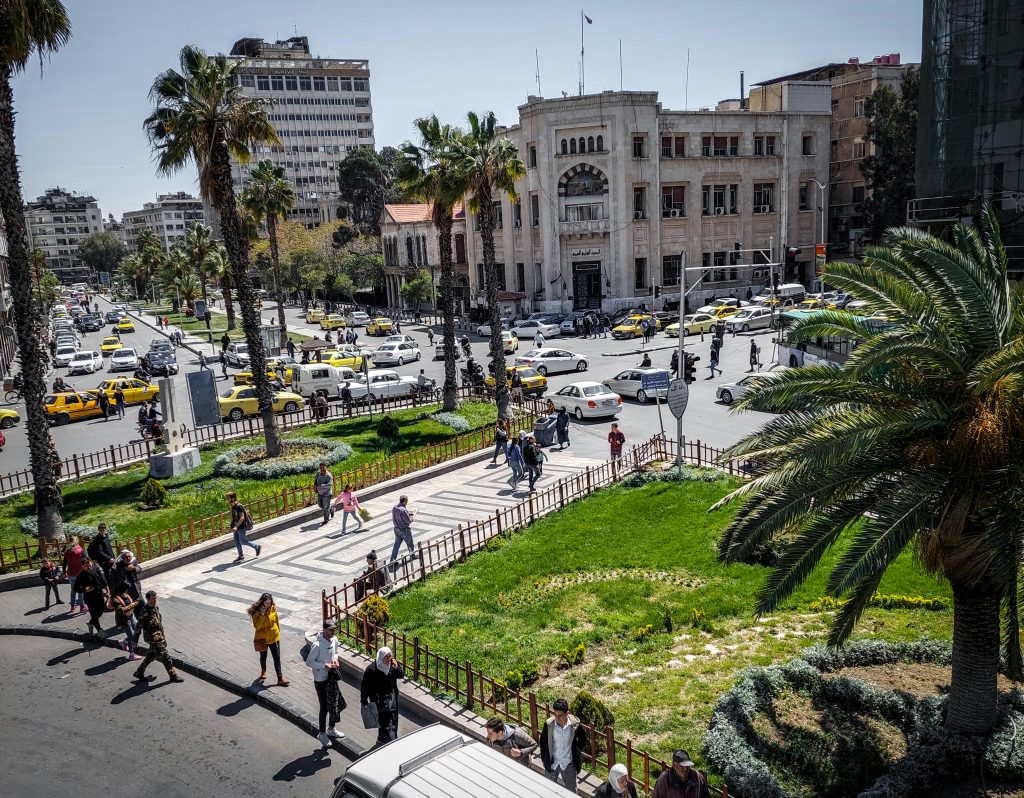
Damascus — The Heartbeat That Fell Quiet for a While
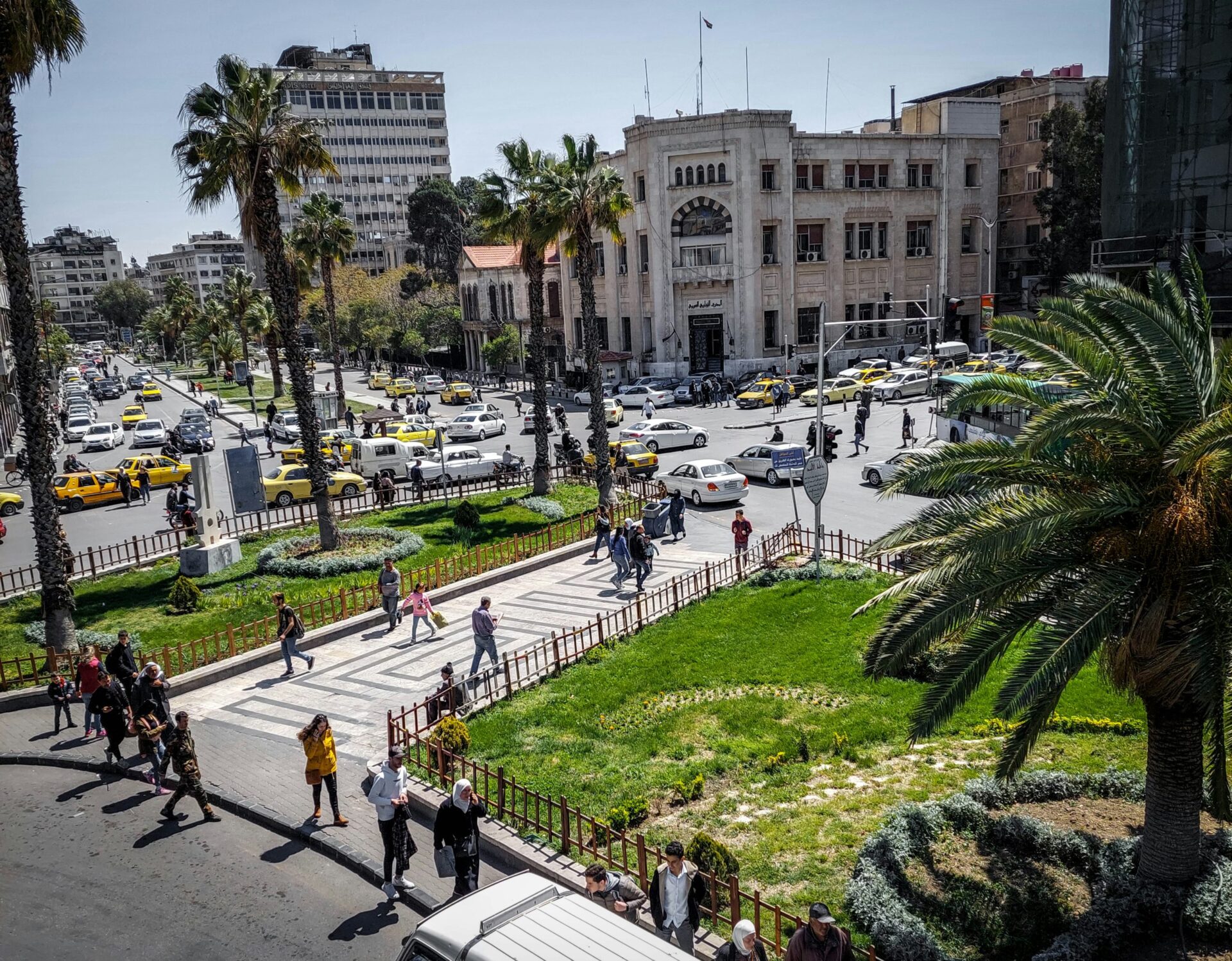
Damascus is the oldest continuously inhabited capital in human history — a city more than eight thousand years old, capital of the Umayyads who spread Islam and Arabic from the borders of China to the south of France, a waypoint for everyone who has moved through this region’s history from Alexander to Saladin.
In the twentieth century, Damascus added to its historical weight a new ambition: to be the capital of Arab nationalist thought. From here emerged the ideas of Michel Aflaq, Antoun Saadeh, and Sati’ al-Husri — large intellectual projects that sought to redefine what it meant to be Arab in the modern world. “The beating heart of Arabism” was not a poetic flourish — it was a genuine cultural and civilisational position.
Then came December 2024.
We are not here to write political history — this is not its place or its moment. But we are documenting something harder: what happens to a language when its capital loses its familiar presence? What happens to drama and poetry and song when its people are scattered?
The answer — which history has taught us more than once — is that a language does not die when a city falls. The Levantine Arabic that survived Aramaic, Greek, Latin, and Ottoman Turkish will not be extinguished by a single event however heavy. What may have shifted is the centre of gravity. But the entire language family — in Lebanon, Palestine, Jordan, and Syria — still pulses and produces and sings and writes.
Language is harder than cities. Jasmine grows in cracks.
Four Words That Open a Door
If you will be working with Levantine speakers — Syrians, Lebanese, Palestinians, or Jordanians — these words will make you close before you finish your first sentence:
- “ktīr mnīḥ” — very good. Say it with warmth and you will light up the room.
- “hallaʾ” — now. One word that shows you know something.
- “yislamu” — thank you / bless your hands. The most beautiful way to express gratitude in Levantine.
- “shū fī?” — what’s there? / what’s up? The most commonly used Levantine daily greeting.
Next in this series: Iraqi Arabic | Ancient, Warm, and Closer to Fusha Than You Think. If Egyptian Arabic is the language of the masses and Levantine is the language of the heart, Iraqi Arabic is the language of the depths — the oldest of the dialects, the closest to Classical Arabic, and the most weighted with pre-Islamic history.
← Previous: Egyptian Arabic | The Dialect Everyone Understands | Next: Iraqi Arabic | Ancient, Warm, and Closer to Fusha →