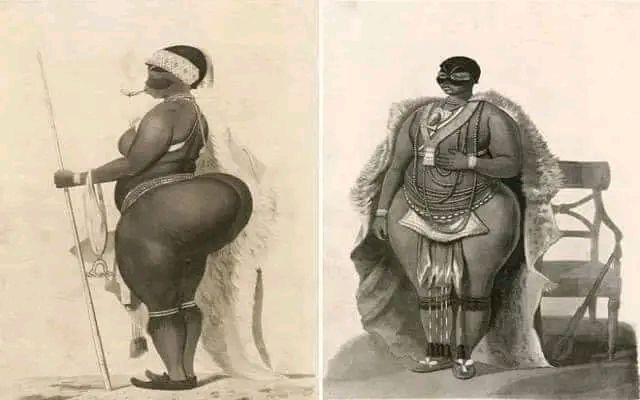
Sara Baartman: When the Body Becomes a Display Screen

From the cages of 19th-century Europe to the digital platforms of today, this article explores the tragic story of Sara Baartman as a mirror for modern ‘digital slavery.’ It analyzes how the human body and personal data are transformed into a display screen for exploitation, calling for a moral review of our technical progress.
The story of Sara Baartman is not just a dark chapter from the nineteenth century, but an early model of what happens when a human being is turned into a show. She was displayed naked before the public, not as a woman, but as a spectacle. Nudity here was not a secondary detail, but the core of the exploitative act: stripping the body of its protection and turning it into an object for looking.
The Sad Story of Sara Baartman:
Sara Baartman’s life was short enough to be forgotten, and harsh enough to remain. Her story is not an isolated incident in the history of a continent or civilization, but a magnified mirror of a human face we have known repeatedly under different names: slavery or exploitation. Saartjie was born in the eastern part of South Africa around 1789, where she was captured by Dutch colonists while she was still a child. They called her Sara because the meaning of Saartjie in the local language is “Little Sara”. One doctor wrote a detailed and insolent description of her body, claiming that her features confirmed the prevailing European belief at the time about the sexual degradation of Black women [1].
The display of “strange” humans reached its peak in the nineteenth century in Europe and America. Audiences paid small amounts of money to watch bodies presented as human wonders. Even some intellectuals of the era participated in this culture; the novelist Charles Dickens described the primitive human as “something very preferable to be swept away from the face of the earth” [2].
Sara arrived at the Piccadilly Circus in London in 1810, where she was advertised as the “Hottentot Venus”. She was displayed naked inside a cage and led as if she were an animal. Members of the Royal Society for the Abolition of Slavery tried to free her, but the court returned her to the shows. In Paris, Sara attracted the attention of the French scientist Georges Cuvier, who drew her in naked positions for “scientific” purposes. A French journalist wrote describing her condition: “Tears fall from her eyes… she jumps, sings, and plays the drum…” [3].
In one party, Sara described herself in a brief and moving phrase: “My name is Sara, very sad Sara” [4]. After years of exploitation, Sara died young. Cuvier dissected her body and wrote: “I have never seen a human head more similar to a monkey’s head than the head of this woman” [5].
The Sad Story of Modern Sara:
If the nineteenth century put Sara in a physical cage, the twenty-first century has built less obvious cages. We live today in a world where personal data is sold, digital behaviors are monitored, and human attention is turned into an economic commodity. We can speak here of a form of “soft digital slavery”: not because humans are bound by chains, but because their daily lives have huge economic value extracted from them, often without full awareness of the scale of what is being provided.
“My name is Sara, very sad Sara” [4] — this sentence does not describe the sadness of one woman only, but an entire mechanism of dehumanization. The body — and today, data — has become the property of the public gaze and the market.
Today on social media, humans are displayed voluntarily this time, but within systems that encourage turning the self into a consumable image: profiles, like statistics, and algorithms that rearrange what we see and say. The essential difference is that participation here is seemingly optional, but it takes place within environments carefully designed to direct behavior. Thus, the question raised by Sara’s tragedy — the question of turning the human into an object — is present in a new form.
The matter did not stop at the body with the old Sara; she was baptized as a Christian against her will, as if renaming her religiously was part of reshaping her identity to suit the system that exploited her. It was a symbolic act saying that power does not stop at controlling the body, but also seeks to rewrite the meaning a person carries about themselves. Here, the past becomes an uncomfortable mirror for the present. Today, we are not forced into religious baptism, but we are practically forced to accept terms of use and privacy policies of digital platforms. We click “I agree” without reading, or without fully understanding what we are agreeing to, and without the possibility of our full understanding of what we agree to. Just as Sara was redefined within a system she did not choose, we are redefined within digital systems that we cannot participate in modern life without passing through them.
Barry Sanders wrote that modern culture has an extraordinary ability to turn humans into spectacles instead of being living subjects. When the human becomes a material for display, they lose something of their inner depth and are reduced back to a surface that can be consumed [6]. This is exactly what happened to Sara: she was turned into a surface to be read, interpreted, and consumed, while her inner life disappeared behind the cage.
Digital Slavery
Digital slavery manifests in several modern forms. The first is the data economy, where economic value is extracted from user behavior without a real return that matches the scale of commercial benefit. The second is mandatory identity verification systems, which make participation in the digital space conditional on providing sensitive documents, photos, and information. The third is the culture of work via platforms, where workers are subject to evaluation algorithms and continuous monitoring that determines their work opportunities without enough transparency. In all these cases, the human is not seen as a complete entity, but as a data source or a production unit.
In fact, many people still do not realize the true value of their data. This appears in public behavior when cybersecurity experts warn of certain leaks on a site; the common saying is: “We have no secrets to fear,” while they are talking about their photos, voices, and conversations, which reflect their being, and which can never be generated virtually for free. The difference between Sara’s cage and the modern digital cage is not in the existence of exploitation, but in its degree of visibility. Her cage was visible to everyone; our cages today are integrated into the infrastructure of daily life.
The story of the old or modern Sara reveals the continuity of one idea: that power always tends to demand more exposure. In Sara’s case, the exposure was physical and direct. In our case, it is informational and symbolic, but it shares the same characteristic: turning what is personal into public material.
This does not mean a direct equality between the tragedies of the past and the forms of the present; Sara’s pains were physical, psychological, and legal in an incomparable way. But recalling her story opens a space to think about the continuity of a human pattern: the tendency to reduce the “other” into a function, an image, or a category. Every age invents its own justifications, from false racial theories to promises of technical efficiency. Perhaps we cannot rewrite Sara’s life, but we can read her story as part of a longer history of slow human learning: learning that technical or scientific progress does not necessarily guarantee a parallel moral progress. Progress always needs continuous review and sensitivity toward the moment when the human becomes — once again — an object.
References:
1. Clifton Crais and Pamela Scully / Sara Baartman and the Hottentot Venus.
2.Charles Dickens / Selected Essays.
3. Archive of the French Press in the nineteenth century.
4. Crais and Scully, the previous reference.
5. Georges Cuvier / Writings in Comparative Anatomy.
6. Barry Sanders / Speculator Culture and the Modern Self.
7. The main formula for nineteenth-century practices from the book by Barry Sanders / The Disappearance of the Human Being.