The Waiting Curb: When Damascus’s Yellow Taxis Became a Memory of Stability

The Damascus taxi protests of April 2026 are not just a labor dispute. They reflect a social contract beginning to come apart at the seams.
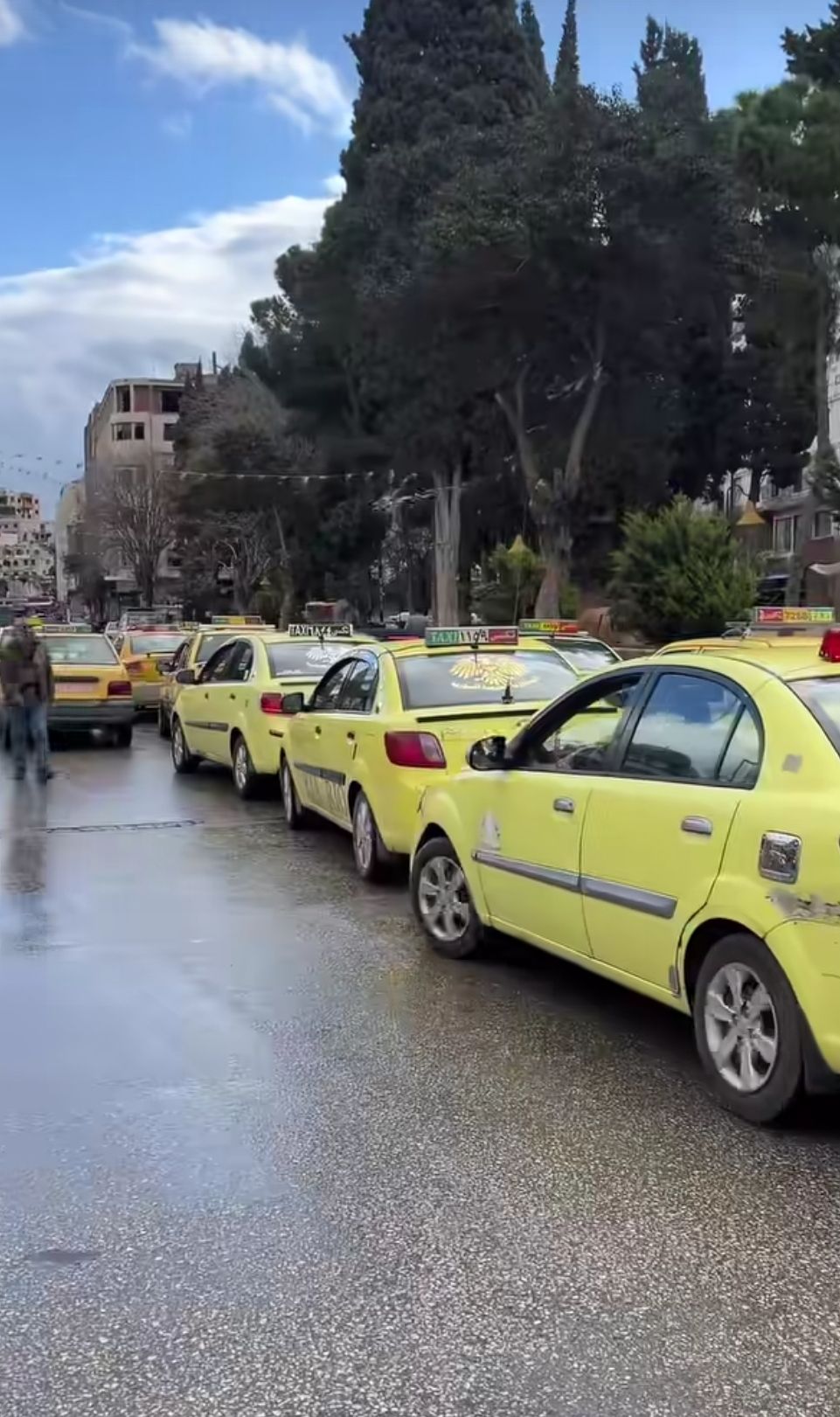
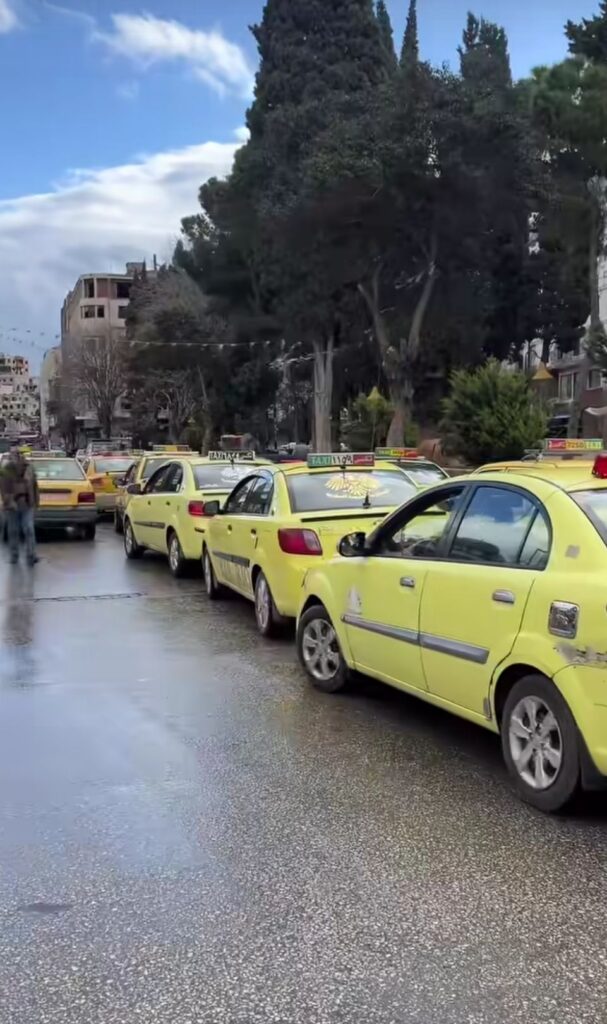
The sixth of April 2026 was not an ordinary day in Damascus. In the early morning hours, phone cameras were recording three scenes in three different locations, their coincidence a reminder that a country can speak in many voices and still be saying one thing. In front of the Ministry of Foreign Affairs and Expatriates, families of detainees held in the northeastern autonomous region spread mats on the pavement since before dawn, their banners asking questions that had no scheduled answers. In the countryside outside Jisr al-Shughur, in the village of Badama, the horns of heavy trucks rose in protest against transit fees that their drivers described as punitive. And in the center of the capital, near the Ministry of Higher Education, yellow dominated the scene — not decoration, but the color of the vehicles whose owners were standing outside them: drivers of licensed public taxis.
These are visually different scenes with a shared grammar. All of them say the same thing: people are tired of waiting. But the taxi crisis deserves particular attention, because it captures with unusual clarity what happens when yesterday’s rules collide with today’s reality — and ordinary working people absorb the impact.
The Scene on the Curb: When Professions Compete by Speed
How many times have you decided to skip the minibus and stand on the curb waving at a yellow taxi, only to find motorcycle drivers parked near the stop already moving toward you, asking where you’re headed? That scene was rare in Damascus a few years ago. Today it is part of the daily folklore of the Syrian pavement.
The motorcycles offer rides at roughly half the taxi fare, sometimes less. They navigate congestion with a flexibility no car can match, reaching the narrow alley the taxi cannot enter. And the licensed yellow cab driver, watching from behind his windshield, feels a bitterness that is difficult to describe — because he pays an annual license fee, insurance, environmental levies, and is nominally bound by a regulated meter, while his competitor on two wheels is bound by none of it.
This asymmetry in obligations is what pushed dozens of drivers to protest in April 2026, demanding what they called professional fairness. But their demands — read calmly, away from the heat of the moment — reveal a crisis deeper than a price competition.
“We are not fighting people over their livelihoods. We are fighting chaos. A driver who pays millions of Syrian pounds annually in licenses and insurance cannot survive alongside a motorcycle or a private car operating through an unlicensed app that contributes nothing to the treasury.” — from the testimony of protesters outside the Transport Workers’ Union.
The Broken Meter: When Compliance Becomes Unaffordable
The question of the meter has become one of the most openly contested issues in Syria’s service sector — and perhaps one of the most quietly embarrassing ones for all involved. Following the meter’s official rate is, in the current economic context, something close to financial self-destruction. Unofficial estimates suggest that a Damascus taxi driver needs upward of 150,000 Syrian pounds per day simply to cover unsubsidized fuel and basic maintenance, at a time when the official meter rate produces nowhere near that over a full day of driving.
The result is what anyone who has taken a taxi in Damascus knows well: a verbal negotiation before every trip, with the passenger feeling exploited and the driver feeling wronged. In the ethical and legal space between those two feelings, informal alternatives have grown, rapidly and predictably.
But honesty requires acknowledging that motorcycle drivers are not a plague that appeared from nowhere. They are a rational response by young men — many unemployed or seeking supplementary income — to a genuine gap in the market that licensed taxis, with their elevated fares in a time of eroding currency, cannot fill. You cannot fight this phenomenon by simply demanding it stop, any more than you can ignore the real damage it causes to drivers who have paid their dues to the formal system.
The real question is not who is to blame. The real question is: why has the regulation not evolved alongside the reality?
Ride-Hailing Apps: When Technology Deepens the Crisis Instead of Solving It
When ride-hailing apps entered the Syrian market, many hoped they would offer a middle path: bringing informal transport under a transparent digital umbrella, as has happened in various other countries. What actually occurred was different.
In the absence of clear legislation defining who is legally entitled to offer rides for payment through these platforms, the apps became a channel for private vehicles to enter the transport market free of any of the obligations attached to the yellow cab. Private car owners register with an app, carry passengers when it suits them, then set the device aside when they find other work. No professional license, no professional insurance, no fixed tax, none of the costs that weigh on the licensed driver.
The result: the driver who spent millions on purchasing a public transport license and professional registration finds himself competing with someone who decided one afternoon to turn his private car into a side income source by pressing a button — not because that person is necessarily acting in bad faith, but because the law has not yet distinguished between the two situations.
This tension is not unique to Syria’s transport sector. As we explored in our article on Smart Cities: Is Humanity Ready for Life in the Future?, there is a genuine friction between the pace of technological change and the pace of legislation in every city that is trying to modernize. In Damascus, that friction plays out at Syrian pound prices and on the backs of people earning a daily wage.
An additional layer of complexity comes from the technical and economic sanctions affecting Syria’s digital environment, which we discussed in Who Gets Blocked and Who Gets Punished? The Geopolitics of AI Platforms. Building a functioning, well-regulated digital transport ecosystem under those constraints is genuinely difficult even when the will is there.
Truck Drivers Too: The Crisis Is Wider Than the Taxi
The simultaneous protest by truck drivers in Badama, Jisr al-Shughur, on the same day was not coincidence. The transit and passage fees that truck drivers reject spring from the same logic: the cost of operating a licensed vehicle becomes unbearable when it rises without adjustment to reflect the changing economic reality.
The Syrian driver, whether at the wheel of a small taxi or a large truck, has increasingly come to feel that he is functioning as a tax collector for the state rather than as the owner of a small private enterprise with a reasonable expectation of profit. And when margins shrink to this degree, taking to the street becomes rational, even when many of those who do it understand that the street alone cannot solve equations this structurally complex.
Progress Cannot Be Stopped — But Chaos Can Be Managed
Something needs to be said plainly: the evolution of the transport sector cannot be reversed. Motorcycles are part of the reality, ride-hailing apps will remain and grow, and a passenger who chooses the faster and cheaper option will continue to do so regardless of what regulations are issued. Demanding that the clock be turned back is not a solution, and calling for the deletion of apps or the forcible removal of motorcycles from the streets will not return passengers to the yellow taxi as long as it remains more expensive in a time of declining real incomes.
But “progress cannot be stopped” does not mean “chaos cannot be managed.” The difference between two markets is not the presence of competition — it is the rules that govern it.
The real problem is not the motorcycle itself. The problem is that its rider is providing a public service without any legal or professional obligation that protects the passenger in the event of an accident or guarantees any minimum standard. The private car operating through an app is not the problem in itself. The problem is that its owner is practicing paid transport work on a part-time, come-and-go basis without being held to any of what is required of someone who chose this as their permanent livelihood.
When someone decides on a whim to tape a “taxi” sign to their personal vehicle, earn money for a few hours, then remove it when something better comes along — depriving professional drivers of part of their income without bearing any of their costs — that is not a “sharing economy.” That is the disorder itself.
What Makes a Driver Legally a Professional?
In most countries where apps like Uber and Careem operate successfully, the solution was neither shutting down the platforms nor defending the old model. The solution was defining a clear answer to one question: what legally qualifies a person to charge money for transporting others?
When that standard is written clearly, it creates a meaningful distinction between three models currently coexisting in Damascus without differentiation:
- The fully licensed professional driver: works in paid transport on a fixed basis, pays professional licenses, insurance, and periodic fees, and meets clear safety standards. This is the yellow cab owner.
- The part-time licensed driver: works through an approved digital platform for a defined number of hours, pays reduced fees proportionate to the nature of their work, and meets a basic but real set of requirements. This is the model that can constitute a legitimate, fair competitor.
- The unlicensed transporter: works without a professional license and outside any legal framework. This is the problem, regardless of whether the vehicle is a motorcycle, a private car, or even a yellow taxi evading its meter.
The distinction between these categories — rather than the warfare between them — is the starting point.
Balanced Solutions: Neither Defending the Old Nor Accepting the Chaotic New
Practical and balanced solutions to a crisis of this complexity cannot come from one direction alone. Here is what seems both logical and achievable:
First: update official pricing honestly. A driver cannot be asked to comply with a meter that does not cover his costs. Either the official rate must reflect the actual economic reality and be reviewed periodically — which would automatically rebuild passenger trust in meter-based fares — or it must be frankly acknowledged that the meter is symbolic, and a transparent alternative pricing mechanism put in its place.
Second: license part-time transport under clear conditions. Rather than fighting everyone who works outside the formal taxi system, a middle-tier professional classification could be established: a “part-time transport license” that allows private car owners to work through approved platforms for a defined number of hours in exchange for reduced fees and basic, mandatory safety standards. This legitimizes part of the grey economy and brings it into the tax and accountability framework, rather than leaving it entirely outside any structure.
Third: regulate motorcycle taxis within the transport system. The motorcycle is a practical transport option for a wide section of the population, particularly in heavily congested areas. Licensing it as a fare vehicle under clear safety conditions — helmets for both rider and passenger, accident insurance, a minimum of verifiable requirements — is far preferable to leaving it entirely unregulated.
Fourth: require platforms to distinguish between driver categories. Every ride-hailing platform operating in Syria should be required to display the driver’s category to the passenger (fully licensed / part-time licensed / motorcycle) and to bear legal responsibility for its drivers in the event of accidents. That requirement alone would give platforms a strong incentive to actually verify their drivers’ status.
Fifth: review fees with an honest eye on reality. Annual licensing costs, insurance, and environmental fees should be subject to periodic review that accounts for the actual income derived from the profession. If these costs burden the driver who is genuinely working in the formal sector while being entirely avoided by those operating in the grey one — the answer is not to raise fees on everyone, it is to apply them fairly to everyone.
As we discussed in our article on When Wall Street Shakes, the Freelancer Feels It First, major economic shocks push people toward informal work — not because they wish to avoid taxes, but because the cost of entry into formal work has become more than they can carry.
Beyond the Financial Loss: What Is Really Being Threatened
What makes the April 2026 protests worth pausing over, beyond a straightforward economic dispute, is the non-material dimension within them. The drivers were not protesting only lost income — they were protesting the loss of standing.
The yellow taxi in Syria’s collective memory was never merely a vehicle. It was part of the social fabric of a middle class that once owned something and ran it. Purchasing a public transport license was a gradual investment, something to build on. The transport union, for all its shortcomings, carried some of the qualities of professional protection — at least symbolically.
Today that sense of holding a “protected profession” is fragmenting. Not because anyone necessarily intended it, but because economic changes moved faster than the legislation could follow. What the drivers are asking for, at a deeper level, is a rewriting of the contract: if you will bind me to taxes, fees, and licenses, protect me from competition that bears none of them.
That is a rational and legitimate request. The difficulty is not with the request — it is with the complexity of the answer.
Conclusion: The Curb Cannot Wait Much Longer
What happened in Damascus on the sixth of April 2026 is not a passing labor protest. It is a concentrated moment that encapsulates a deeper dilemma: what happens to a formal sector when economic transformation overtakes it before legislation catches up?
The yellow taxi does not deserve protection because it is yellow. It deserves protection because its owner entered a legal contract with the state, and has the right to expect the state to hold up its side. But that protection does not mean freezing time — it does not mean closing the door on every new form of transport.
Technological evolution in the transport sector is not in question. The apps will remain, the motorcycles will remain, and demand for faster and cheaper service will remain. What is in question is how that evolution is managed fairly — so that the arrival of technology in a market is not a pretext for evading legal responsibility, and so that compliance with the law is not a punishment for those who respect it.
The Syrian citizen balancing shrinking currency against the need to reach work with dignity deserves both: transport that is reasonably priced, and a driver who earns a fair return without having to bargain or beg. Achieving both is not impossible — but it requires legislation courageous enough to prioritize clarity over administrative comfort, and to set the rules of transport on a foundation that acknowledges reality as it actually is.
The Syrian curb has no room left for more waiting. And the question now before the relevant authorities is not: do we preserve the yellow taxi? The question is: can we build a transport system in which the law has a voice — for everyone who works within it, regardless of what color their vehicle is?
Sources and References
- Coverage of the Damascus taxi drivers’ sit-in outside the Transport Workers’ Union, April 2026.
- Coverage of the Badama truck drivers’ protest, Jisr al-Shughur countryside, April 2026.
- See our article: Smart Cities: Is Humanity Ready for Life in the Future?
- See our article: Who Gets Blocked and Who Gets Punished? The Geopolitics of AI Platforms
- See our article: When Wall Street Shakes, the Freelancer Feels It First
- Syrian Transport Workers’ Union — Q1 2026 report.
- World Bank. Gig Economy and Informal Transport in Post-Conflict Cities. Working Paper, 2024. worldbank.org