Why We Cry, Pray, and Fall in Love in Our Mother Tongue

The deepest case for heritage language preservation — why the first language holds emotional depth, spiritual resonance, and dimensions of identity that no translation can carry.
Ask someone who speaks three languages which one they dream in. The answer is almost never a choice — it is a discovery. The language of the dream is not selected. It surfaces, from somewhere below the level of conscious linguistic management, carrying with it an emotional texture that the other languages do not quite have.
Ask a bilingual person which language they would use in a moment of sudden fear — a stumble, a near-miss in traffic, an unexpected pain. Again: not a choice. A word, or a sound, or a fragment of prayer — and almost always from the first language. The one that was there before the other languages arrived.
This is not a trivial observation. It points to something fundamental about the relationship between language and the deepest layers of human experience: the layers of emotion, of spirituality, of intimacy, of identity. And it is the reason — the deepest reason — why the work of heritage language preservation that this series has been discussing is not primarily a linguistic project. It is a human one.
The Science of Language and Emotion
The relationship between the first language and emotional depth has been studied systematically for decades. The findings are consistent and, to anyone who has lived bilingually, intuitively recognizable.
In a landmark series of studies, neuroscientist Catherine Harris at Boston University presented emotionally charged words and phrases — terms of endearment, childhood taboo words, family commands — to bilingual participants in both their first and second languages, while measuring skin conductance responses (a reliable physiological measure of emotional arousal). The results were unambiguous: words in the first language produced significantly stronger emotional responses than equivalent words in the second language, even in participants whose second-language proficiency was high or dominant.

The word “mother” in English activates different neural pathways than the word “أُمّ” in Arabic, in a speaker who grew up hearing the Arabic word at the center of their earliest emotional universe. The difference is not the meaning — both words denote the same relationship. The difference is the weight of accumulated experience that each word carries. The Arabic word is not just a label. It is a sediment of every moment the speaker’s mother spoke to them, called to them, comforted them, reprimanded them — in Arabic. The English word, however well-learned, cannot carry that sediment. It arrived later, when the emotional architecture was already built.
The first language is not merely the language you learned first. It is the language in which your emotional self was formed — the language that knows your fear before you do, that holds your grief before you name it, that opens in prayer before your conscious mind has found the words.
This is why many bilinguals report that therapy in the second language feels less emotionally engaging than therapy in the first — why the conversation that reaches the deepest is conducted in the mother tongue. It is why immigrants who are fluent in the majority language for decades still dream in their first language. It is why the Quran, for a Muslim raised on its Arabic, carries a spiritual resonance in Arabic that even the most accurate translation cannot replicate.
The Language of Prayer
For Muslim families — and for Arab Christian families whose liturgical language is Arabic, or who grew up praying in Arabic — the relationship between Arabic and spiritual experience is direct and deeply personal.
The Quran is, by the consensus of Islamic scholarship, untranslatable in the full sense. The translations are understandings, approximations, glosses — valuable and sometimes beautiful, but not the thing itself. The rhythm, the sound, the specific choices of Arabic vocabulary, the layering of meaning across classical and root forms — these are inseparable from the spiritual experience of the text as a Quran-reciting Muslim has received it for fourteen centuries.
A child who grows up able to hear Quranic Arabic as something familiar — not foreign, not merely beautiful in an abstract sense, but recognizable — has a relationship to their faith that is categorically different from a child for whom the Arabic of the Quran is opaque. The prayer that is understood, even partially, even imperfectly, lands differently than the prayer that is performed in a language of pure sound with no semantic anchor.
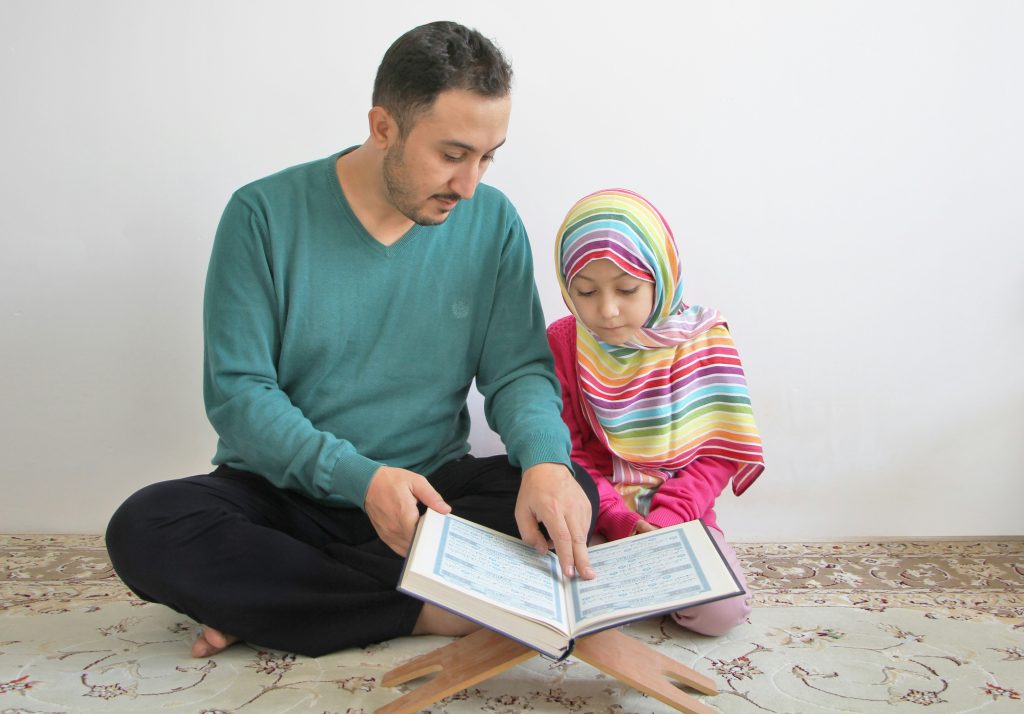
This is not a reason to exclude children from Arabic religious practice until they are fluent — quite the contrary. Familiarity is built through immersion, repetition, and exposure long before full comprehension arrives. A child who has heard Arabic prayers and Quranic recitation since infancy will always have a different relationship to that Arabic than a child who encounters it only in adulthood as a learner. The early exposure is not wasted if the meaning is not yet understood. It is laying groundwork that comprehension will later inhabit.
The same principle applies, though in different forms, to the relationship between language and cultural ceremony more broadly: the Arabic of Eid greetings, of birth and death and marriage, of the specific expressions of grief and joy that Arabic has refined over fourteen centuries of civilization. These expressions are not replaceable by their translations. They carry cultural meaning that is inseparable from their specific linguistic form — meaning that a child who knows the language can access and a child who does not knows only secondhand.
The Language of Intimacy: Love, Anger, and Home
Beyond prayer and ceremony, the mother tongue is the language of intimacy — of the emotional registers that carry the highest stakes: love, anger, grief, comfort, family belonging.
Research by Aneta Pavlenko at Temple University — whose book Emotions and Multilingualism is among the most comprehensive treatments of this topic — documents a consistent pattern across multilingual speakers: the first language is typically experienced as more emotionally direct, more viscerally immediate, and more personally anchored than the second language, even when the second language is dominant in terms of usage and formal proficiency.
This asymmetry has profound implications for family relationships. An Arab parent who cannot express the full depth of their love, their pride, their grief, or their reprimand to their child in the majority language — who reaches the limit of their majority-language emotional range and finds themselves unable to say exactly what they mean — has encountered the boundary of a language. The mother tongue is where that boundary disappears.
But the asymmetry runs in the other direction too — and this is the dimension that matters most for the heritage language preservation argument. A child who grows up without deep fluency in their parents’ mother tongue cannot fully receive the emotional communication that language carries. The parent who speaks Arabic and the child who receives English receives the meaning, perhaps. They may not receive the weight.
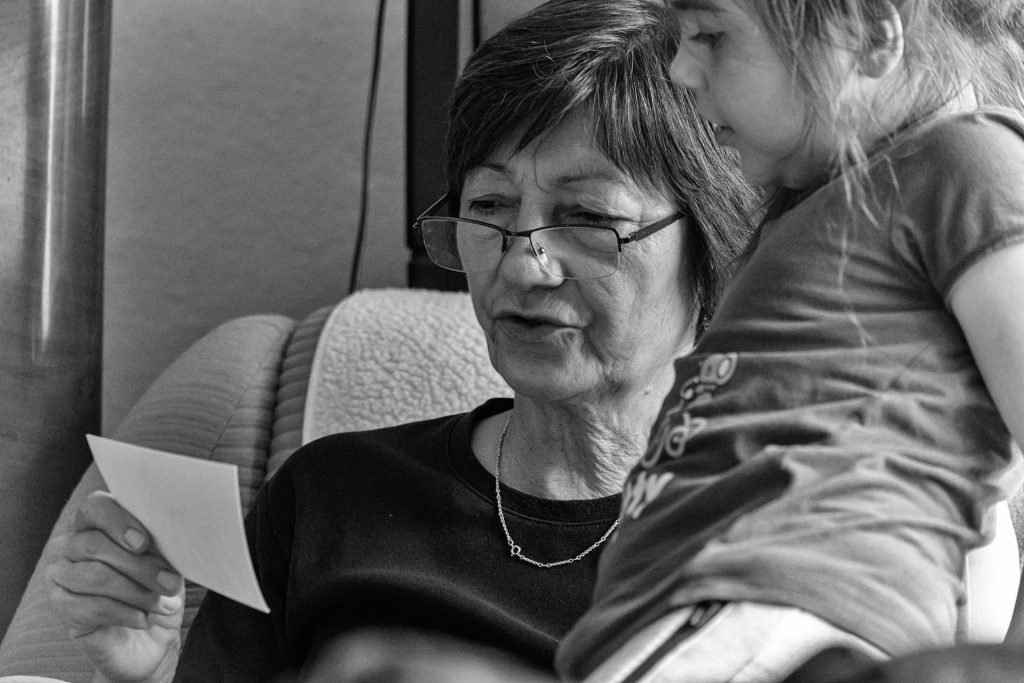
This is a form of emotional translation loss that no dictionary can address. The grief of an Arabic-speaking grandmother who cannot fully be heard by her grandchildren who speak no Arabic is not merely a linguistic inconvenience. It is a severing — of relationship, of transmission, of the emotional inheritance that language carries.
Language and Identity: Who You Are in Which Language
One of the most frequently documented experiences of bilingual individuals is what linguists call language-identity association: the sense that different languages access or express different dimensions of the self.
Many Arabic-English bilinguals describe this experience directly: in Arabic, they are someone slightly different than the person they are in English. More direct in emotional expression. More embedded in family and community. More connected to a specific history and geography. More themselves, perhaps — or a different dimension of themselves that English does not contain. This is not a pathology. It is the natural consequence of the fact that identity is partly constructed through language, and that a different language activates different facets of a socially constituted self.
For children of the diaspora, this dimension of bilingualism carries particular weight. They are navigating two identities — the identity that belongs to the majority culture and the identity that belongs to the heritage — and both are legitimate, both are real, both deserve space. A child who has access to deep Arabic has access to the dimension of their identity that Arabic holds. A child whose Arabic is shallow or absent has that dimension attenuated — present in the family’s memory, in the culture, in the faces of relatives who speak the language — but inaccessible in the direct, unmediated way that language makes accessible.
This is why the question of heritage language preservation is ultimately not a question about language. It is a question about what kind of self a child will be able to construct — how fully, how honestly, how deeply — as they grow up and become the adults they are becoming.
You are not giving your child a language. You are giving them a dimension of themselves that only that language can hold.
Arabic and the Question of Belonging
Arabic is not a language like others in one important respect: it is the sacred language of over a billion Muslims, the literary language of one of the world’s great civilizational traditions, the spoken tongue of four hundred million people across twenty-two countries and a vast diaspora, and one of the six official languages of the United Nations. It is a language with a fourteen-century literary tradition of extraordinary depth — in poetry, in prose, in philosophy, in science, in law, in theology.
A child who grows up with deep Arabic does not merely have a communication tool. They have access to this entire civilization — not through translation, not through secondhand mediation, but in the original. They can read Al-Mutanabbi. They can read the Quran as it was written. They can follow the news from Cairo and Beirut and Riyadh and understand not just the words but the inflections, the cultural context, the humor, the grief. They can feel at home in the Arab world, not as a tourist but as someone to whom it belongs.
And when they travel in the Arab world — and they will — they can experience what it means to speak a language that opens doors not because of its economic value but because of its cultural intimacy. To speak Arabic to an Arab stranger is not merely communication. It is recognition. It says: I come from the same place. I carry the same sounds. I know the words your grandmother said to you.
This is what heritage language preservation is ultimately for. Not for professional advantage, though that advantage is real. Not for cognitive development, though those benefits are documented and significant. But for this: the capacity to belong — fully, personally, linguistically — to the civilization that made you.
A Word to Parents Who Are Tired
This series has covered a great deal of ground: the science of bilingual brain development, the myths and the evidence, the OPOL method, the practical strategies for heritage language preservation, the digital tools, the school systems, the translation practices. It has been, in places, demanding reading — because the subject itself is demanding. Raising bilingual children is not easy. It requires sustained effort, patience through resistance, creativity in finding new contexts and motivations, and a certain willingness to hold a long-term vision against the daily friction of a shorter-term world.
If you are reading this as a parent who is tired — who has tried and struggled, who has watched their child respond in the majority language for the hundredth time, who sometimes wonders whether the effort is worth it — we want to say this directly:
It is worth it. Not because the research says so, though the research does say so. Not because of the career advantages, though they are real. But because one day your child will sit with their grandmother in a room where only Arabic is spoken, and they will be present — fully present, in the language, in the relationship, in the moment. Or they will read something in Arabic and feel it land differently than it ever could have in translation. Or they will pray, in Arabic, and understand — not just intellectually but in the body, in the breath — what the words are asking of them.
That moment is worth all of it. And it is only possible because someone — you — decided that the language was worth the work.
References
- Harris, C. L., Ayçiçegi, A., & Gleason, J. B. (2003). Taboo words and reprimands elicit greater autonomic reactivity in a first language than in a second language. Applied Psycholinguistics, 24(4), 561–579.
- Pavlenko, A. (2005). Emotions and Multilingualism. Cambridge University Press.
- Dewaele, J.-M. (2008). The emotional weight of “I love you” in multilinguals’ languages. Journal of Pragmatics, 40(10), 1753–1780.
- Pavlenko, A. (2006). Bilingual selves. In A. Pavlenko (Ed.), Bilingual Minds (pp. 1–33). Multilingual Matters.
- Grosjean, F. (2010). Bilingual: Life and Reality. Harvard University Press.
- Koven, M. (2007). Selves in Two Languages: Bilinguals’ Verbal Enactments of Identity in French and Portuguese. John Benjamins.
The Multilingual Family
Bridging Cultures and Tongues — Eight Articles


The Multilingual Family series — eight articles from science to identity | Zy Yazan