Himba Women: Lessons in Natural Beauty and Family Strength

Himba women of Namibia bathe in smoke, wear ochre on their skin, and carry up to 40kg of jewelry. What they carry is deeper than tradition — it’s a complete philosophy of identity.
The first time I saw a photograph of a Himba woman, I stopped for a long moment.
It wasn’t only the color — though the deep red-ochre is striking in ways that photographs struggle to contain. It was something in her posture. In the way she held the camera’s gaze. A confidence that wasn’t performing itself. A dignity that didn’t apologize for existing. A beauty that wasn’t asking for anyone’s opinion.
I thought: this is a woman who knows exactly who she is.
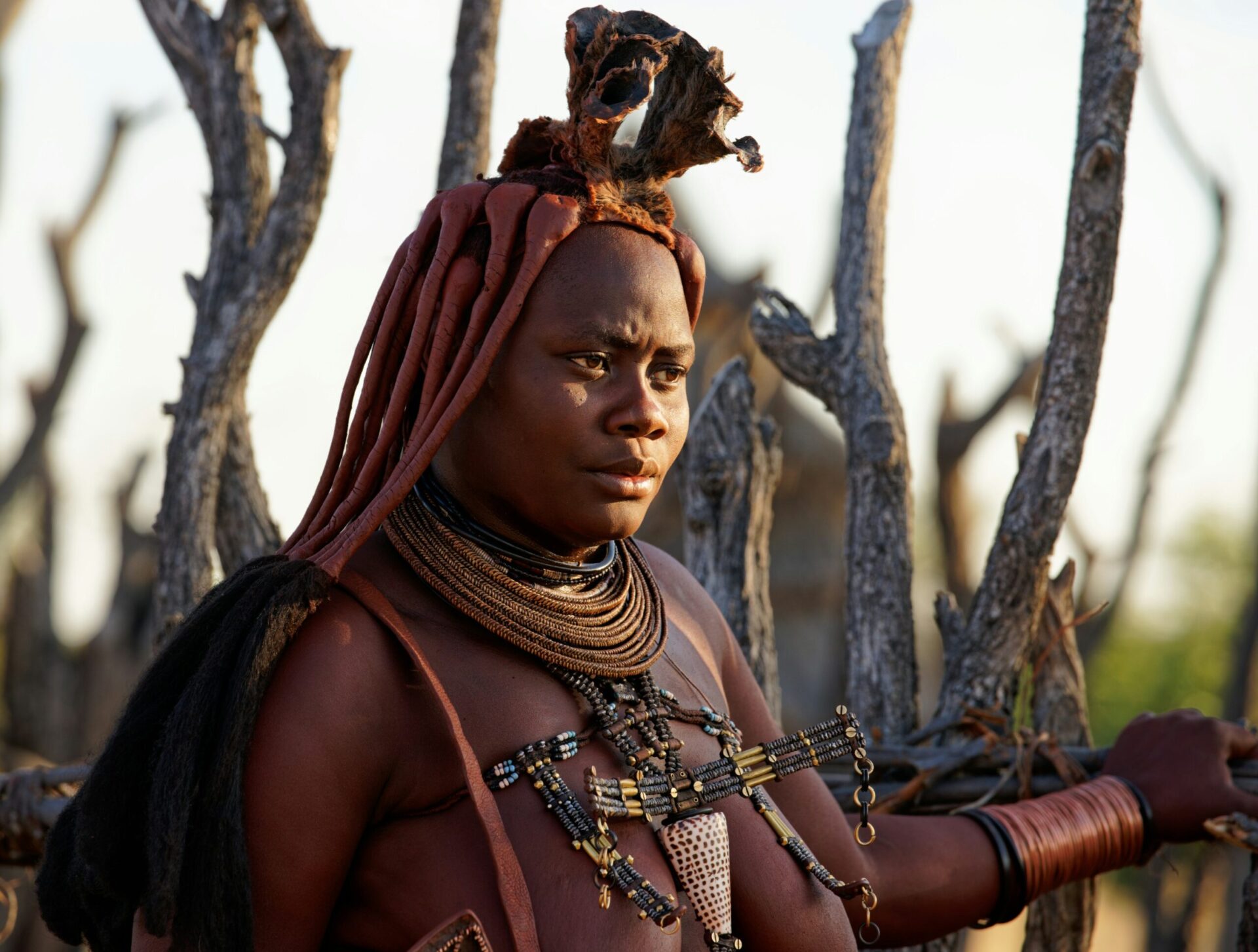
Otjize: When the Body Is Both Canvas and Archive
The Himba women of Namibia’s Kunene region apply a mixture called otjize to their skin and hair daily — a paste of butterfat, animal fat, and ground red ochre stone. The deep reddish-brown it produces isn’t decoration.
In Himba philosophy, red symbolizes blood and earth — the two foundations of life. The woman who carries this color is saying: I am alive. I come from this land. I remember where I come from.
But otjize is also — and this is what quiets the condescension of outside observers — an extraordinarily intelligent technology. It acts as a natural sunscreen in relentless desert heat. It moisturizes skin in extremely dry air. It repels insects. It cleanses the skin of dead cells when removed. In an environment of radical scarcity, this mixture is a millennia-old answer to the daily question of survival.
The body in Himba culture is not a display — it is a living archive of identity, wisdom, and belonging.
Smoke Bathing — Intelligence Where Water Is Scarce
Namibia is one of the driest countries on earth. Fresh water is precious and often distant. Himba women do not bathe with water in the conventional sense.
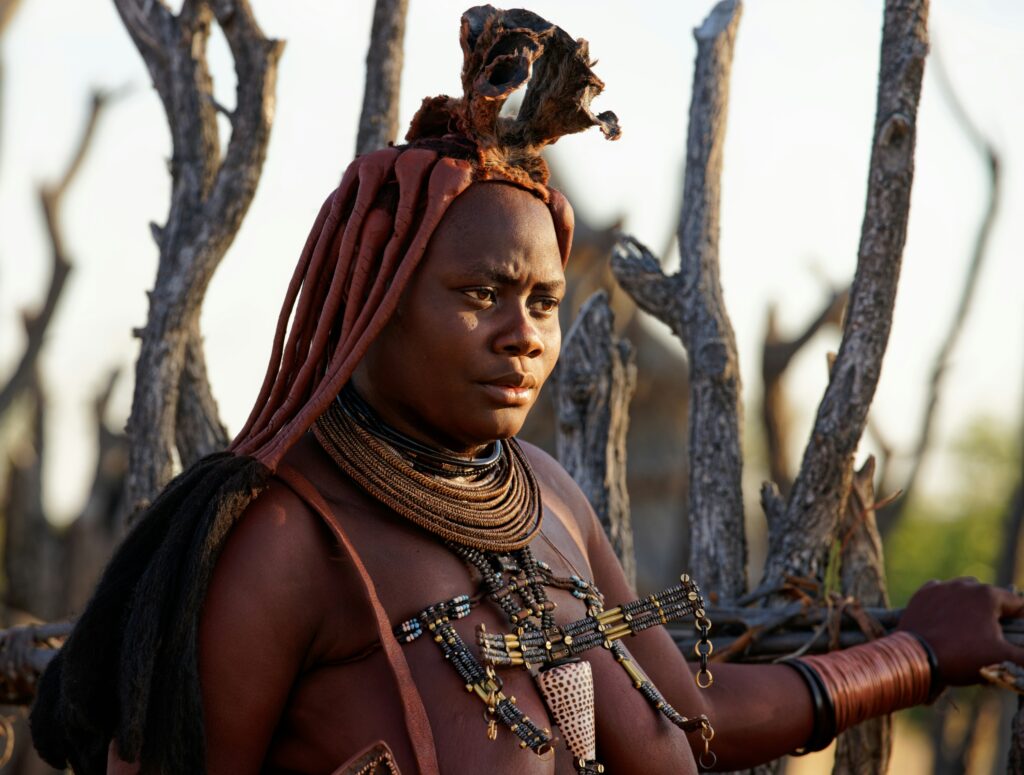
Instead: smoke bathing. Burning embers are mixed with specific aromatic herbs and placed beneath their leather garments so the body sweats and is cleansed by the heat and the antimicrobial properties of the herbal smoke. When done, the old layer of otjize — which has absorbed the day’s sweat and environment — is removed and a fresh application follows.
The result, according to Western women who have experienced it, is a warm, subtle fragrance unlike any manufactured perfume. This isn’t ignorance of hygiene — it is a different system, developed over thousands of years, precisely calibrated to an environment where conventional hygiene would simply be impossible.
Hair as Social Language
In Himba culture, a woman’s hair is not a style choice — it is a legible social biography. Anyone in the community can read it:
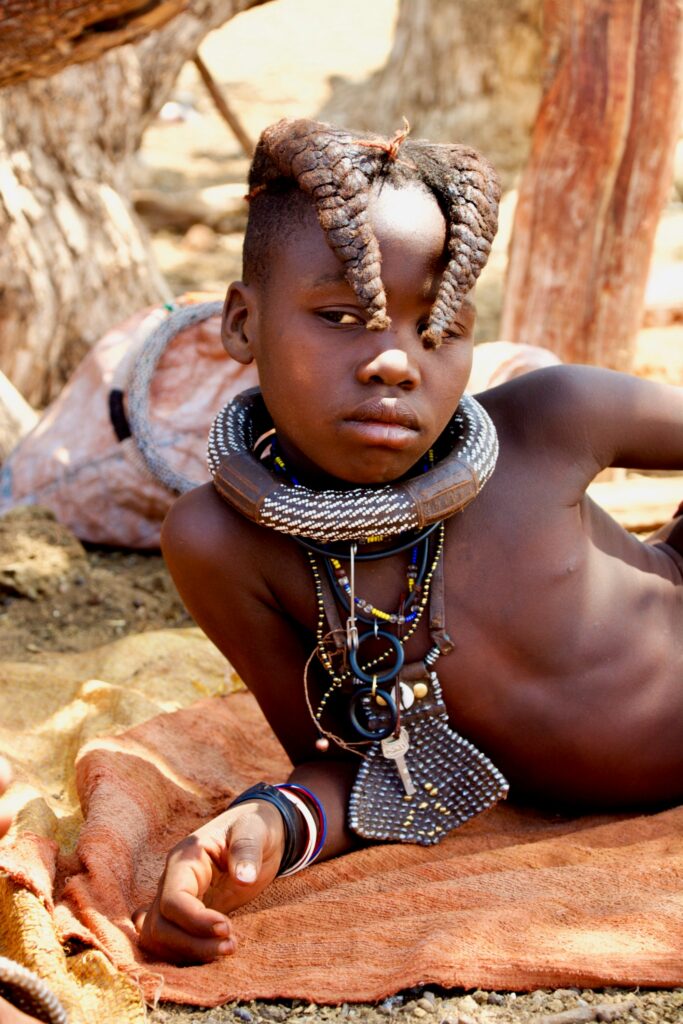
- Young girls before puberty: Two braids forward — simplicity signaling the age before responsibility.
- At puberty: A complex arrangement covered in otjize-infused clay — a declaration that a girl has entered womanhood.
- A married woman who has given birth: Wears a leather headdress called Erembe projecting forward — an unmistakable crown that says: this woman has full standing and status.
No social media profile needed. No résumé required. In Himba society, your body and hair announce who you are more clearly than any written record.
The Song That Exists Before the Child
Among the most beautiful practices in Himba culture is one that concerns the arrival of every new life.
It is believed that a mother “hears” the song of her future child. She sits alone in silence under a tree and listens until the song comes to her. Then she teaches it to the father, and they sing it together throughout the pregnancy. The community sings it at the moment of birth. And that song remains the child’s identity for the rest of their life — sung to them in joy, sung in correction, sung at the hour of death.
The tradition holds something quietly profound: every person arrives in the world carrying something specifically their own — and those around them should listen before they speak.
On Misconceptions — Honestly
There is a Himba practice that draws significant outside attention and misrepresentation: the tradition known as Okujepisa Omukazendu, in which a husband may offer a guest the company of his wife overnight as an act of extreme social hospitality.
The way this is discussed online — especially in tourism and clickbait contexts — strips it entirely of its actual cultural logic and presents it as either primitive behavior or sexual sensationalism. Serious anthropological work treats it differently: as a socially governed ritual aimed at building inter-community bonds and alliances, operating within strict unwritten rules. Is it alien to most readers’ values? Yes. But judging it by an entirely external cultural standard — without engaging with its internal logic — is exactly what rigorous cultural studies argue against.
Similarly: what looks, to an external eye, like “not washing” or “covering oneself in mud” is, as we’ve seen, a sophisticated environmental technology that has sustained a community for centuries in one of the harshest climates on earth. The condescension says more about the observer than the observed. (See our article: Ubuntu Philosophy: I Am Because We Are)

The Double Inheritance System — Quiet Architecture
Himba society has an intriguing legal structure: it is patrilineal in authority and leadership, yet wealth — cattle in this pastoral culture — is inherited through the matrilineal line. This means a man’s wealth does not pass to his own sons; instead, it goes to his sister’s sons. “The maternal uncle” bequeaths his wealth to his nephews.
This dual system, complex as it sounds, functions to distribute resources across family networks and prevent the concentration of wealth in any single lineage. It binds extended families through shared material interest. It is social architecture of considerable sophistication — rarely visible in the quick photographs that circulate of Himba women online.
What Himba Women Teach
Returning to that photograph — the woman who holds the camera’s gaze with such unhurried steadiness — I understand now what I was seeing.
She doesn’t only know who she is. She knows why she is what she is. Her body carries her history. Her hair narrates her chapter. Her work builds her home and her community. Her child’s song existed before birth. Her generosity follows laws older than any written code.
In a world that asks constantly about identity — how to find it, maintain it, protect it against relentless change — Himba women live the answer. Not because they are outside history, but because they are inside it with both feet planted.
See also: Preserving Arab Traditions in American Life | The 100-Day Secret: How Koreans Celebrate Their Newborns | Ubuntu Philosophy: I Am Because We Are
References:
- Gallay, S., et al. (2014). Otjize as natural sunscreen for Himba women. African Journal of Dermatology. View study
- Wikipedia — Himba people. View article
- National Geographic — Himba women of Namibia. View article
- Bollig, M. (1998). Risk and Risk Minimisation Among the Himba Pastoralists of Northwestern Namibia. Nomadic Peoples, 2(1).
- Crandall, D. (2000). The role of time in Himba valuations of cattle. Journal of the Royal Anthropological Institute, 6(1), 101–114.