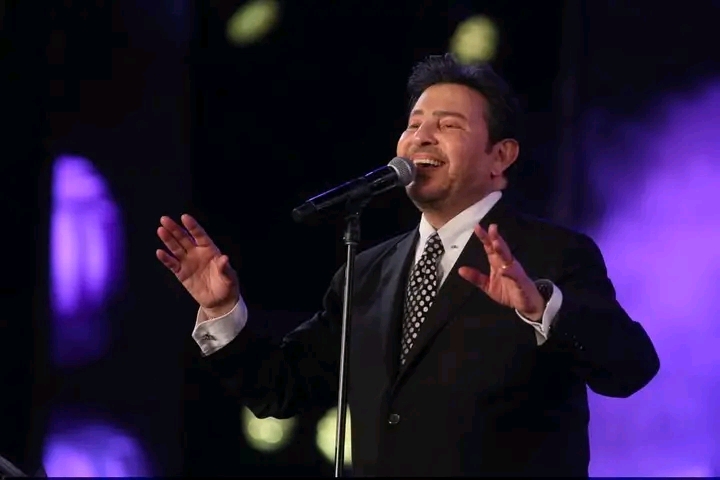
Hany Shaker: The “Prince of Song” — From the Nightingale’s Legacy to the Melancholy of Departure

A contemplative elegy on the passing of Hany Shaker; a critical look at the legacy of Abdel Halim’s successor, his union battles, and his reign over “refined sorrow” in the Arab memory.
In Paris, where solitude sometimes takes on a poetic character, the news reached me like a cold shock: Hany Shaker has passed away. Here, far from the clamor of Cairo and its daily details, death takes on another dimension; it becomes akin to a comprehensive review of an entire generation’s memory.
I grew up with this man’s voice, and as a critic who always attempts to deconstruct aesthetic phenomena, I find myself today before an impossible task: how can half a century of disciplined “laments” be reduced to a few lines? Hany Shaker was not just a singer; he was an “institution of sorrow” that shaped our concept of polite emotional heartbreak.
“Ali el-dahkaya ali… Helli fi samaya helli” (Raise your laughter high… Shine in my sky, shine forth)… This call for joy always seemed to me, through the microscope of criticism, like a thin mask hiding a sea of tears that never dried in his throat.
Chapter I: The Curse of Beginnings and the Burden of the “Expected Successor”
Hany Shaker was born in December 1952, at a historical moment when Egypt was boiling with political and artistic transformations. He grew up in the Dokki district of Cairo, within a family that appreciated art but feared for him from the “temptations” of the artistic scene. His father was a prominent official, and his mother was the “compass” that directed him toward the Conservatory. This academic background is the first key to understanding Hany Shaker’s persona; he was not just a “performer” by nature, but an “instrumentalist” who understood the language of instruments before the language of words.
In 1966, he was chosen to portray the young “Sayed Darwish.” This was the “first sin” that embroiled him in historical comparisons. For a child to begin his career playing the role of the godfather of Arabic music meant that the ceiling of expectations was hit early. When he came of age in the early seventies, he found himself face-to-face with giants: Abdel Halim Hafez, Farid al-Atrash, and Mohamed Roshdy. The general atmosphere was leaning toward “folk songs” at times and “long epics” at others, but Hany chose the “short emotional song” that speaks directly to the soul.
Discovered by the great composer Mohamed el-Mougi, he debuted with the song “Helwa Ya Donia” in 1972. This song caused an artistic earthquake; the audience found in him the “scent” of Abdel Halim Hafez without being a mere copy. There was a natural hoarseness and a carefully studied vibrato that made Abdel Halim himself feel a genuine threat. Indeed, Hany was the “beautiful threat” that forced the veterans to reconsider the musical map.

Chapter II: The Psychology of Sorrow.. Why Did We Become Addicted to His Laments?
In the psychoanalysis of the Arabic song, we find that Hany Shaker occupied the zone of “tamed pain.” He does not scream in the lover’s face, nor does he take revenge with vulgarity; instead, he reproaches with silent tears. He excelled at presenting the image of the “victim man” who refuses to abandon his refinement despite betrayal. In the eighties and nineties, with the market opening and the cassette becoming a popular commodity, Hany Shaker’s albums were the top sellers because they offered “therapy through tears” for millions of young people suffering from the weight of social changes.
Songs like “Ghalta” (A Mistake), “Takhsari” (You Lose), and “Ya Ritni” (I Wish) were not just melodies, but narrative texts about personal defeat. In Tunisia, we listened to him during our “quiet evenings,” seeing in him a model that transcended geographical borders. His voice possessed the quality of “emotional globalization”; the sorrow he sang was understood by the Syrian, the Moroccan, and the Saudi with the same degree of intensity. It is the sorrow that needs no translation.
Chapter III: The Cassette Era and Nostalgia.. The King of Sad Posters
Hany Shaker cannot be separated from the “industry of nostalgia.” During the nineties, his image on cassette covers—with his heartbroken gaze and carefully groomed hair—was part of the decor in every Arab teenager’s room. There was a strange harmony between the artist’s appearance and the content of his art. We never saw him in excessively “casual” clothes or trying to keep up with loud fashions; he remained faithful to the formal suit, as if to say that sorrow requires a special kind of dignity.
Critically speaking, Hany Shaker is the singer who managed to maintain the “classical style” within the mold of the modern song. While Hamid el-Shaeri was leading the revolution of fast “youth music,” Hany Shaker insisted on the presence of warm violins and long solos. This artistic defiance is what made his works live so long; fads die, but classicism remains like aged wine, increasing in value with the passing of years.
Chapter IV: The Last Warrior.. Hany Shaker vs. “Mahraganat”
The period during which he served as the “Head of the Musicians’ Syndicate” (2015 – 2022) is the most controversial in his career. Here, the artist collided with reality. Hany Shaker saw that “public taste” was undergoing systematic sabotage, so he decided to draw the sword of prohibition. As a writer living in the West, I viewed this conflict with much contemplation. Was Hany fighting “Mahraganat singers,” or was he fighting “time” itself, which no longer resembled him?
He was subjected to sharp criticism, with some accusing him of “artistic dictatorship” and hostility toward innovation. But the truth is deeper; Hany Shaker felt a moral responsibility toward the “microphone” that the giants once stood before. For him, music is not just “noise” or offensive words, but a sacred message. Despite his later resignation, his stance remained a symbol of the rejection of “vulgarity,” even if we disagreed with his administrative tools.

Chapter V: Personal Tragedy.. When Loss Sings Through His Voice
There is a moment in every artist’s life that divides their career into a ‘before’ and an ‘after.’ For Hany Shaker, the death of his daughter “Dina” in 2011 was that tragic turning point. We witnessed a man breaking before our eyes. The sorrow that was an “artistic performance” in the songs of the seventies and eighties had now become a “scar” in the soul. In his later concerts, his voice carried an extra hoarseness—not due to age, but due to suppressed tears.
Here, Hany Shaker’s humanity shone through; he refused to trade on his tragedy and bore his pain with the silence of men. This heartache changed his vocal choices; he gravitated more toward nationalistic and soulful works that address the absolute, as if fleeing from the triviality of the world into the vastness of eternity.
Chapter VI: “Nessiank Saab Aked”.. The Constitution of Failed Relationships
We now reach the crown jewel of his career, the song that became an “icon”: Nessiank Saab Aked (Forgetting You is Certainly Hard). The audience nicknamed him the “Singer of Failed Relationships,” a title that carries within it overwhelming love. Why? Because we all, at some point in our lives, were that “failure” in love who found no one to console us but Hany Shaker.
“Nessiank saab aked… Maloosh gheir hall waheed… Abda’ min tani hayati… Wa asadef hub gadeed” (Forgetting you is certainly hard… It has only one solution… To start my life all over again… And find a new love).
This song is not just a musical work; it is a case study in Arab social psychology. The song suggests the solution (new love), but the melody screams that this solution is a beautiful illusion. In this song, Hany Shaker managed to embody the “impossible”—to love someone who betrayed you, and to try to forget them while drowning in their details. This paradox is the secret of his survival at the top for half a century. The audience loves to see their heartbreaks in the mirror of a beautiful and dignified artist.
Chapter VII: The Strange and Intriguing in the Persona of the Prince of Song
Away from the spotlight, Hany Shaker was an intriguing personality. Despite his fame for “artistic gloom,” he was one of the artists with the quickest wit and a genuine Egyptian sense of humor in his private gatherings. He also adored Zamalek SC to the point of “refined fanaticism,” sometimes seeing in Zamalek’s losses an extension of his musical melancholy!
A fact many may not know is that Hany possessed a universal musical ear; he regularly listened to Western classical music, drawing from it his robust melodic structures. In his final years, despite the attacks on him, he enjoyed the respect of musical academics in Europe, who saw him as the “last performer” to use operatic and breathing techniques in emotional pop songs.

Conclusion: Farewell to the Last of the Gentlemen
Hany Shaker passed away today, leaving behind a void that cannot be filled by fake “trends” or electronic noise. The man who taught us how to grieve without losing our dignity, and how to love without begging for sympathy, has departed. To me, his passing is the “last cry” of the era of beautiful art.
Hany Shaker does not die as long as there is a brokenhearted lover in a far corner of the Arab world playing an old cassette tape or opening a YouTube link, searching for an echo of their pains in the throat of the “Prince of Song.” Farewell, Hany Shaker. Thank you for always being the beautiful “mistake” in our calculations, and the “difficult forgetting” in our collective memory.
References and Documentation:
- The Official Biography of Hany Shaker – Egyptian Opera House Archives.
- Critical Study: “Arabic Song Between Authenticity and Innovation” – Cairo University.
- “Maspero” Interview Archives – Dialogues from the 1970s and 80s.
- Critical articles in “Al-Kawakib” and “Akher Sa’a” magazines across five decades.