
Politics of Attraction: Is Bali Losing Its Identity?

When tourism becomes the foundation, not just a sector, too little destroys the economy and too much destroys the environment. A critical look at Bali’s hard equation.
Word count: ~2,500 • Estimated reading time: 13 minutes
Politics of Attraction
Politics of Attraction: Is Bali Losing Its Identity?
There is a term governments and investors use often without pausing on it for long: “policies of attraction.” The phrase sounds technical and neutral — just a package of incentives to draw in capital and visitors. But behind this tidy phrase lies a harsh equation: every island or city that adopts an “attraction policy” is betting that the economic benefits will outweigh the cultural and environmental costs it will pay later. The problem is that this cost is rarely mentioned in tourism ads, or in speeches welcoming investors.
The digital nomad arriving in Bali today carries a ready-made mental image: a tropical paradise, low cost of living, an always-smiling population, and endless green rice fields. This image is not entirely false, but it is carefully cropped from a much wider and more complicated context. The paradise the visitor sees is the product of a fragile economic equation, and a social and environmental tax paid by the island’s own residents, often without being consulted about it at all.
The central question worth asking bluntly: is Bali sacrificing its cultural and environmental identity for an economic survival that is not sustainable to begin with? And is what looks like “growth” on official paper actually a slow process of replacing the soul of a place with a generic copy that could exist anywhere else on earth?
Economic Exclusion: From Rice Fields to Service Counters
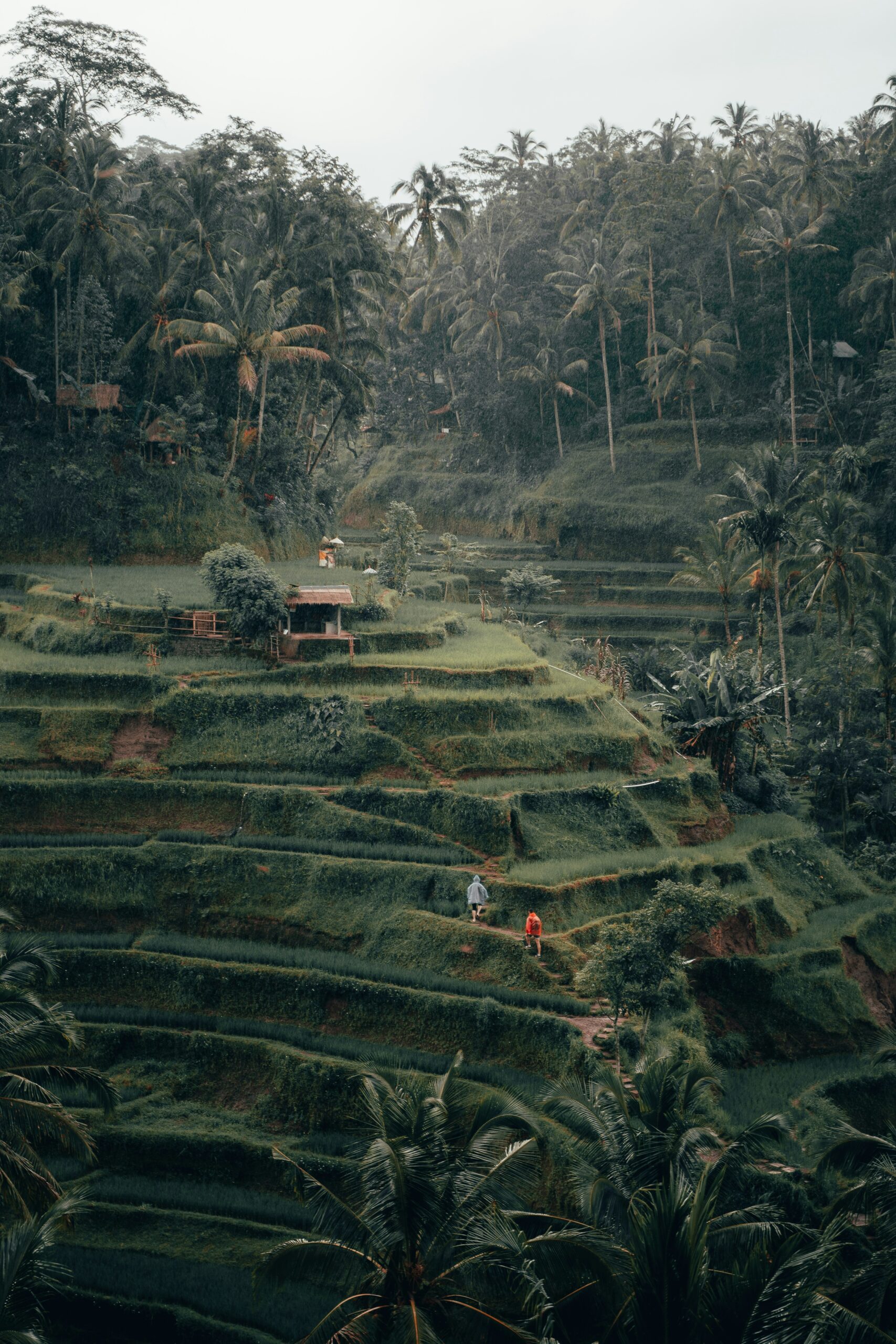
For decades, Bali’s economy was built on agriculture, at its heart the famous “Subak” system — the traditional cooperative irrigation network for terraced rice fields, recognized by UNESCO as world heritage for its unique philosophy linking farming to local spirituality. But this system faces a genuine existential threat today, not from drought or pests, but from a simple and harsh economic logic: land planted with rice generates limited income, while that same land, if converted into a villa, a cafe, or a yoga studio, generates many times that income in a far shorter time.
This gap in returns creates enormous pressure on local families who own agricultural land. Many find themselves facing a harsh choice: either keep growing rice with steadily declining income while living costs rise, fueled by the tourists and foreign residents themselves, or sell or lease the land to a long-term foreign investor. The expected result of this economic pressure: a forced, not chosen, shift from a stable agricultural economy to a fragile, low-wage tourism service sector.
The cruel irony here is that whoever works today in a cafe built on their own family’s former rice field often earns wages that barely cover the cost of living that rose because of that very cafe’s existence. The local worker in hospitality earns, on average, wages that do not match the prices charged in the very market where they serve tourists, because those prices are set in the strong foreign visitor’s currency, not in the local wage’s currency.
This contradiction shows up sharply in the rental market itself. A villa whose land was, just a few years ago, a rice field, now rents monthly for an amount that can exceed the full annual salary of the local worker who cleans it or tends its garden. This gap is not just a dry economic statistic; it redraws the map of who has the right to stay in a given place. Local families increasingly find themselves physically pushed out of their own neighborhoods, not because they chose to leave, but because the rental and property market around them shifted entirely to speak to a foreign pocket, not theirs. Whoever owns land sells or rents because they cannot compete with new market prices if they wanted to buy, or even renew the lease on their own home.
This pattern of spatial exclusion has a name in urban studies literature: “displacement” — where no one is forced out at gunpoint, but market mechanics alone are enough to gradually empty an entire neighborhood of its original residents, in favor of new residents better able to afford the higher prices. The irony is that this emptying often happens under the banner of “development” and “investment,” two terms hard to publicly object to without being accused of opposing progress.
Profits Exported, Not Reinvested
More dangerous than the wage gap is the path of the profits themselves. A large share of Bali’s major tourism projects — luxury villas, hotel chains, coworking spaces, even some of Instagram’s famous “turquoise” cafes — are partly or fully owned by foreign investors, often through complex ownership structures that work around Indonesia’s foreign land-ownership laws.
This means a large portion of the profit generated by the tourism economy is never reinvested in the local community — in schools, hospitals, or infrastructure — but instead transferred to bank accounts outside Indonesia. The village hosting the project gets low-wage jobs in service, cleaning, and security, while the real value of the project — the profits, the brand, the growth — goes somewhere else entirely.
This pattern is not pure theoretical speculation; it is the classic form of what economists call “tourism leakage”: the situation where the tourism sector appears to be booming in aggregate numbers, while the actual value leaks away from the host community. And the more Bali depends on direct foreign investment in tourism, the larger this leakage becomes.
When Land Becomes More Valuable Than Its Crop
A snapshot of the economic gap between traditional farming and tourism investment
The traditional “Subak” irrigation system has been on UNESCO’s World Heritage list since 2012, recognized as a unique philosophical model linking agriculture to local Hindu beliefs. And yet, the value of a single square meter of rice land, when sold for a tourism project, is many times higher than its annual farming yield — which explains the shrinking rice-farming area in places like Canggu and Ubud over the past decade.
Spatial Erosion: When a Path Loses Its Soul
To understand what this shift looks like on the ground, one need look no further than what’s locally known as the “Canggu Shortcut” — a rural road that used to cut through rice fields, used as a shortcut between surrounding villages. Today, that same path has turned into a dense commercial strip: cafes with matching Western design, luxury gyms priced to rival their European equivalents, and “healthy” restaurants aimed exclusively at the wallets of digital nomads and long-term tourists.
The problem is not the existence of these places itself, but the total sameness they are beginning to take on. A cafe in Canggu looks almost identical to one in Bali’s other hotspots, or in Lisbon, or in Mexico City — the same visual style, the same avocado toast menu, the same light-colored “minimalist” aesthetic. This pattern has a well-known term in critical tourism literature: “whitewashing” — the process of stripping away a place’s cultural specificity in favor of a uniform global aesthetic aimed at a particular audience, regardless of where that audience physically happens to be.
When every place resembles every other place, the traveler loses the real reason for traveling at all. And worse, locals lose along with it their sense that this place is still “home.”
The signage itself tells this story quietly: shop names along those streets are often written in English exclusively, with no trace of Indonesian or local Balinese, as if the only intended audience is the foreign visitor, not the Balinese neighbor who used to walk this road before it became an Instagram-famous “shortcut.” Even the architecture itself is starting to shift: traditional homes with high roofs and open courtyards are gradually being replaced by buildings designed specifically for “reels” — white facades, infinity pools, and lighting optimized more for a phone camera than for actual living in the tropical climate.
The Environmental Tax: Infrastructure Not Built for This Scale
Bali is an island, and its resources are naturally limited. Water, sanitation, and road infrastructure were originally designed to serve a stable local population, not to absorb millions of annual visitors plus a constant inflow of long-term residents.
Bali’s waste crisis is widely documented: certain beaches experience what’s known seasonally as “trash season,” where ocean currents wash enormous amounts of plastic waste ashore, a large share of it tied directly to consumption linked to the tourism sector (water bottles, packaging materials, hotel waste). Local waste management systems, designed to serve small agricultural communities, simply collapse under this scale of consumption.
The freshwater crisis is more dangerous and less visible in tourist photos. Luxury hotels, private villas with their pools, and golf courses consume enormous amounts of groundwater in a region that already relies on this same water to irrigate rice fields and meet residents’ needs. In certain coastal areas, excessive groundwater extraction has led to saltwater intrusion into freshwater aquifers — a process that’s difficult to reverse, and that directly threatens local farmers’ ability to keep farming at all.
Here the vicious cycle closes: tourism drains the water farming needed, which speeds up farmers’ shift into the tourism sector, which increases pressure on water even further.
How Have Other Destinations Handled the Same Dilemma?
Bali is not the only destination facing this hard equation between economic survival and sustainability. Several other global destinations have tried different regulatory approaches worth reflecting on as comparative models.
Barcelona: Escalating the tourist accommodation tax. As of April 2026, Catalonia sharply doubled its tourist stay tax, reaching around €12 per night in Barcelona for five-star hotels (a combination of a regional and a municipal levy), up from a previous ceiling of just €4.50. The stated goal of the policy is not only to generate additional revenue, but to curb the mounting pressure on the local housing market and fund infrastructure services strained by dense tourist crowding.
Venice: An entry fee for day-trippers. Since 2024, Venice — the first city in the world to take this step — has charged an entry fee of between €5 and €10 on “day-trippers” (those not staying overnight in the city) during peak days. In the first full season of implementation in 2025, more than 720,000 visitors paid the fee, generating around €5.4 million, but visitor numbers on the busiest days dropped only slightly — raising a fundamental question: are financial fees alone enough to change crowd behavior, or are they merely a tool to fund the damage caused by the crowds continuing anyway?
Thailand: A total closure of Maya Bay to let the ecosystem recover. This is perhaps the most radical of the three models. After the famous Maya Bay (the filming location for the movie The Beach) welcomed up to 5,000–6,000 visitors daily, the crowding led to near-total destruction of coral reefs and coastal vegetation. Thai authorities closed the bay completely starting in 2018, banning boats and swimming entirely for years. The result: the return of small reef sharks to the shallow area, a notable rise in the share of living coral (from just 8% to between 20-30% by 2023), and a gradual reopening of the bay after 2022 under strict limits (a maximum of 300 visitors per hour, a ban on deep swimming, and a ban on approaching the reefs). Even today, the bay undergoes an annual seasonal closure (August-September) to give the ecosystem a periodic rest.
What unites these three models, despite their differing intensity, is an official acknowledgment that unregulated tourism destroys the very asset it depends on — whether that asset is the social fabric (Barcelona), the urban and demographic balance (Venice), or the fragile ecosystem itself (Thailand). The fundamental difference between these cases and Bali’s is that Barcelona, Venice, and Thailand can all “afford” to impose strict limits, because tourism, however important, is not the sole foundation of their national economies. Bali, by contrast, is not in that position.
When Tourism Is the Foundation, Not a Sector
Here lies the core of the dilemma that makes Bali’s case more complicated than its global counterparts. Barcelona can impose a doubled hotel tax because Catalonia’s economy is diverse enough to absorb any potential drop in visitor numbers. Venice can impose an entry fee because Italy as a whole has a broad industrial and agricultural economic base. Thailand can close an entire bay for years because its national economy, despite its heavy reliance on tourism (about 7% of GDP), remains diverse enough to absorb the loss of a single tourist site for an extended period.
Bali is fundamentally different. Tourism here is not one sector among several — it is the backbone almost everything rests on: labor, rents, land prices, even everyday food and services have become directly or indirectly tied to the presence of tourists. When the flow of visitors declines (as happened catastrophically during the COVID-19 pandemic), the local economy collapses almost entirely overnight; families who had already given up their agricultural land years before the pandemic suddenly lost their sole source of income.
This is the impossible equation Bali actually faces: far too little tourism means immediate economic collapse for families who no longer have an agricultural fallback, while far too much of it means slow but equally serious environmental and cultural destruction. Between these two extremes, there is no easy balance point that can simply be imported wholesale from Barcelona, Venice, or Thailand.
The Hidden Cost of Bali’s Digital Nomad Dream
Toward a New Model: Balance as Necessity, Not Luxury
The call here is not to close Bali off from tourism, nor to stop the flow of digital nomads — that would simply destroy an entire economy with no ready alternative. The call is for a radical shift in how tourism itself is thought of: from being a goal in itself (attracting the maximum possible number of visitors and investors), to being a tool serving a larger goal — Bali’s continued existence as a place with a coherent cultural and environmental identity.
In practice, this means: real, binding taxes on foreign tourism real-estate investment, with a share returned directly to the local communities affected (along the lines of the idea behind Barcelona’s and Venice’s fees, but scaled to Bali’s economy); strict protection of traditional agricultural irrigation systems from real-estate conversion; subjecting some of the most environmentally strained sites to periodic closures modeled on Thailand’s Maya Bay; and real (not merely rhetorical) support for alternative economic paths that let local families earn a dignified income without fully giving up their land or their agricultural identity.
There is also a dimension no less important than legislation: the responsibility of the visitor and the foreign resident themselves. A political decision alone, no matter how strict, will change nothing if demand for the “cheap and fast tourist experience” stays the same. The digital nomad who chooses to rent a home from a local family at a fair price instead of a foreign brokerage firm, who learns a few words of the local language, and who frequents neighborhood markets instead of ready-made chains alone, contributes in practice — even if in a small way — to keeping part of the economic value inside the host community instead of leaking it entirely abroad. This does not replace the absence of a clear government policy, but it reminds us that “policies of attraction” are not governments’ responsibility alone; they are also the sum of countless small individual choices made by everyone who decides to make Bali a home, even a temporary one.
Conclusion: An Equation Not Solved by Slogans
Bali today faces a genuinely difficult equation: the absence of tourism means immediate economic collapse with no ready alternative, while its excess means the slow destruction of the environment and cultural identity that made Bali worth visiting in the first place. What makes this equation more complicated than its counterparts in Barcelona, Venice, or Thailand is that tourism in Bali is not just one economic sector among several — it is the foundation nearly everything else rests on.
The real solution, if one exists, will not be written in a single government report, nor in a passing “responsible tourism” social media campaign. It will be written, if it is written at all, in difficult and uncomfortable political decisions, somewhat like what Thailand did when it chose to close its most famous tourist site for years despite the immediate losses, because it understood that the asset being sold to tourists cannot be consumed without limit, forever.
The question that remains genuinely open is not “does Bali need tourism?” — the answer is known and clear. The real question is: do Bali, and its partners among investors, governments, and the visitors themselves, have enough courage to reshape this relationship before the identity that drew everyone here in the first place becomes nothing more than a memory in old photos?
The answer to this question will not be written in a single government report or a passing marketing campaign. It will be written, if it is written at all, through thousands of small accumulated decisions: a farmer’s decision not to sell his land despite a tempting price, an investor’s decision to genuinely include the local community in the profits rather than just the margins, and a visitor’s decision to see Bali as a place with its own people and history, not merely a beautiful backdrop for a passing photo.
In our upcoming articles, we will explore in greater depth how conscious temporary living can be part of the solution rather than the problem, and how someone choosing to live in Bali can be a responsible “neighbor,” not just a passing consumer of a place they borrowed for a while.
Sources and References
– Reference documentary: “The Hidden Cost of Bali’s Digital Nomad Dream” — YouTube
– Report on Barcelona’s doubled tourist accommodation tax (April 2026) — Best Places to Travel
– Report on Venice’s 2025 day-tripper fee results — The Traveler
– Coverage of Venice’s original entry-fee launch and stated goals — NBC News
– Report on coral reef recovery at Maya Bay after closure — CNN Travel
– Details on Maya Bay’s ongoing seasonal closure (2026) — 5 Star Marine Phuket
– UNESCO recognition of the traditional “Subak” irrigation system as World Heritage (background, 2012)