
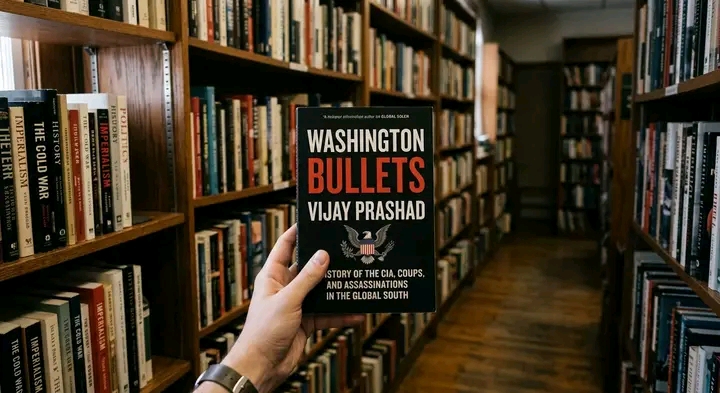
Washington Bullets Book Review: Dissecting the Mechanics of Imperial Hegemony

In “Washington Bullets,” Vijay Prashad provides a political dissection of American hegemony, tracing a history of interventions and coups through a manual that explains how modern imperialism operates.
Word Count: 510 words · Estimated Reading Time: 3 minutes
Washington Bullets
The Monroe Doctrine and Intelligence Bullets: A Study in American Mechanics of Control.
In his book Washington Bullets, Vijay Prashad offers a political dissection of what can be termed the mechanics of American hegemony. This work transcends a mere historical narrative of US military and political interventions worldwide; it serves as a stark reminder of the coups orchestrated by the United States through the CIA and its proxies on the ground. It is, essentially, a manual illustrating the operational methods of modern imperialism.
From Regionalism to Global Strategy
Prashad begins with the “Monroe Doctrine” (1823), which declared Latin America as the United States’ “backyard” and a zone of direct influence. Over time, this doctrine evolved from a regional stance into a global strategy—particularly after World War II—where Washington began to view the entire world as an arena for imposing its direct influence without resistance or objection.
“Prashad describes global intervention methods through the metaphor of bullets; every intervention Washington undertakes is a bullet fired into the head of a nation attempting to escape its hegemony.”
Types of Bullets: From Assassination to Economic Strangulation
These “bullets” take various forms. Some are literal, manifest in the explicit assassination of rivals, such as Patrice Lumumba. Others are economic bullets fired through institutions like the IMF and the World Bank, which practice forms of siege and economic strangulation against countries that defy American dictates to control their own resources. There are also “soft bullets,” such as election interference and the secret funding of opposition groups through organizations that carry slogans of civil activity but act as intelligence proxies.
The Regime Change Manual: Nine Steps to Control
Prashad focuses on the CIA not as a mere intelligence-gathering agency, but as a strike force for US foreign policy and corporate interests. He outlines a nine-step “regime change manual”:
- Win Public Opinion: Launching media campaigns to vilify the target government.
- Identify a Proxy: Finding the right person to lead the opposition and guarantee US interests.
- Infiltrate the Military: Ensuring the loyalty of army leaders through money, political pressure, or threats.
- Economic Warfare: Imposing suffocating sanctions to provoke public protest.
- Diplomatic Isolation: Applying a total diplomatic blockade on the target government.
- Mass Mobilization: Orchestrating demonstrations to demand the fall of the regime.
- Political Green Light: Securing approval from high-level political and military authorities in Washington.
- Physical Liquidation: Assassinations as a necessary step when required.
- Erasure of Truth: Denying responsibility and working to erase historical memory.
Methodological Critique
Despite its heavy political and historical subject matter, Prashad’s prose is sharp and fast-paced. He dismisses “spreading democracy” or “fighting communism” as the true goals of US policy, instead linking every “bullet” to the capitalist balance sheet. By moving through Africa, Asia, and Latin America, he shows that these events are not isolated incidents but a recurring, meticulously executed strategy based on declassified documents and whistleblower confessions.
However, the book is written from an explicitly Marxist-Leftist perspective, which occasionally simplifies the world into a black-and-white binary. Washington is sometimes depicted as an absolute evil without full consideration of complex security interests or local realities. By attributing every failure or revolution to foreign intervention, the book occasionally overlooks the weight of internal conflicts, local corruption, and domestic authoritarianism.
Conclusion
Washington Bullets is a political outcry and a dense historical record. It is an essential reading of the history that Washington attempts to obscure, providing one critical perspective among many that must be read with a discerning eye.
Book Profile
Title: Washington Bullets: A History of the CIA, Coups, and Assassinations
Pages: ~162
Publisher: LeftWord Books
Subject: A political history of US interventions and CIA-led coups worldwide. The original edition features a foreword by former Bolivian President Evo Morales.
About the Author
Name: Vijay Prashad
Profile: A prominent Indian historian, journalist, and Marxist intellectual. He serves as the Executive Director of Tricontinental: Institute for Social Research.
Major Works: Author of over 30 books covering Third World issues, people’s histories, and political critiques of imperialism.
Sources & Links:
- Get the book: LeftWord Books