Yandex and the Arabic-Speaking Audience — Is It Worth the Effort?

Yandex isn’t just a Russian search engine — it has a quiet but real presence in the Arab world, particularly in the Gulf. This article gives an honest answer to whether connecting your site to Yandex makes sense for you, and walks you through the setup if it does.
When we talk about search engines in the context of Arabic content, Google dominates the conversation — and rightly so. But there’s another engine that has established a quiet, real presence in the region, for reasons most content creators wouldn’t immediately guess.
Yandex — the Russian engine that holds over 60% market share in its home country — has gained a foothold in parts of the Arab world, particularly in Gulf countries, driven by the significant Russian-speaking communities living there. Over recent years, it has also meaningfully expanded its Arabic-language content support.
The question isn’t “is Yandex important?” — it’s: “Is it important for you, your audience, and where you are right now?”
Who Uses Yandex in Our Region?
An honest answer requires understanding the digital demographics of the Arab world — particularly the Gulf states:
Russian, Ukrainian, and Russian-speaking communities in the UAE, Saudi Arabia, Kuwait, Qatar, and Bahrain represent millions of residents who instinctively turn to Yandex as their default search engine — the same way an Arabic speaker defaults to Google.
Privacy-focused users in some countries find Yandex a viable alternative to Google, driven by different data policies and indexing behavior.
Tourism and hospitality content targeting Russian visitors to the Arab world — hotels, restaurants, services, travel — finds in Yandex a direct channel to that audience that Google simply can’t replicate.
Yandex won’t rival Google in Arabic traffic volume — but it can be a targeted channel for an audience you can’t reach anywhere else.
Does Yandex Support Arabic Content?
Yes — and it’s improving. Yandex indexes Arabic content, supports right-to-left text rendering, and recognizes Arabic terms within search results. Its algorithms have developed natural language understanding for Arabic, though they still trail Google in this area.
In practical terms: if your site is in Arabic, loads quickly, and has a clear structure, Yandex is capable of indexing it and surfacing it to Arabic-language searchers using its engine.
How to Connect Your Site to Yandex Webmaster
The tool is free and available at: webmaster.yandex.com
You’ll need a Yandex account — free to create. The steps follow the same pattern as Google Search Console and Bing:
- After signing in, click “Add site” and enter your full site address including https://.
- Choose your verification method — the easiest is the HTML meta tag. You’ll receive a code that looks like: <meta name=”yandex-verification” content=”XXXX”/> — however, unlike Google and Bing, RankMath does not include a dedicated Yandex field in its webmaster tools. The practical workaround is to install the free WordPress plugin “Insert Headers and Footers” from the plugin repository, then paste the code into the <head> field and save. If you use Yoast, you can add the code manually under Yoast → Settings → Site connections.
- Click Verify — your site ownership will be confirmed.
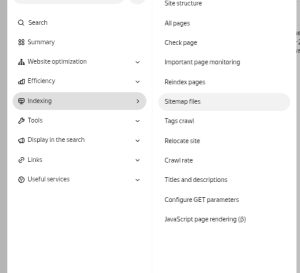
- From the left menu, go to Indexing → Sitemaps and submit your sitemap URL: https://yourdomain.com/sitemap_index.xml
If you’ve completed the previous two articles in this series, you already know two-thirds of this process. Nothing here is new territory.
What’s Inside Yandex Webmaster?
The tool is well-built and offers a solid feature set:
- Crawl and indexing data: Pages Yandex has visited, successfully indexed, and those it rejected with reasons.
- Performance report: The queries for which your site appears in Yandex results, with clicks and impressions.
- Backlink report: Sites linking to yours — Yandex has historically placed significant weight on external links in its ranking algorithm.
- Direct URL submission: Request immediate crawling and indexing of a specific page.
For advanced users: Yandex supports the IndexNow protocol we mentioned in the Bing article — meaning that enabling it in RankMath automatically sends new content notifications to both Bing and Yandex simultaneously, with no additional effort on your part.
The Honest Answer: Is It Worth Your Time?
A straight answer, because that’s what your time deserves:
Yes, it’s worth it — if:
- Your content targets Russian-speaking or Russian-adjacent communities in the Gulf or Europe.
- Your site covers tourism, hospitality, or services aimed at foreign visitors in the Arab world.
- You have Russian-language content or plan to add it.
- You’re directly targeting Russian or Ukrainian markets.
It can wait — if:
- Your audience is entirely Arabic-speaking with no overlap with Russian-speaking communities.
- Your blog is new and still building its foundation with Google and Bing.
- Your resources are limited and you want to focus on higher-impact actions first.
But if you do decide to connect — the setup takes under ten minutes. After that, Yandex handles its own crawling and indexing on its schedule, with no ongoing effort from you.
A good audience doesn’t always mean a large audience — sometimes it means the right audience. Yandex is a gateway to readers Google simply won’t bring you.
In the next article — the last in the connection group — we cover the remaining search engines: Baidu, DuckDuckGo, Ecosia, and others. One clear question answered: what do you actually do with them?
Previous in the series: Don’t Ignore Bing — Connecting Your Site to Bing Webmaster Tools
Next in the series: Other Search Engines — Baidu, DuckDuckGo, Ecosia and Beyond