Translating the Minefield: When Cinema Becomes the Dictionary

How does a cinematic “gag” turn into a linguistic term that baffles translators? A journey through the evolution of the Egyptian dialect and its modern challenges.
A living language is a breathing organism; it never stops growing or shedding its skin. For a translator, the real dilemma doesn’t lie in formal dictionaries, but in that gray area where words are suddenly born from a “joke” in a movie scene or a “catchphrase” of a dramatic character. These words aren’t just natural linguistic evolutions; they are cultural “mutations” that keep specialist translators—especially those working from English to Arabic—in a constant battle with the concept of Localization.
Translation is not the transfer of words; it is the transfer of the cultural “code” that makes a word laugh or hurt in its original context.
The Global Dilemma: Languages “Created” in Studios
This phenomenon isn’t exclusive to Arabs. Translators from English face terms born in Hollywood that have become daily lingo. Take, for instance, the term “Friendzone” which was born in the sitcom Friends in 1994, or the term “Gaslighting” derived from a 1944 classic film. In 2026, we see words like “Delulu” (short for Delusional) spreading through short clips, leaving traditional translators helpless in conveying the meaning with the true spirit of “Pop Culture.”
Five Arabic Traps (Understandable Across Borders)
Before diving into Egyptian specifics, there are Arabic expressions born from “Memes” that have become understood by every Arabic speaker in 2026, yet remain very recent:
- (هبد – Habd): (To confidently fabricate information) – Spread digitally to describe “active ignorance.”
- (قصف جبهة – Qasf Jabha): (The devastating comeback) – A military metaphor moved into social debate.
- (في كيسه – Fee Keeseh): (Meaning something guaranteed or under control) – Modern youth slang.
- (تشخصنها – Tshakhsanha): (To personalize a conflict) – A verb derived from the word “Personal.”
- (وضع الطيران – Wad’ al-Tayaran): (Total ignoring) – A metaphor from phone “Airplane Mode.”
For beginners, check out our article: Arabic Grammar | How the Engine Works
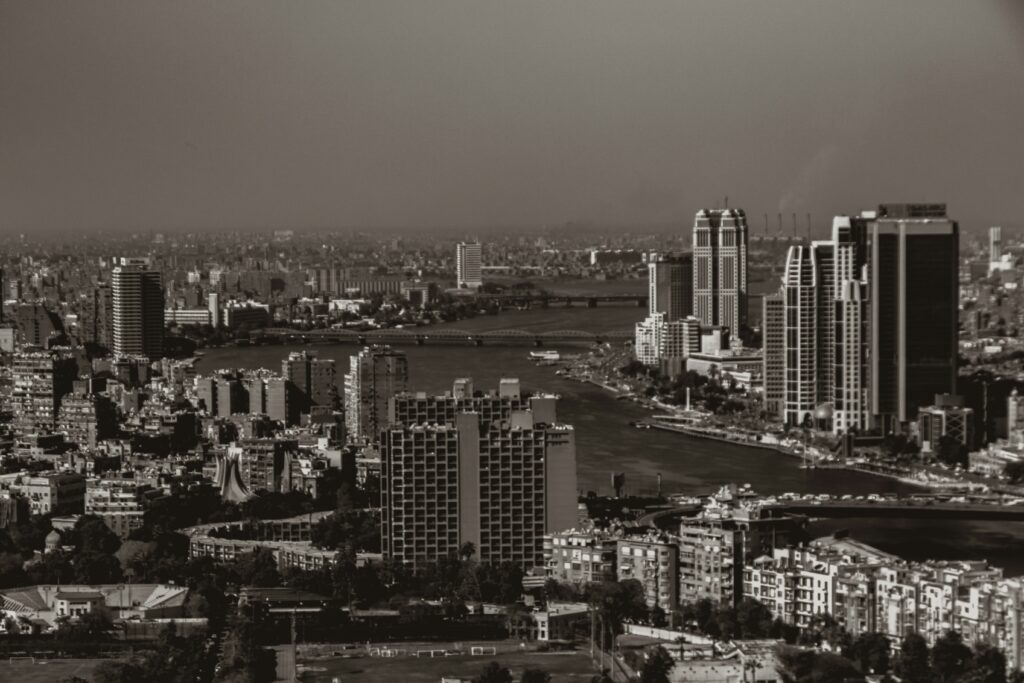
Egypt, Cairo and the Nile River
Ten Egyptian Words: Why Wouldn’t an “Egyptian” from 1980 Understand Us?
Here is a list of ten Egyptian words born purely from drama, cinema, and trends:
1. بَسِّطتهالك (Bastahtalk)
Source: The character “Sayed Abu Hafiza” performed by Akram Hosny.
Example: “The issue was very difficult, but I بسطتهالك (Bastahtalk) completely.”
Meaning: Explaining the complex simply, mixed with “Fahlawa” (cleverness/knack).
Why is it baffling? In 1980, one would understand it as a physical verb (to flatten something), but wouldn’t grasp the sarcastic irony regarding the “supernatural ability to explain.”
2. فاكس (Fax)
Source: A technical word turned into youth sarcasm, spread through sitcoms.
Example: “فاكس (Fax) to this whole topic!”
Meaning: To ignore the matter completely.
Why is it baffling? In 1980, the “Fax” was a revolutionary office machine; using it as a verb meaning “forget it” would leave them in technical bewilderment.
3. لَمِيض (Lamid)
Source: Used in modern series to describe digitally “pedantic” characters; a distortion of the words “Almai” (brilliant) or “Lamah” (perceptive).
Example: “Don’t be لميض (Lamid) and correct the manager while he’s explaining!”
Meaning: The pedantic person who thinks they are smarter than everyone else.
Why is it baffling? The word has a modern musical ring and implies a sarcasm not found in the traditional “Lamah.”
4. مِتـشَـيـِّك (Metsheyek)
Source: Social media platforms (the blue “Check” verification mark on accounts).
Example: “I شيكت (Sheyekt) on him, and he’s not bad at all.”
Meaning: Someone who has gained digital “verification” or become “official.”
Why is it baffling? In the 80s, “Metsheyek” meant someone wearing elegant clothes (from *Shyaka* / Elegance). The new meaning is purely technical.
5. بَقَّق (Baqqaq)
Source: Modern “Thug-Intellectual” films.
Example: “بقق (Baqqaq) your eyes at this paper!”
Meaning: To stare with exaggerated focus (opening eyes wide).
Why is it baffling? It is an innovative onomatopoeic word. In 1980, an Egyptian would say “Ballem” or “Boss”; “Baqqaq” has a modern, tough-street (Sarsagi) vibe.
6. مَنْتَخ (Mantakh)
Source: Meme culture that glorifies laziness.
Example: “I’m on holiday today; I just sat أمنتخ (Amantakh) in front of the TV all day.”
Meaning: Total relaxation to the point of melting into the chair.
Why is it baffling? It’s an evolution of “Antakha,” but in 2026, it describes the state of “non-action” as a daily philosophy.
7. سِكّة (Sekka)
Source: Street language adopted in TV series.
Example: “This mobile is سكة (Sekka).” or “This guy is سكة (Sekka).”
Meaning: Something low-quality or an unreliable person.
Why is it baffling? In 1980, “Sekka” only meant a “road” or “path.” Describing a person as “Sekka” would sound like an incomplete sentence (A road to where?).
8. كَمَنّـنا (Kamannana)
Source: A famous song by Mohamed Henedi and Mohamed Fouad in the movie Ismailia Rayeh Jay.
Example: “What’s with this peace of mind? You’re living in the كمننا (Kamannana) and forgetting the world.”
Meaning: A mysteriously harmonious and playful mood.
Why is it baffling? It has no linguistic origin; it is a “cinematic word” par excellence. Those who didn’t see the film in 1997 will never crack the code.
9. حَلَّق (Hallaq)
Source: Gags from comedy films.
Example: “حلق (Hallaq) him and don’t reply!”
Meaning: To ignore someone or stall them.
Why is it baffling? Someone in the 80s would think you’re talking about “Barbering,” “Earrings,” or “Flying.”
10. هَجّص (Haggas)
Source: Dramatic archetypes of the “Con-man” who tells unbelievable stories of heroism.
Example: “Your friend keeps يهجص (Yehaggas) to us saying he was Egypt’s boxing champion, but he’s afraid of his own shadow.”
Meaning: Fairy tales and imaginary heroics.
Why is it baffling? It’s the modern replacement for the old “Fashar” (exaggerator), but it carries a vibe of “media showmanship” and has a funny ring suited for the “Trend” era.
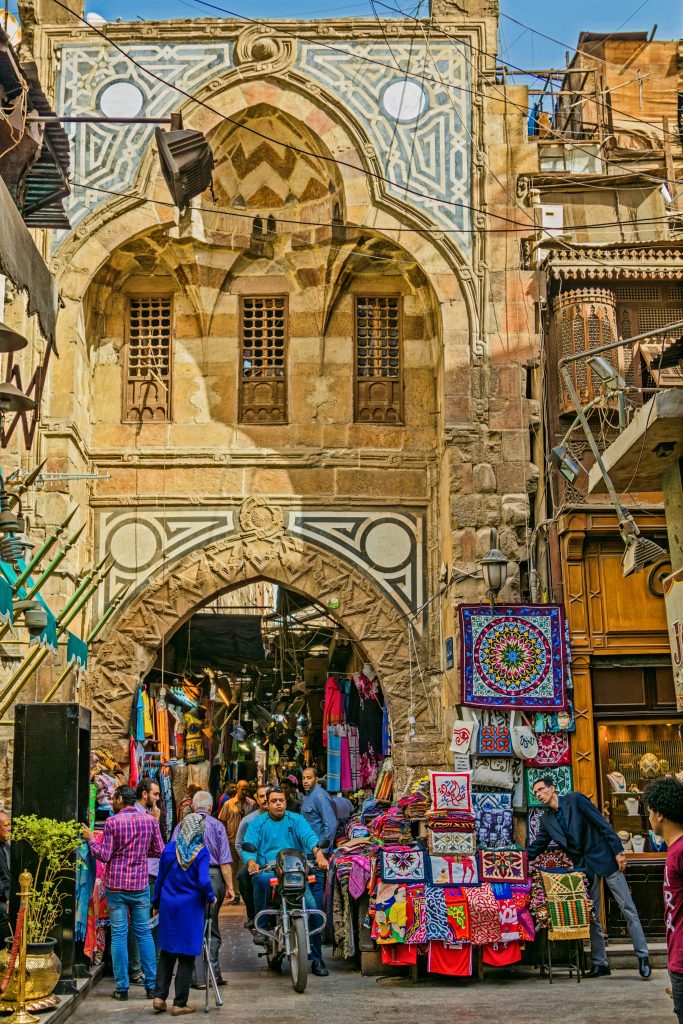
Khan el Khalili, Cairo, Egypt
For Translators: Review the article: Arabic Is Twenty Languages Inside One | At Least
For those who want to dive deeper and write specialized prompts, see the 8-article series: Arabic & its Dialects and the third article on Egyptian | The Dialect Everyone Understands
- Dictionary of Modern Egyptian Slang (Digital Edition 2025).
- Analysis of Cinema Language and its Impact on Dialect – Cairo University Studies.