Arabic Grammar | How the Engine Works

The Arabic sentence starts with a verb. Nouns change form based on their role. The dual has its own form. A clear guide to how Arabic grammar actually works.
In the summer of 2017, Sara — a German exchange student in Cairo — sat across from her Egyptian professor holding an exam paper in slightly trembling hands. She had spent six months studying Arabic in Berlin before arriving. She knew vocabulary. She understood some sentences. But the first exam revealed something she had not expected: she knew what to say, but did not understand why words appeared in that order, why noun endings kept changing from one sentence to the next, or why the verb sometimes came first and sometimes seemed to vanish entirely.
In broken Arabic she told her professor: “I know the words, but the language moves in a way I don’t understand.”
He smiled and said: “You don’t know the words — you know the parts. The engine hasn’t become clear to you yet.”
This article is for people who want that engine to become clear. Not to become a grammarian, but to understand the internal logic of Arabic — the logic that makes it, once grasped, one of the most consistent and architecturally beautiful languages on earth.
Engine One | Root and Pattern — The Column and the Moulds
We covered the trilateral root in the first article of this series. But a root alone is an incomplete creature. It needs a mould to be poured into — what Arabic grammarians call the wazn (morphological pattern or measure). Think of it this way: the root is the raw clay; the pattern is the mould. The same clay in different moulds produces different shapes, each with its own function and meaning.
Arabic has many patterns, but a limited number of the most common ones is enough to understand what is happening:
| Pattern | Functional Meaning | Example from K-T-B | Example from Another Root |
|---|---|---|---|
| faʿala | Past tense verb (single agent) | kataba (wrote) | dhahaba (went) |
| fiʿāl | Noun of the act / tangible result | kitāb (book) | ḥisāb (account) |
| fāʿil | Active participle (one who does) | kātib (writer) | dhāhib (going) |
| mafʿūl | Passive participle (what was done) | maktūb (written; fate) | maḥsūb (calculated) |
| mafʿal | Noun of place or time | maktab (office, desk) | madrasa (school) |
| faʿʿāl | Intensive form (one who does much) | kattāb (prolific writer) | ʿallām (the all-knowing) |
| tafʿīl | Verbal noun of intensive action | taktīb | taʿlīm (education) |
| iftʿāl | Verbal noun of acquisition | iktitāb (subscription) | iḥtimāl (probability) |
The point of this table is not to memorise it — it is to absorb its idea: when you know one root and recognise the common patterns, you can infer the meaning of dozens of words you have never encountered before. This is the moment Arabic learners describe as a click — a feeling of having cracked a code.
(See our article: Classical Arabic | The Mother Tongue That Never Died) — for the sensory logic of the three-letter root and detailed examples.
Engine Two | Sentence Order — When the Verb Goes First
In English, German, and most European languages, a sentence typically begins with the subject: John reads the book. Subject first, then verb, then object — what linguists call SVO order.
Classical Arabic prefers a different sequence: VSO — verb first, then subject, then object. Qaraʾa Muḥammadun al-kitāba. The verb opens the scene; then we learn who performed it; then what it acted upon.
Why this order? It is not arbitrary. In a language that begins with the verb, the first question posed to the listener is: what happened? — not who are we talking about? This is a different information priority — the event before the person. In poetry and rhetoric, this gives Arabic a particular impact: the action strikes you first, before you know who caused it.
But — and this is a nuance many introductory textbooks skip — Arabic is flexible. SVO order is perfectly valid when you want to emphasise the subject rather than the action:
- Qaraʾa Muḥammadun al-kitāba — focus on the reading: something happened.
- Muḥammadun qaraʾa al-kitāba — focus on Muhammad: it was specifically he who read it, not someone else.
The difference is subtle but real, and any native speaker registers it immediately. This conscious flexibility is one of the reasons Arabic can express fine semantic distinctions that fixed-order languages sometimes struggle to convey.
The Nominal Sentence | When the Verb Disappears
There is another sentence type in Arabic with no real equivalent in English — and it is a common source of confusion for new learners: the jumla ismiyya (nominal sentence), which begins with a noun and requires no verb “to be”.
In English you say: The weather is beautiful. The “is” is mandatory. In Classical Arabic you say: al-jawwu jamīlun — no verb at all, and the sentence is grammatically complete. The subject (the weather) and the predicate (beautiful) are sufficient on their own.
This absence is not carelessness — it is a stylistic choice. The nominal sentence in Arabic conveys a sense of permanence and absolute truth, while the verbal sentence conveys occurrence and change. Allāhu wāḥidun — not “God is being one”. The absoluteness is intentional.
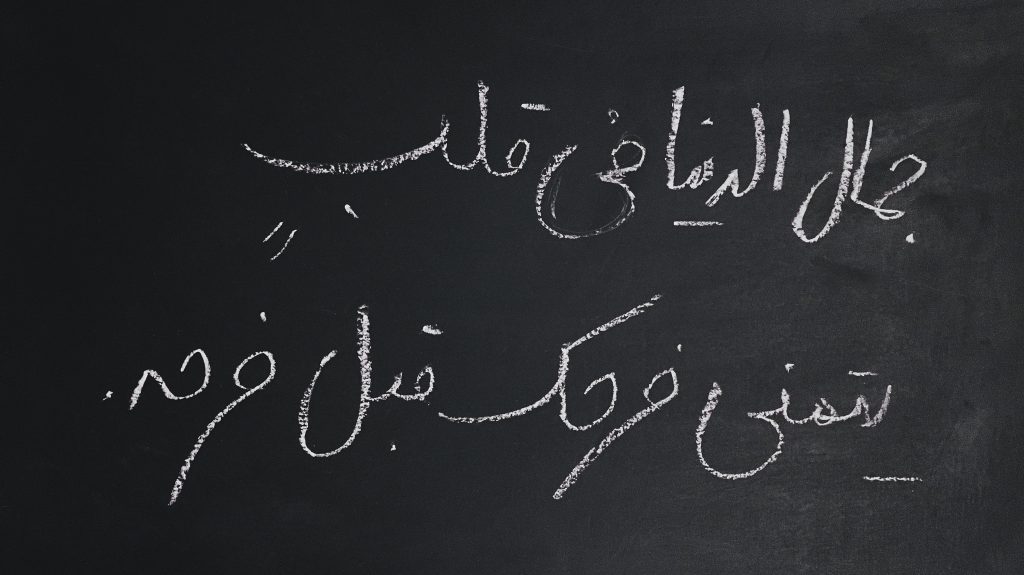
The verse works through deliberate omission: “in a heart” arrives with no verb, leaving the reader suspended for a beat before the meaning completes itself. Arabic’s capacity to drop the linking verb turns that pause into feeling — something the English translation carries in meaning but cannot quite replicate in form.
Engine Three | Case Endings — When the End of a Word Speaks
If there is one feature of Arabic grammar known outside Arab communities, it is the case system — usually discussed in a tone of exaggerated dread. Case endings (iʿrāb) are changes to the end of a word — through short vowel markers — that indicate its grammatical role in the sentence.
Before this sounds alarming, consider why cases exist at all.
In English, the function of a word is determined almost entirely by its position: The dog bit the man is completely different from The man bit the dog. Move the words, change the meaning. The language is locked to its word order.
Arabic chose a different solution: instead of fixing words in position, it marks each word with a suffix that tells you its function wherever it appears in the sentence.
| Case | Primary Marker | Function | Example |
|---|---|---|---|
| Nominative (rafʿ) | ḍamma ( ُ ) | Subject / predicate | qaraʾa Muḥammadun al-kitāba |
| Accusative (naṣb) | fatḥa ( َ ) | Direct object / adverb / complement | qaraʾa Muḥammadun al-kitāba |
| Genitive (jarr) | kasra ( ِ ) | After prepositions / possessive | fī al-kitābi fāʾida |
What this means in practice: ḍaraba al-waladu al-kalba (the boy struck the dog) is completely different from ḍaraba al-walada al-kalbu (the dog struck the boy) — a change of one vowel on two words, and the meaning flips entirely.
Cases are not a punishment for the student — they are the price of freedom. When you know the case system, you can rearrange a sentence in almost any order without losing the meaning. The endings carry the meaning instead of the position.
The proof is classical Arabic poetry, where the poet places words in whatever order the metre and rhyme demand — and the reader still knows who did what to whom, because the case markers are doing the structural work.
Cases in the Dialects | What Happened?
A fair question: if cases are so central, why did they largely disappear in the colloquial dialects? The historical answer: when Arabic spread to non-Arab populations during the early Islamic conquests, the spoken case system was the hardest feature to acquire. Gradual simplification followed — the final vowel of a word began to drop in natural speech, leaving a consonant-final word. This is exactly what all the Arabic dialects do today: we say al-kitāb, not al-kitābu or al-kitāba, and rely on context and word order to convey function instead.
Engine Four | Dual and Plural — A Language That Counts in Three Tiers
Most world languages distinguish two categories: singular (one) and plural (more than one). Arabic distinguishes three: singular, dual, and plural. This is not a grammatical luxury — it is genuine descriptive precision.
The dual is formed by adding -ān (nominative) or -ayn (accusative and genitive) to the end of the singular:
- kitāb → kitābāni / kitābayn (two books)
- madrasa → madrasatāni / madrasatayn (two schools)
- ṭālib → ṭālibāni / ṭālibayn (two students)
The plural is where Arabic becomes a poem unto itself. There are two main types:
Sound Plural | The Regular Plural
Formed by adding a suffix to the singular without changing its internal structure:
- Masculine sound plural: muʿallim → muʿallimūn/muʿallimīn
- Feminine sound plural: muʿallima → muʿallimāt
Broken Plural | The Plural That Breaks the Singular
This is what fascinates foreigners and challenges learners — and is simultaneously what gives Arabic a unique internal beauty. The broken plural does not add to the singular: it reshapes it from the inside.
| Singular | Broken Plural | Meaning |
|---|---|---|
| kitāb | kutub | books |
| rajul | rijāl | men |
| bayt | buyūt | houses |
| kalima | kalim / kalimāt | words |
| ʿayn | aʿyun / ʿuyūn | eyes / springs |
| qalam | aqlām | pens |
What every serious Arabic learner eventually notices is that broken plurals follow patterns too — they are not random. Fiʿāl, afʿāl, fuʿūl, fiʿala — each plural pattern clusters nouns of similar sonic structure. The deeper you go into Arabic, the more broken plurals feel predictable rather than arbitrary.
Engine Five | Grammatical Gender — A Current That Runs Through the Whole Sentence
In English, grammatical gender is nearly absent — it only touches pronouns (he/she/it). In Arabic, grammatical gender runs through the entire sentence like an electrical current: every noun is masculine or feminine, adjectives agree with their noun, verbs agree with their subject, and all pronouns carry gender.
The most common marker of feminine gender is the tāʾ marbūṭa (ة) at the end of a noun:
- muʿallim → muʿallima (teacher, f.)
- ṭālib → ṭāliba (student, f.)
- mudīr → mudīra (director, f.)
But — and here comes the surprise — not everything ending in tāʾ marbūṭa is feminine (for instance, khalīfa, caliph, is masculine), and not every feminine noun carries the marker (for instance: shams sun, arḍ earth, nafs soul — all feminine with no visible marker). These exceptions exist in every language. German has three grammatical genders with countless exceptions. French is no cleaner.
What matters is to grasp the principle: when you say “the big house” in Arabic, the adjective follows the noun — not precedes it as in English — and must agree with it in gender, definiteness, and number:
- al-baytu al-kabīru (the big house — masculine)
- al-madrasa al-kabīra (the big school — feminine)
- baytun kabīrun (a big house — masculine indefinite)
- madrasatun kabīratun (a big school — feminine indefinite)
When an Arabic poet writes laylatun sājiyatun hādiʾatun ʿamīqatun — a still, quiet, deep night — three feminine adjectives follow the feminine noun “night” in chain. The sentence sets itself to music on its own.
Engine Six | Verb Conjugation — A Network Linking Agent to Time
The Arabic verb carries more information inside itself than its English equivalent. When you say kataba, you know from context it is past tense — but the subject pronoun is already embedded in the verb form itself. Katabtu means “I wrote” — no separate “I” required.
Arabic verbs conjugate across three primary tenses:
| Pronoun | Past | Present | Imperative |
|---|---|---|---|
| I (anā) | katabtu | aktubu | — |
| You, m. sing. (anta) | katabta | taktubu | uktub |
| You, f. sing. (anti) | katabti | taktubīna | uktubī |
| You two (antumā) | katabtumā | taktubāni | uktubā |
| You all, m. (antum) | katabtum | taktubūna | uktubū |
| You all, f. (antunna) | katabtunna | taktubna | uktubna |
| He (huwa) | kataba | yaktubu | — |
| She (hiya) | katabat | taktubu | — |
| They two, m. (humā) | katābā | yaktubāni | — |
| They two, f. (humā) | katabatā | taktubāni | — |
| We (naḥnu) | katabnā | naktubu | — |
| They, m. (hum) | katabū | yaktubūna | — |
| They, f. (hunna) | katabna | yaktubna | — |
What stands out here: Arabic distinguishes anta (you, masculine) from anti (you, feminine) — making it more precise than English in addressing individuals. It also distinguishes hum (they, masculine) from hunna (they, feminine) — a distinction many languages lack.
Present and Future | One Tense for Two Times
A fine point that often puzzles learners: Classical Arabic has no separate future verb form. The present tense covers both, and the prefix sa- or sawfa signals the future:
- yaktubu al-āna — he writes now (present)
- sayaktubu ghadan — he will write tomorrow (future)
This treatment of the future reflects something almost philosophical: the future is an extension of the present, not a separate time with its own conjugation system. Arabic handles it lightly, with a prefix, and moves on.
Engine Seven | The Definite Article — The ʾal That Never Changes
Against all this elegant complexity, Arabic gives you one genuine gift: the definite article is always al-, in every situation. No “a” versus “an” versus “the” as in English. No der/die/das as in German. One article covers everything — masculine, feminine, singular, plural, any case:
- rajulun — al-rajulu (a man / the man)
- imraʾatun — al-imraʾatu (a woman / the woman)
- kutubun — al-kutubu (books / the books)
But al- has one beautiful phonological behaviour worth knowing: sun letters and moon letters. Some consonants “absorb” the l of the article and double themselves; others leave it pronounced in full.
| Type | Example | Actual Pronunciation | Note |
|---|---|---|---|
| Sun letter | al-shams | ash-shams | shīn doubles itself |
| Sun letter | al-nūr | an-nūr | nūn doubles itself |
| Moon letter | al-qamar | al-qamar | lām pronounced fully |
| Moon letter | al-kitāb | al-kitāb | lām pronounced fully |
Why? Simple phonetics. Sun letters are all articulated from approximately the same place in the mouth as the lām — the tip of the tongue near the upper teeth — so a natural assimilation occurs in fluent speech. Moon letters are articulated elsewhere, so no assimilation happens. The language follows acoustic physics, not an arbitrary rule.
What Does All This Mean for the Learner?
After all these engines, a fair question: does a foreign learner need to master all of this to communicate?
The honest answer: no — not at first.
For daily colloquial conversation, you do not need the case system. The dual is infrequently used in spoken Arabic. Broken plural patterns are acquired gradually through exposure. What suffices at the start is a working vocabulary of common roots, basic sentence order, and verbs in their most common forms.
But — and this is why we wrote this article — understanding these mechanisms gives you something conversation alone cannot: it gives you the feel of Arabic. When you hear a sentence and notice the subject carrying its ḍamma and the object its fatḥa, you are no longer parsing a rule — you are sensing the balance of the sentence, the way a musician senses the weight of a chord. That is the difference between someone learning a language and someone beginning to inhabit it.
Sara, our German student from the opening of this article, spent the rest of her year in Cairo writing roots on small cards and pinning them around her flat. By the end of the year she was reading newspaper headlines and understanding them — not because she had memorised every rule, but because the engine had become clear to her. After that, the words went to their places on their own.
(See our article: Why the Arabic Translation You Received Sounds Like a Translation) — where we show how understanding Arabic’s internal mechanics directly affects translation quality.
Next in this series: Egyptian Arabic | The Dialect Everyone Understands. Now that we understand the structure, we move to the most widely spread and culturally influential dialect in the Arab world — the language of Abdel Halim Hafez, Adel Imam, and every Arab drama student’s first sentence.