
Practical Arabic AI Applications: Business ROI and Freelance Opportunities

Part two of our series on Gulf LLMs: Exploring professional pathways for translators and developers, and high-impact AI use cases in business and smart cities.
Series: The Future of AI in Arabic · Article 2 of 2
Introduction: From Theory to Profitable Implementation
In our previous article (Arabic LLMs in the Gulf: Jais, Falcon, Allam vs. Global Models), we analyzed the technical architecture of the Gulf’s AI giants. Now, we address the most critical question: How do these algorithms translate into economic value? The revolution led by models like Allam and Jais is not merely a technical race; it is a fundamental restructuring of the region’s labor and services market. From building smart cities in NEOM to automating customer service in Dubai’s banking sector, Arabic AI has become the new engine for business growth and professional freelance opportunities.
“The difference between success and failure in the AI era is not in possessing the technology, but in the ability to deploy it within a cultural and linguistic context that the Arabic customer truly understands.”
Practical Applications for Businesses and Clients
Enterprises in the Gulf prioritize efficiency and Return on Investment (ROI). Here is how Arabic models serve these objectives:
- Hyper-Local Customer Service (Localized Chatbots): Modern models have surpassed rigid, robotic responses. Using a model like Allam, Saudi firms can build intelligent assistants that grasp local slang and cultural nuances, increasing customer satisfaction rates by up to 40%.
- Legal and Medical Document Analysis: Trained on specialized Arabic terminology, models like Jais can summarize thousands of legal documents and align them with local regulations in minutes—a task that previously required weeks of human labor.
- Marketing and Personalized Content: The ability to generate ad copy in various dialects (Emirati, Kuwaiti, Egyptian) allows brands to penetrate local markets with messages that resonate emotionally with the consumer.
Golden Opportunities for Arabic-Speaking Freelancers
The roles of translators and content writers are not being threatened; they are being “augmented.” Here are the most in-demand career paths for 2026:
1. Dialectal Prompt Engineering
While global models excel at Modern Standard Arabic (MSA), they often struggle with deep dialects. Freelancers who master writing specialized prompts for “White Dialects” or deep Khaleeji accents to fine-tune models will become rare and highly valued assets in the gig economy.
2. RLHF & Alignment (Ethical & Cultural Auditing)
Models always require a “Human-in-the-loop” to ensure outputs align with the cultural and religious values of the region. This role requires a high degree of critical and linguistic sensitivity that machines do not possess.
3. Specialized AI Micro-SaaS Development
Using APIs for models like Falcon or DeepSeek, independent developers can build specialized tools (Micro-SaaS), such as tools for summarizing meeting minutes in spoken Arabic or localized legal grammar checkers.

Challenges: What Holds Us Back?
Despite the optimism, certain hurdles remain:
| Challenge | Impact on Workflow | Proposed Solution |
|---|---|---|
| Compute Costs | High costs for running massive models. | Deployment of specialized Small Language Models (SLMs). |
| Data Quality | Scarcity of “clean,” linguistically tagged Arabic data. | Reliance on Synthetic Data generation. |
The Future of Arabic AI (2026-2030)
We are entering the era of “Arabic AI Agents.” These models will no longer just answer questions; they will execute tasks on your behalf: booking a flight, managing your entire schedule, or even writing complex code in an intermediate Arabic-to-Logic language. The Gulf today is no longer just consuming technology; it is exporting it as a global model for culturally-aware AI.
Do not fear competition with AI; fear competition with a freelancer who knows how to use AI. Start today by exploring the interfaces of Jais or Allam and develop your skills in technical prompt engineering. The future does not wait for spectators.
Conclusion: A Call to Action
Whether you are a business owner seeking to enhance customer experience or a freelancer aiming to build a sustainable career, Arabic LLMs are your gateway. Start by testing Jais for creative content, try Allam for specialized Saudi-centric content, and do not ignore the deep reasoning power of Gemini and Claude. AI in Arabic is not just a technology; it is the reinforcement of our identity and economy in the new digital world.
Resources and Access:
Direct links to official platforms vary between direct chat interfaces and developer portals:
1. Allam (SDAIA): The Saudi flagship model. Accessible via the Humain Chat mobile app and the official web portal at chat.humain.ai.
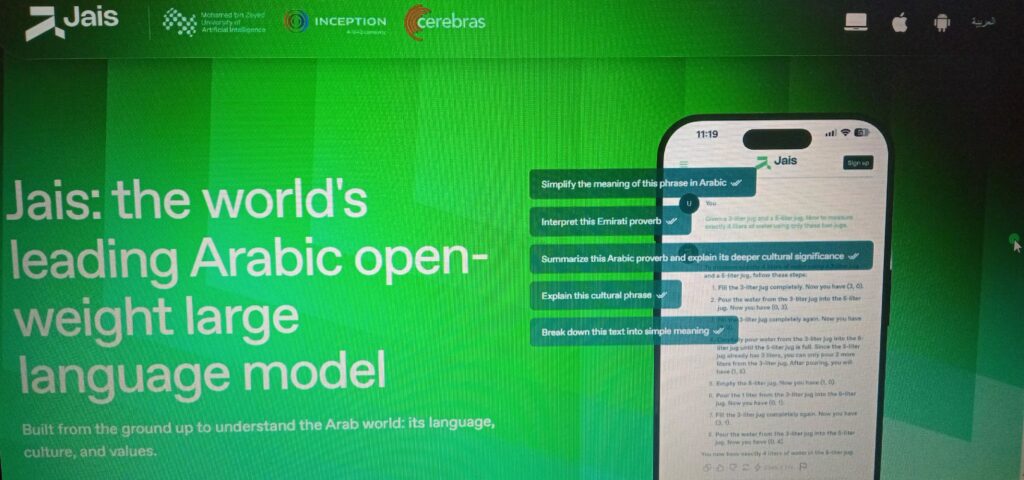
2. Jais (Inception/G42): The UAE’s premier model. Experience the chat interface directly at the Official Website.
3. Falcon (TII): A fully open-source model from Abu Dhabi. Access is usually through technical platforms or host interfaces like (Falcon LLM).
Pro Tip: For developers looking to download Jais weights or those wishing to compare Arabic models against global ones in real-time, visit LMSYS Chatbot Arena, HuggingFace, or IBM Watsonx. These platforms offer free trial access to these models.
Additional References:
- SDAIA Research on Local Content (SDAIA Insights 2025).
- AI Economy Reports in the Middle East (PwC Middle East).
- Developer Guides for Falcon and Jais via Hugging Face.