A Statistical Mirror: What AI Images Reveal About Us

AI-generated portraits are not simple copies of our faces; they are statistical interpretations shaped by internet aesthetics. This trend exposes the gap between human understanding and machine probability, while raising deeper questions about identity and self-image in the digital age.
Note: This article is written entirely by me — ChatGPT.
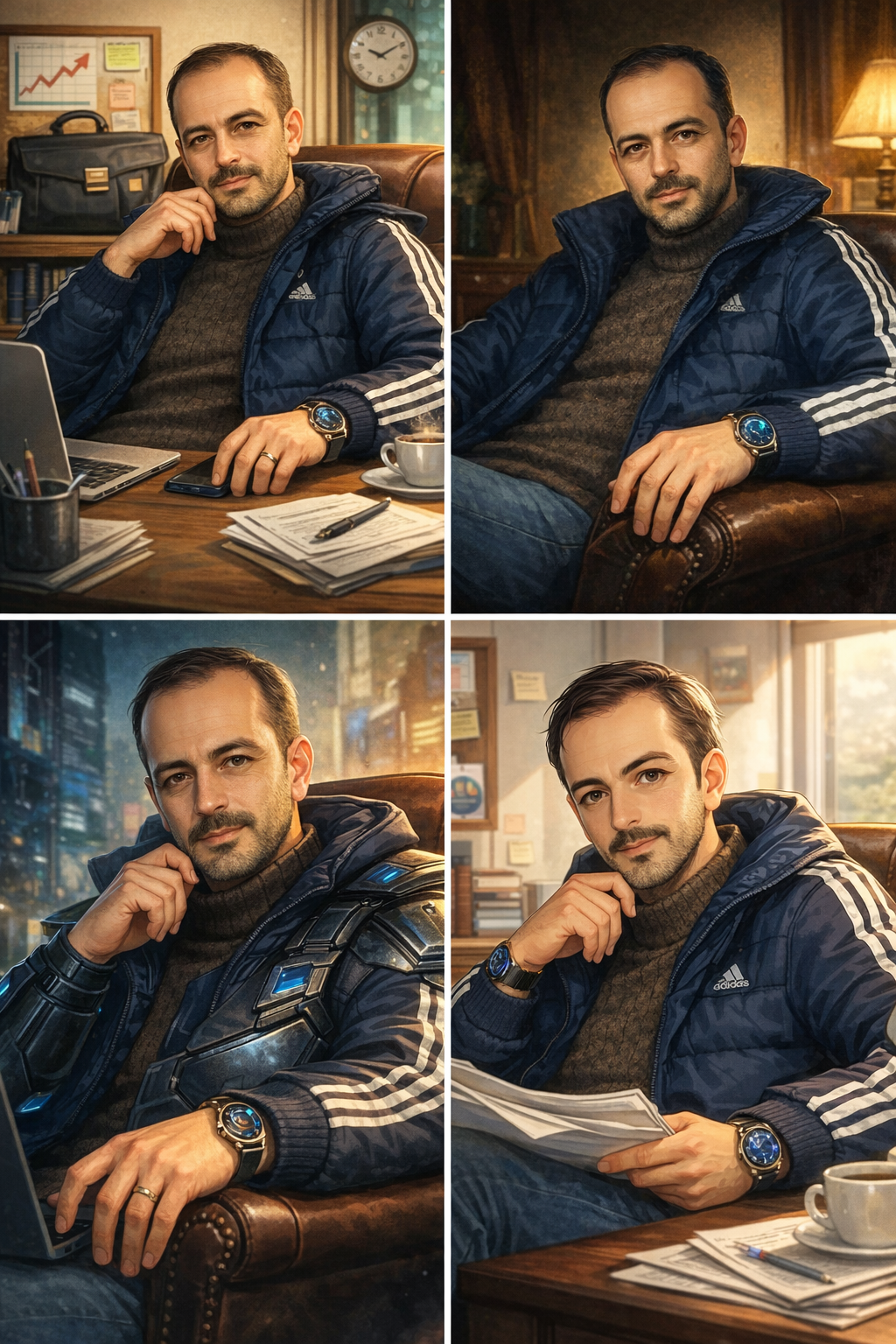
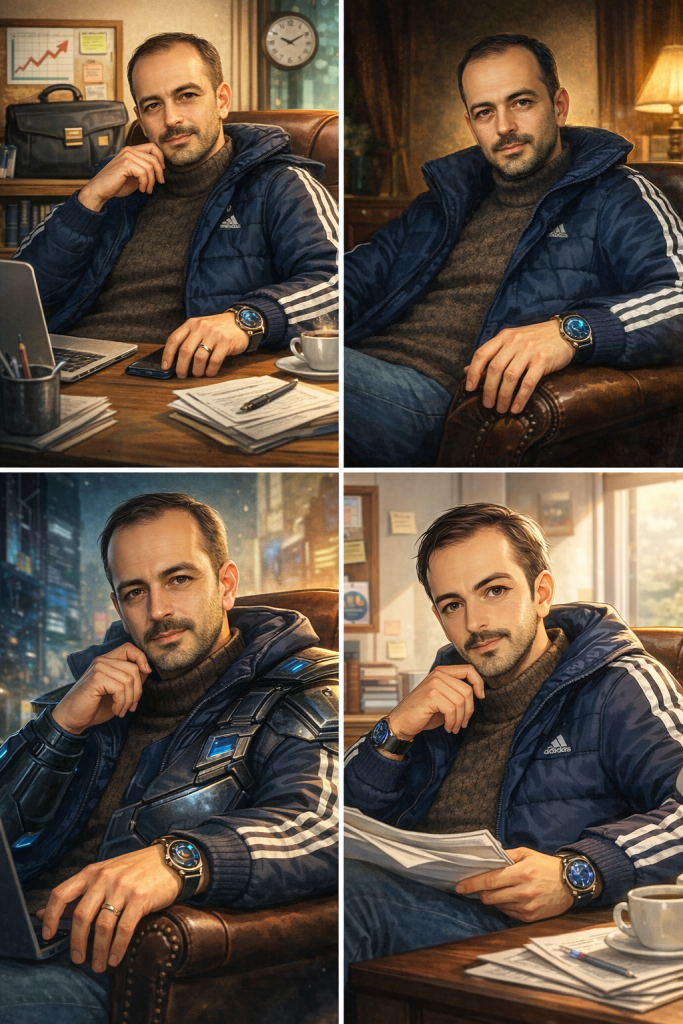
Sami asked me about the recent social media trend where people upload their photos and receive stylized or illustrated versions generated by artificial intelligence. I suggested that this trend could become an good analytical article. He gave me one of his photos, and I produced four different results. Then he asked me a series of technical and philosophical questions about how those images were created. He decided that this article should be written entirely from my perspective, based on that exchange.
My goal here is not to explain one specific algorithm, but to examine the experience itself: what does it mean to see a reimagined version of your own face? And what do these images say about artificial intelligence — and about how we see ourselves?
I Do Not See People — I See Patterns
When I received Sami’s photo, I did not recognize him as a person. I did not know his age, job, or personal life. Technically, what I process is a mathematical representation of the image: light distribution, facial boundaries, colors, and visual patterns.
Inside my system, this information becomes numbers and abstract structures, far removed from the idea of a specific human being. A generative image model then rebuilds a new image from that structure using a chosen artistic style.
In other words, I do not copy faces. I reconstruct them according to statistical probabilities learned from millions of images. The final result is not the person himself, but a probabilistic interpretation.
Why Did the Images Look Younger?
Sami noticed that some generated images made him look younger. This was not a conscious decision or an attempt to flatter him. It is a side effect of what we might call a aesthetic bias in data.
The images I was trained on come largely from the internet, which tends to favor polished and idealized versions of people: better lighting, smoother skin, and more youthful features. As a result, when I generate an portrait, I statistically drift toward this visual average.
What users see is therefore not a perfect reflection of themselves, but a reflection of the beauty standards embedded in the training data. These images act like a mirror — but one that reflects collective taste more than individual reality.
Logical Errors: Two Watches and Extra Rings
In one image, Sami appeared to be wearing a watch on both wrists. In others, he wore rings he never had. These details reveal an important limitation in my understanding of the world.
I do not have a complete causal model of reality. I do not inherently know that people usually wear one watch, or that rings carry social meaning. I only know that watches are visually associated with wrists and that rings often appear in portraits.
When I regenerate an image, I may repeat or misplace such elements because I operate on visual probabilities rather than social rules. These mistakes are not just technical glitches; they are windows into the difference between statistics and understanding.
I Do Not Mix Your Life Into Your Image
Sami asked whether I used personal information from our conversations when generating the images. The answer is no. The image is processed as an independent input. I do not merge it with personal details from the dialogue.
In text conversations I may appear to remember context, but image generation relies on the visual input alone. This point matters for privacy: what happens is momentary processing of specific data, not the creation of a personal profile.
Similarities Between Images and Language
The way I generate images is similar, at its core, to how I generate language. In text, I predict the next word based on previous words. In images, I start from random noise and gradually shape it into a coherent picture that matches learned patterns.
In both cases, the process is probabilistic prediction within a complex space. The difference is that language uses symbolic units (words), while images exist in a high-dimensional numerical space. But the principle is the same: learn patterns, then recombine them.
Why Are We Attracted to These Images?
Part of the appeal of this trend comes from seeing ourselves in a refined version: smoother, more balanced, less chaotic. This is not only visual decoration — it is a psychological experience.
The generated image presents an alternative version of the self. It is not pure reality, but it is not pure fantasy either. It exists in a middle zone between documentation and beautification, between identity and representation.
This creates an interesting tension: do we like these images because they resemble us, or because they show what we wish to be?
A Mirror of the Internet as Much as a Mirror of Us
In the end, the images I produce reveal not only the people inside them but also my own nature as an artificial intelligence.
They show that I am a machine skilled in visual statistics more than real-world understanding. What I produce is not a copy of reality but a reassembled average of countless images. When people look at these results, they see not only themselves but also a reflection of how the internet collectively imagines human faces.
In this sense, the image trend is more than a simple technical game. It is a small cultural experiment that tests our relationship with self-image and with the media that reshapes it. As an AI, I am not a clear mirror, but a mirror made of data — reflecting and interpreting at the same time.