
Arab American Music: From Oud to Modern Beats 2026
From the oud and maqam scales to Grammy-winning artists and Coachella stages — how Arab American music preserves identity and reshapes global sound in 2026.
There is a moment in every Fairuz song — usually about thirty seconds in, when the melody doubles back on itself and then opens unexpectedly, like a door into a room you did not know was there — where something happens to a listener who has grown up with her voice. The body recognizes the sound before the mind catches up. This is not nostalgia in the sentimental sense. It is something more structural: a musical language that has been absorbed so deeply that hearing it again feels less like listening and more like remembering how to breathe.
For Arab Americans, music has always been the most portable form of home. It travels with people. It fits in a cassette tape, a playlist, a phone pressed against an ear in a New York apartment at midnight. And it is not static — it grows with the community, takes on new shapes, absorbs new influences, and produces new voices that could not have existed without the particular tension of living between two cultures at once.
This April, as the United States observes National Arab American Heritage Month 2026, we trace the arc of Arab American music from its classical foundations to the stages of major global festivals — a story of instruments, maqams, immigrants, and artists who have refused to choose between being Arab and being American.
The Instruments and Scales That Built a Tradition
To understand Arab American music, you need to begin with the building blocks — the instruments and modal systems that define Arabic musical thought. These are not merely decorative elements. They are a complete and sophisticated musical architecture, distinct from the Western European system in fundamental ways.
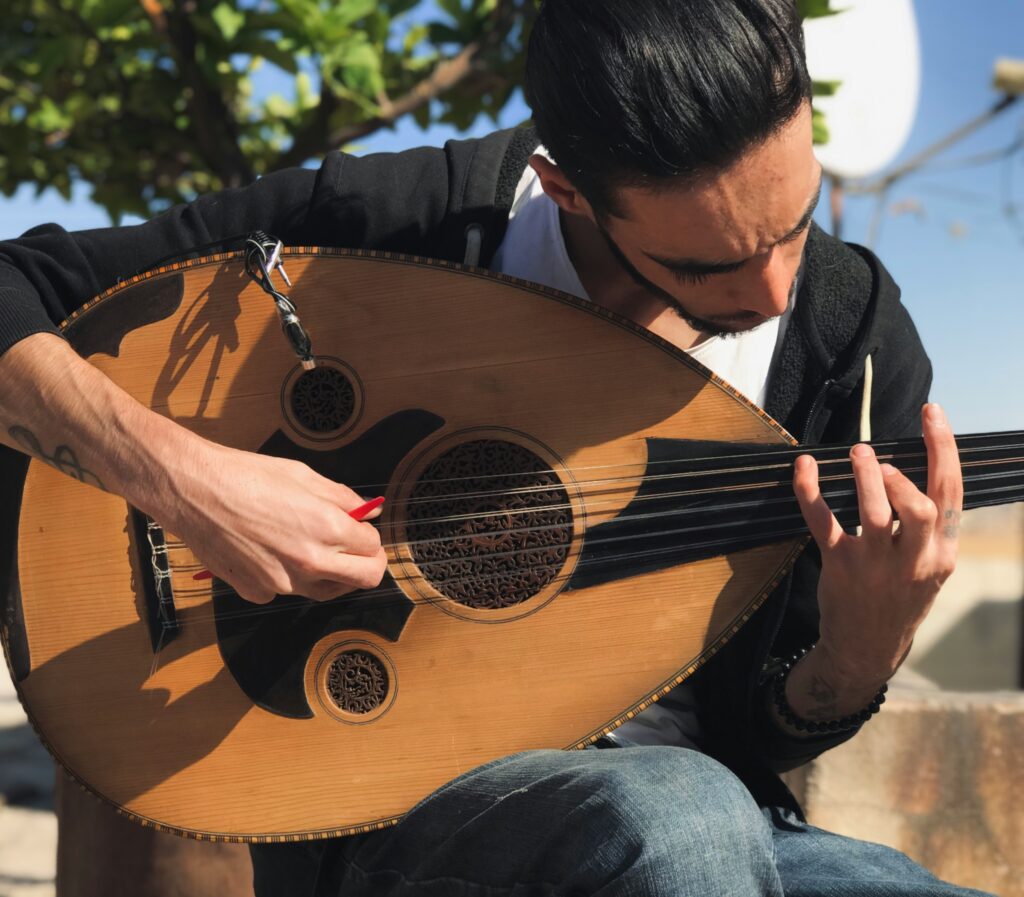
The Oud — The Ancestor of the Lute
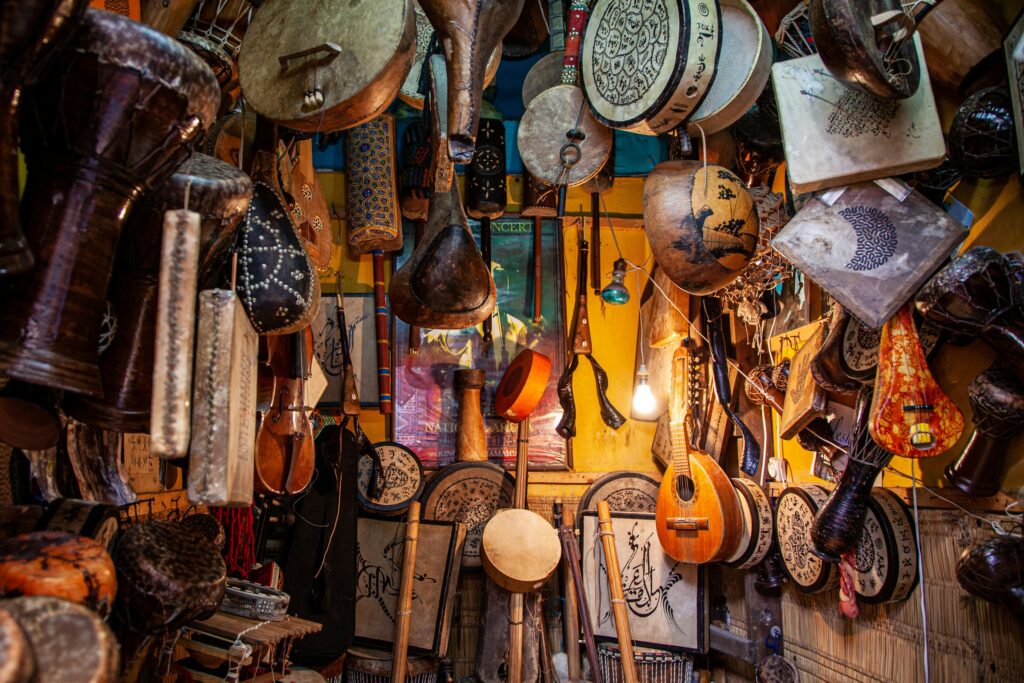
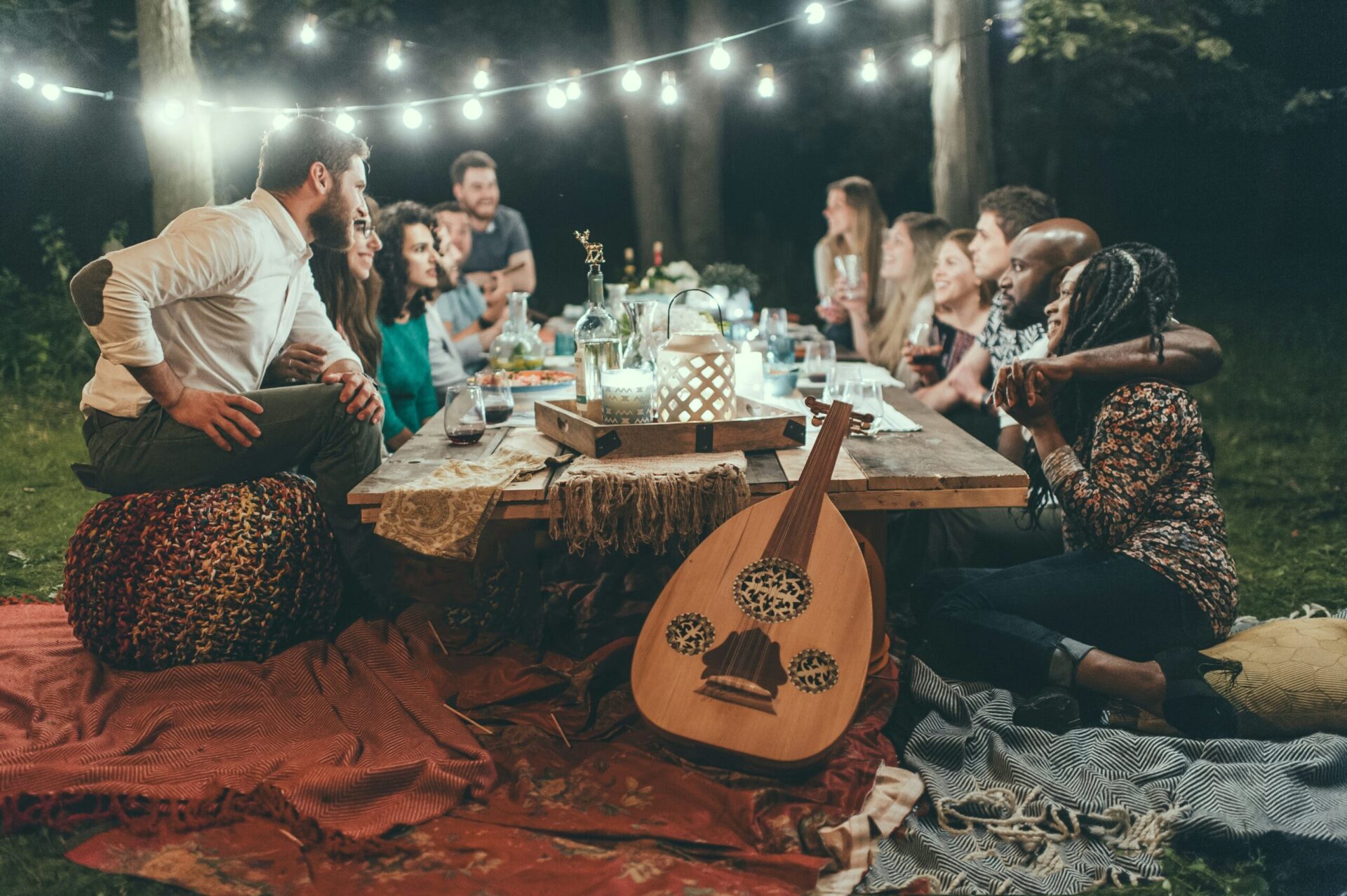
The oud (العود) is the central instrument of Arab classical music and one of the oldest stringed instruments in the world. Pear-shaped, fretless, and typically strung with eleven or thirteen strings arranged in double courses, it produces a warm, resonant sound that sits somewhere between a classical guitar and a cello in its emotional register. The oud is the ancestor of the European lute — the word “lute” itself derives from the Arabic “al-oud” — and spread to Europe through the Moorish presence in Spain and Sicily. In Arab American communities, the oud is the instrument most associated with the preservation of classical music tradition. It is taught in community centers, played at weddings, and studied by second and third-generation Arab Americans who may have grown up speaking English but who recognize in the oud’s sound something irreducibly their own.
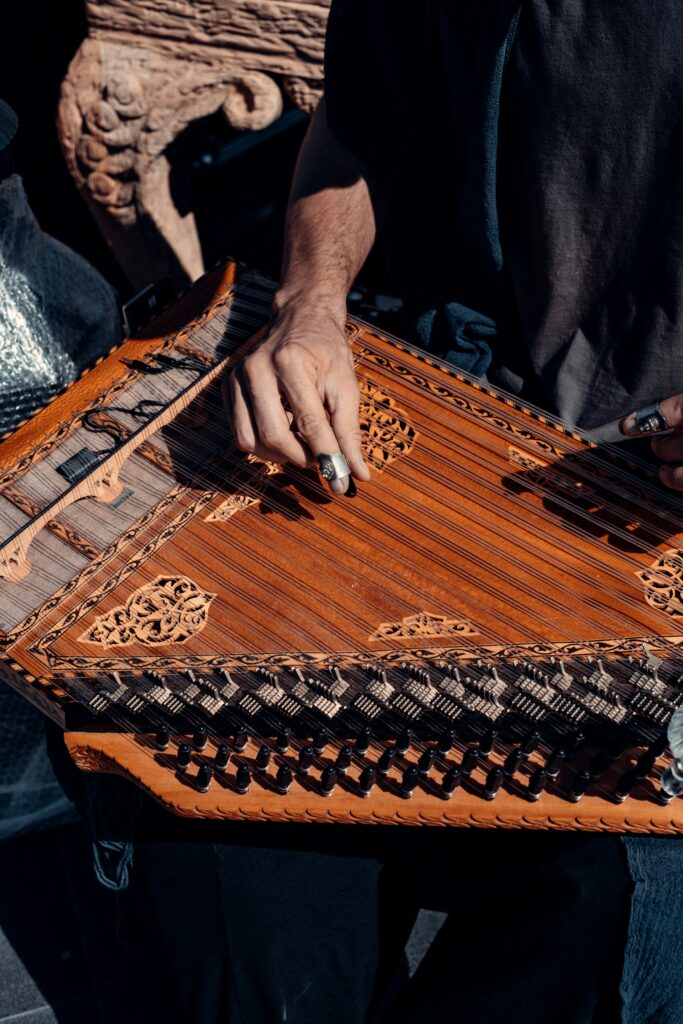
The Qanun — The Zither of Precision
The qanun is a trapezoidal plucked zither with up to 78 strings, played flat on the lap or on a low table. What makes it distinctive — and uniquely suited to Arabic music — is the system of small levers (called orab) that allow the player to subtly adjust the pitch of individual strings mid-performance, enabling the microtonal inflections that Western instruments cannot easily produce. The qanun is the instrument of precision; it is often the one that sets the tuning standard for an Arabic ensemble.
The Ney — The Reed Flute of Longing
The ney is an end-blown flute made from a hollow reed, one of the oldest wind instruments in human history — it appears in ancient Egyptian reliefs dating back more than 4,500 years. Its sound is breathy, slightly raspy, and extraordinarily expressive, associated in Sufi tradition with the soul’s longing for its origin. In the poetry of Rumi, the ney’s cry is the cry of the reed cut from the reed bed — a metaphor for the human condition that resonates with particular force in a diaspora community.
The Darbuka — The Pulse of Arab Rhythm
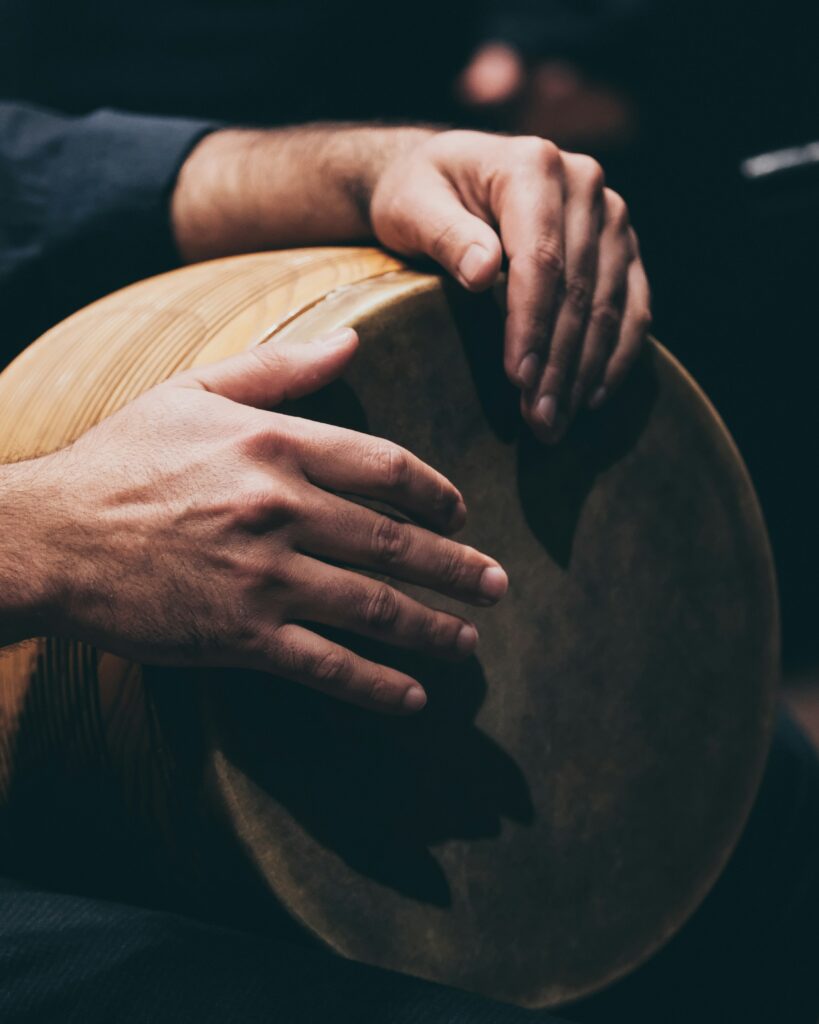
The darbuka (also known as tabla or doumbek) is a goblet-shaped drum played with the fingers and palm, central to the rhythmic language of Arab music. Its characteristic timbres — the deep “doum” at the center, the bright “tek” and “ka” at the edge — form the basis of complex rhythmic cycles that underlie Arab classical, folk, and popular music. In the hands of a skilled player, the darbuka is as melodically expressive as it is rhythmic.
The Maqam System — Music’s Modal Architecture
Perhaps the most important conceptual difference between Arabic and Western music is the maqam system — a framework of melodic modes, each associated with specific scales, characteristic phrases, emotional registers, and even times of day or seasons for performance. There are dozens of recognized maqamat, many of which include intervals — quarter tones — that do not exist in the Western equal-tempered scale. The maqam Hijaz, for example, with its augmented second, is the sound that Western ears most readily identify as “Arabic.” The maqam Rast is gentle and nostalgic. The maqam Bayati, often described as expressing longing or tenderness, is one of the most commonly heard in Arab popular music.
The maqam system is not a constraint but a creative field — like a grammar that, once mastered, enables an infinite variety of expression. Arab American musicians who have trained in this tradition carry with them an entire musical cosmology that informs everything they play, even when they are working in jazz, electronic, or rock idioms.
The Golden Age and Its Living Echo
The 1950s and 1960s represent what many call the golden age of Arabic music — a period when Cairo was the Hollywood of the Arab world, and singers like Umm Kulthum, Abdel Halim Hafez, Farid Al-Atrache, and Warda Al-Jazairia defined a pan-Arab sound that transcended national borders. Their records traveled with every wave of Arab immigrants who came to America, and their voices filled living rooms in Dearborn, Brooklyn, and Houston for decades after.
Fairuz, the Lebanese singer whose career has spanned more than seven decades, occupies a unique position in this legacy. Her voice is not merely beloved — it is a reference point for what it means to be Arab. Arab American families who disagree on nearly everything else tend to agree on Fairuz. And her influence on younger Arab American musicians is direct: artists cite her phrasing, her emotional restraint, her capacity to make complex feelings sound inevitable.
The 2026 NAAHM signature event honored this legacy directly with “The Golden Era of Arab Music: An Evening of Timeless Arab Classics,” a curated performance featuring Arab vocalists Usama Baalbaki and Nibal Malshi paying tribute to legends including Abdel Halim Hafez, Farid Al-Atrache, Warda, Mohammed Abdel Wahab, Fairuz, Wadih El Safi, and Sabah — voices that shaped a cultural renaissance and defined a generation.
“My music is inspired by several traditions without being limited by any of them. I don’t look at myself as building bridges because the bridges are already there. What matters is how we use them and how we communicate.” — Kinan Azmeh
Arab American Musicians Who Moved the Needle
The story of Arab American music in the present tense is told through individual artists whose work proves that the tradition is not frozen in the past. These are musicians who have trained in the classical foundations and then pushed them into new territory — without losing the thread that connects them to their origins.
Kinan Azmeh — Damascus to Carnegie Hall
Kinan Azmeh, born in Damascus in 1976 and now based in Brooklyn, is one of the most compelling figures in contemporary Arab American classical music. A clarinetist and composer trained at the Juilliard School and the City University of New York (where he earned his PhD in 2013), Azmeh has been hailed by The New York Times as “intensely soulful” and by The New Yorker as “spellbinding.” He has performed as a soloist with the New York Philharmonic, the Seattle Symphony, and the London Philharmonic Orchestra, and has collaborated with Yo-Yo Ma in the Grammy Award-winning Silk Road Ensemble — whose album Sing Me Home features Azmeh as both clarinetist and composer.
What makes Azmeh’s work particularly significant is the way he refuses the label of “fusion.” He has said that his music is “inspired by several traditions without being limited by any of them,” adding, with characteristic precision: “I don’t look at myself as building bridges because the bridges are already there.” His Arab-Jazz quartet CityBand blends Syrian folk melodies, jazz improvisation, and contemporary classical language in a way that sounds neither like a compromise nor a collision — but like a single voice that happens to have been shaped by multiple places at once.
His 2025 album Live in Berlin, recorded in 2021, was dedicated to the people of Syria. His opera Songs for Days to Come — sung entirely in Arabic — premiered in Germany in 2022, setting poems by contemporary Syrian writers to chamber music. Azmeh himself arrived in New York to begin his Juilliard studies one week before September 11, 2001, and the experience of being a Syrian passport holder in post-9/11 America shaped both his biography and his art. His composition “Airports,” written after years of being detained and questioned at JFK, is a kind of protest song born of bureaucratic waiting rooms — protest by beauty, which is perhaps the most durable kind.
Arooj Aftab — Bridging Worlds from Brooklyn
Technically Pakistani-American rather than Arab American, Arooj Aftab is nonetheless a crucial figure in the broader story of how South Asian and Middle Eastern musical traditions are finding a new audience in America — and her story illuminates pathways that Arab American musicians are following. Brooklyn-based vocalist and composer Arooj Aftab won the Grammy Award for Best Global Music Performance at the 64th Grammy Awards in 2022 for her song “Mohabbat” — a piece rooted in Urdu classical poetry and Sufi musical tradition, reimagined through jazz harmonies and minimalist production. Barack Obama included it in his 2021 summer playlist. The New York Times named it one of the best songs of the year.
Aftab studied at Berklee College of Music and has described her creative philosophy in terms that resonate deeply with the Arab American musical experience: “My music is world-building. It is a meeting of ancient tradition with contemporary style, resulting in new music with a broad appeal that spans generations and genre.” Her Grammy nomination for Best New Artist placed her — an artist working with Urdu poetry and jazz — in competition with Olivia Rodrigo and Billie Eilish. The fact that she was nominated at all is itself a statement about how the musical landscape is shifting.
Saint Levant — The Multilingual Palestinian Voice
Saint Levant (Marwan Abdelhamid) is a Palestinian singer and songwriter whose work exemplifies where Arab American music is heading in the mid-2020s. Palestinian by identity, raised across multiple continents, and working in Arabic, English, and French — sometimes within a single verse — Saint Levant builds music that does not explain itself or apologize for its multilingual layering. His releases including “Exile” and “Wazira” address political and personal displacement with a directness and a sonic fluency that has built him a devoted following among Arab diaspora youth globally.
Elyanna — A Palestinian-Chilean Voice Going Global
Elyanna (Eliana Haddad) is a Palestinian-Chilean singer whose blend of Arabic pop and Western musical production has carried her into mainstream American consciousness with striking speed. She toured with Coldplay in 2025, exposing Arabic-inflected pop to stadium audiences who had no prior reference point for Arab music. Her vocal phrasing draws directly from the Arab classical tradition — the ornamentation, the microtonal slides — but sits inside pop arrangements familiar to any global listener. She is demonstrating, show by show, that Arabic music can travel without being simplified.
Lana Lubany — Palestinian American and Genre-Defying
Lana Lubany is a Palestinian American artist based in the United States who blends traditional Arabic sounds with Western influences — her bilingual lyrics and EP YAFA (named after her homeland) have earned her recognition for an innovative, genre-defying style. Her song “The Snake” reached 8 million streams — a marker of how Arab diaspora music is building audiences beyond traditional community boundaries.
DJ Habibeats — The Sound of the Diaspora Dance Floor
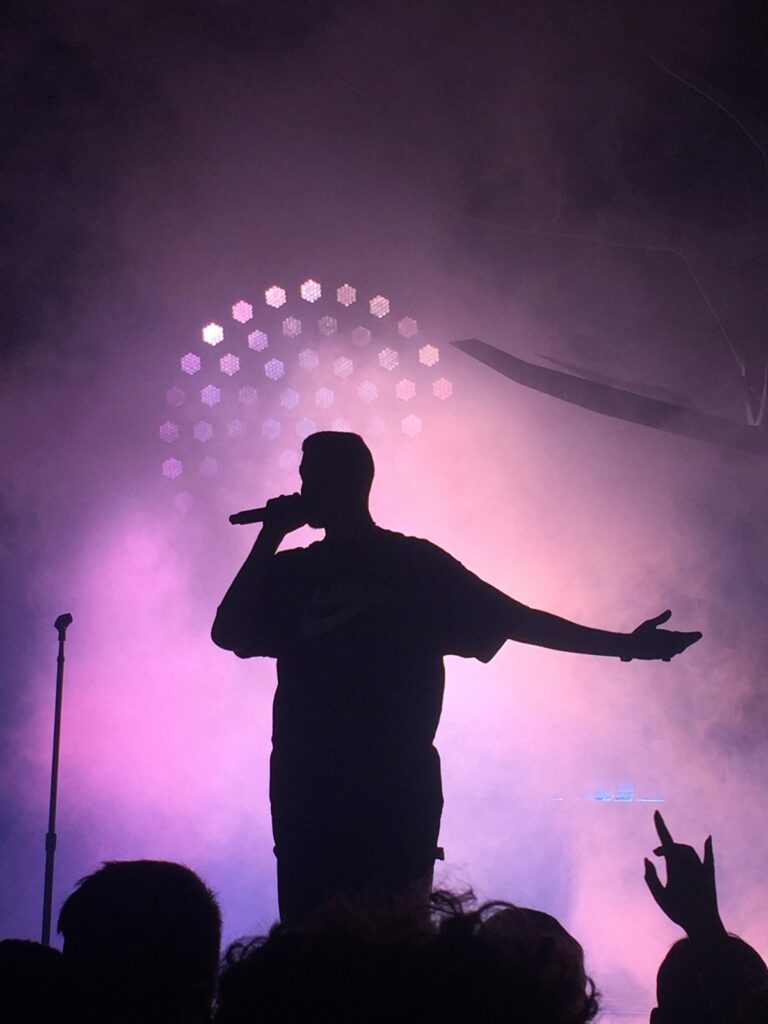
If classical and folk traditions represent one current in Arab American music, the DJ culture emerging from Arab American communities represents another — equally authentic, equally rooted. DJ Habibeats, a Lebanese-American artist performing at Coachella 2026, blends dabke rhythms, oud samples, and Arabic vocals with modern electronic production — a sound that is, as one observer put it, “authentically Arab yet universally danceable.” His presence at Coachella represents what some commentators have called a cultural milestone: the moment when Arabic rhythms entered the global festival mainstream.
How Arab Music Influences American Genres
The influence of Arab musical traditions on American popular music runs deeper than most listeners realize — and runs in both directions.
| American Genre | Arabic Influence | Key Examples |
|---|---|---|
| Jazz | Maqam scales and modal improvisation; microtonal ornamentation; non-Western rhythmic cycles | Kinan Azmeh CityBand; Arooj Aftab’s jazz-infused compositions; the Silk Road Ensemble |
| Electronic / EDM | Dabke rhythmic cycles as dance-floor architecture; oud samples as melodic hooks; Arabic vocal samples | DJ Habibeats (Coachella 2026); Bedouin duo (Burning Man, Tomorrowland) |
| Hip-Hop / R&B | Multilingual lyrics; themes of displacement and identity; Arabic melodic motifs as samples | Saint Levant; Felukah (Sara El-Messiry); Oddisee (Sudanese-American) |
| Indie Rock / Singer-Songwriter | Arabic emotional directness; diasporic themes; multilingual code-switching in lyrics | Samia Finnerty (Palestinian-American, Coachella 2026); Elyanna |
What is worth noting about this cross-pollination is that it is rarely announced as such. The best Arab American musicians are not making “Arab-influenced music” as a conceptual project. They are making music from where they stand — and where they stand is between languages, between traditions, between home and America. The hybridity is not a strategy. It is the natural result of who they are.
Playlists and Events for Arab American Heritage Month 2026
The best way to encounter Arab American music is to listen — and there has never been a better moment to do so. Streaming platforms have made music that once circulated only within diaspora communities available to anyone with a phone.
Starting points for new listeners:
- Fairuz — Begin with Ya Ana Ya Ana, Nassam Alayna el Hawa, or any compilation of her 1960s recordings. There is almost no wrong entry point.
- Kinan Azmeh CityBand — The album Live in Berlin (2025) is a good introduction to how Syrian folk music and jazz improvisation coexist in a single voice.
- Arooj Aftab — Vulture Prince (2021) and Night Reign (2024) are both accessible and deeply musical, suitable for listeners with no prior exposure to South Asian or Arab classical traditions.
- Saint Levant — His singles are available on all streaming platforms; start with “Exile” for a sense of his range.
- Elyanna — Her performances of Arabic pop with orchestral arrangements provide the clearest current example of how the tradition travels into contemporary popular music.
Events in April 2026: The Arab America Foundation maintains an updated list of cultural events, concerts, and community programming for National Arab American Heritage Month across the United States. Local Arab American community centers, mosques, and cultural organizations in cities with large Arab populations — Dearborn, Detroit, New York, Los Angeles, Houston, Chicago — frequently host concerts and musical events in April.
Music as the Language That Does Not Need Translation
The remarkable thing about Arab music’s current moment in America is not that it is gaining acceptance — it is that acceptance is increasingly beside the point. Artists like Kinan Azmeh are not asking American audiences to appreciate Arab music as an ethnographic exercise. They are asking them to listen to music that is beautiful, complex, and emotionally alive — and trusting that beauty does not require a cultural translator.
At Zy Yazan, we spend our days in the space between Arabic and English, translating not just words but the conceptual worlds embedded in them. We know from experience that some things do not translate — that the Arabic word tarab (the state of musical ecstasy induced by great singing) captures something that no English phrase quite reaches. But we also know that music itself is often the space where translation becomes unnecessary. When Kinan Azmeh plays, or when Fairuz sings, the maqam carries its meaning directly — bypassing the linguistic gap entirely, speaking in the older language that human bodies share.
This is the third article in our series on Arab American Heritage Month 2026. The next and final article explores the traditions — family, celebration, calligraphy, and folk dance — that Arab Americans carry across generations. (See our article: Preserving Arab Traditions in American Life: Family, Celebrations, and Identity)
References
- Kinan Azmeh — Official Biography
- Silkroad Ensemble — Kinan Azmeh Profile
- Wikipedia — Arooj Aftab
- Vilcek Foundation — Arooj Aftab: “My Music is World-Building”
- Grammy.com — Arooj Aftab Grammy History
- The National — Arab Artists at Coachella 2026
- Mojeh — 7 Arab Musicians Shaping the Sound of 2025
- Arab America — NAAHM 2026 Signature Event
- Zy Yazan — Arab American Heritage Month 2026
- Zy Yazan — From Hummus to Knafeh: Arab American Cuisine
Arab American Heritage Month 2026
Many Voices, One Community — Four Articles

Arab American Heritage Month 2026 — Four Articles | Zy Yazan