

Arab Holidays — A Cultural Guide for the Foreign Visitor

A cultural and touristic guide to the Arab world’s major celebrations — from Eid al-Fitr to Christmas to a New Year rooted in ancient Babylon.
When a foreign visitor plans a trip to the Arab world, they often arrive with an implicit assumption tucked inside a well-meaning question: “How do they celebrate their religious holidays?” The assumption underneath is that holidays in this part of the world are religious by definition and Islamic by default. But that framing misses half the picture — and arguably the more interesting half.
The Arab world is not a single religious bloc. It is a civilizational space whose roots go deeper than the three Abrahamic faiths that all, notably, originated in this very region. In this article we offer — through the lens of cultural observation rather than religious explanation — a map of the celebrations Arabs observe today: where they come from, how they are lived, and what each one means for the foreign visitor who wants to understand rather than simply navigate around them.
First: Understanding the Map — Arabs Are Not All Muslim
The necessary starting point: Arab identity is a civilizational and linguistic identity, not a religious one. Among the roughly 450 million Arabs today, there are Muslims — the majority — and Christians who by various estimates make up 8 to 10 percent of the region’s population, as well as Jews and other religious minorities including Druze, Yazidis, and Mandaeans. Egypt alone is home to between 10 and 20 million Coptic Christians, one of the oldest continuously existing Christian communities in the world.
The gentle irony is that the three traditions Westerners sometimes call the “Abrahamic faiths” — Islam, Christianity, and Judaism — all emerged from this exact region. Christian communities of the Middle East are among the oldest in the world, with many tracing their faith back two millennia to the foundation of the religion in what is today Palestine, Israel, and Syria. Some Christians in parts of Iraq and Syria still speak dialects of the Aramaic languages that Jesus would have spoken. Abraham himself, the shared patriarch of all three traditions, is believed in religious texts to have been born in Ur — the ancient Sumerian city in what is now southern Iraq.
In a real sense, the Middle East is not “the region that holds other people’s religions.” It is the region that exported its religious traditions to the rest of the world. That context is the key to understanding why Arabs celebrate Eid al-Fitr, Christmas, and New Year’s within the same calendar span — and why the same shortbread cookie appears on tables across all three.
The three traditions that shaped Western civilization all originated in a stretch of land not much larger than the state of Texas.
Second: Eid al-Fitr — The Feast at the End of the Fast
Eid al-Fitr arrives at the conclusion of Ramadan, the Islamic month of fasting, and is the moment when the gate reopens after thirty days of abstaining from food, drink, and entertainment from sunrise to sunset. It usually starts with Muslims going to the mosque and praying special Eid prayers, generally followed by shopping, visiting family and friends wearing new clothes and sweet perfumes, eating traditional sweet dishes, feasting, and gift-giving.
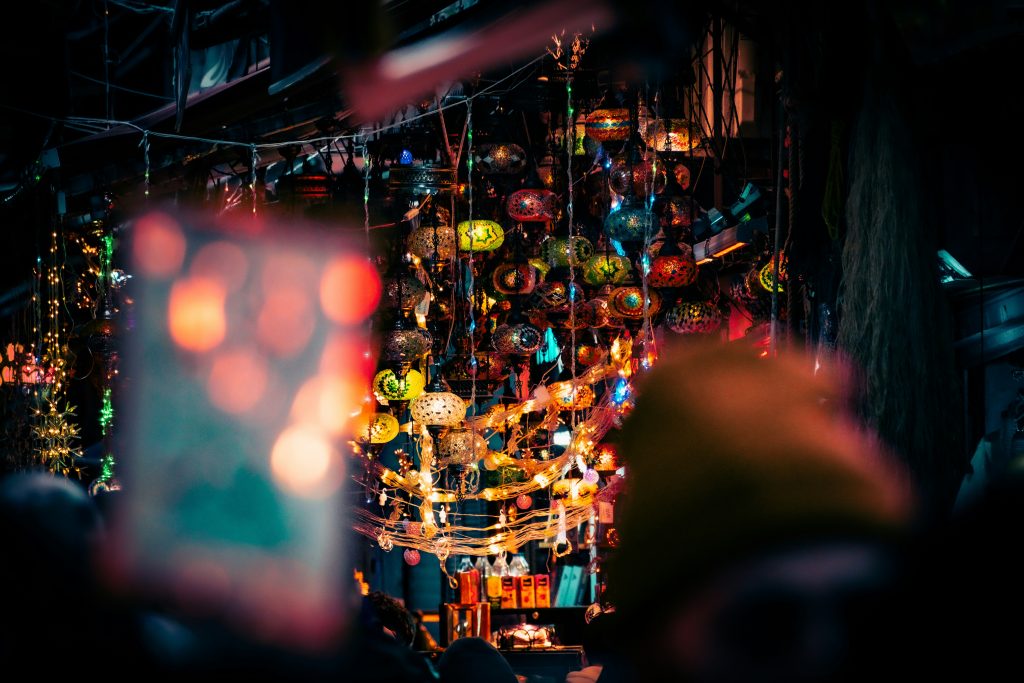
For the foreign visitor who happens to be present during Eid, the sensory experience is remarkable. The streets before dawn fill with families in their best clothes heading to open-air prayers. Children receive “Eidiyya” — gifted money from elders — and sweets tables groan under plates of ka’ek, maamoul, and baklava. Public spaces fill with colored lights and the particular sound of a city that has decided, collectively, to celebrate.
The date shifts forward by roughly 11 days each year because it follows the lunar Islamic calendar — meaning it moves through all seasons over the course of three decades. This is worth knowing for anyone planning to be present for it. The official holiday lasts three days in most Arab countries, though the festive atmosphere persists for at least a week.
Third: Eid al-Adha — The Festival of Generosity
Arriving approximately seven weeks after Eid al-Fitr, Eid al-Adha, the “Festival of the Sacrifice,” is the second of the two Islamic holidays celebrated each year worldwide and is considered the holier of the two. Its core narrative — Ibrahim’s willingness to sacrifice his son, and the substitution of an animal in his place — exists in variant form across all three Abrahamic scriptures.
What strikes the outside observer is the social architecture of the occasion. Muslims may perform an act of zakat and friendship by slaughtering a sheep or cow and distributing the meat to family, friends, and the poor. The traditional division is one third for the family, one third for neighbors, and one third for those in need. This isn’t cultural decoration — it is a religious obligation that turns the act of eating into an act of solidarity. Arab cities during Eid al-Adha are animated by this movement: doors knocked on, dishes carried between homes, neighbors who may not share blood sharing a meal.
Fourth: Christmas — The Nativity in Its Homeland
Arab Christians predate most European Christians. The Christian communities of the Middle East are among the oldest in the world, with many tracing their faith back two millennia to the foundation of the religion in what is today Palestine, Israel, and Syria. This is not historical decoration. When Arab Christians celebrate Christmas, they are doing so in the geographic cradle of the religion itself.
Christmas is officially recognized in five Arab countries — Syria, Sudan, Jordan, Lebanon, and Iraq — and is celebrated to some extent throughout the region. But the celebration extends well beyond those official borders. In Lebanon, several Muslims describe Christmas as their favorite holiday. When asked why, the answer is consistent: most other holidays in Lebanon are observed by one religious community, but Christmas belongs to everyone.
The variations in how Christmas is celebrated across the Arab world are a study in the region’s diversity. In Syria, a Christmas camel replaces Santa and his reindeer, its significance coming from the transportation of the Three Wise Men to Bethlehem. In Egypt, the Coptic Orthodox Church observes a 43-day Nativity Fast requiring abstention from meat, dairy, and eggs, ending with midnight mass. In Syria, services in Damascus’s Bab Touma and Bab Sharqi precede family visits, while some communities light small bonfires on Christmas Eve. In Iraq, Chaldean Christian families gather on Christmas Eve and one of the children reads aloud the story of the birth of Jesus in Syriac, the language of liturgy for Assyrians and Chaldean Christians.
One detail that surprises Western visitors: in many ways, a Christmas table is similar to an Eid table because the experience of food here is more cultural than religious. Ka’ek and maamoul — delicious semolina cookies filled with nuts and dates — are par for the course during Christmas, Easter and Eid alike. The same sweet bridges the two celebrations, which says something important about how deeply culture and religion are woven together in this part of the world.
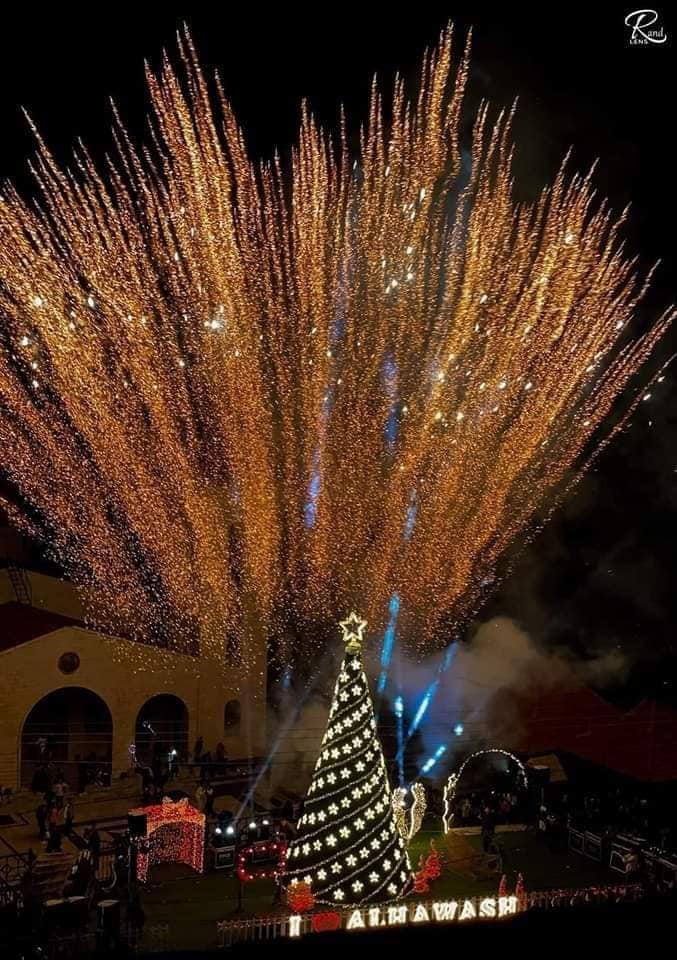
Bethlehem is not only a place in a scripture. It is a city in Palestine today, where Arab Christians celebrate Christmas in the location where the story of Christmas is set.
Fifth: New Year’s Day — A Holiday Born in Babylon
Here is the deepest layer in the story of Arab celebrations: the January 1st New Year’s festivities are not a Western import. Their roots reach directly into this region. The oldest recorded new year festivities date back to 2000 B.C. in ancient Mesopotamia, where Iraq is now. Called akitu, the festival, which could last for up to 12 days, started on the day of the first new moon after the spring equinox.
The Babylonians called the holiday “Akitu.” The weeklong celebration marked the beginning of the barley harvest, coinciding with the first new moon after the vernal, or spring, equinox. Akitu celebrations were sprawling and complex, with lots of singing and parades in the streets, and deep religious as well as political significance. The Roman calendar that Julius Caesar reformed in 46 BCE — which itself drew on Babylonian astronomical calculations — moved the New Year to January 1 and named the month after Janus, the two-faced god of beginnings. In 1582, after reform of the Gregorian calendar, Pope Gregory XIII re-established January 1st as New Year’s Day.
When Arab cities celebrate the New Year with fireworks over the Burj Khalifa or along the Beirut corniche, they are — whether consciously or not — participating in a tradition that originated in the river valleys of their own region four thousand years ago, traveled through Rome and medieval Europe, and returned to the Middle East wearing a global costume. It is less “borrowed from the West” and more “reclaimed from humanity’s oldest civilization.”
Holidays as a Gateway to Cultural Tourism
For the foreign visitor who wants to understand the Arab world in depth rather than at surface level, the holiday calendar is a rare entry point. During Ramadan you can sit at a communal iftar table in one of Cairo’s or Damascus’s squares and be welcomed as an honored guest by strangers. During Christmas you can attend midnight mass at the Church of the Nativity in Bethlehem or at a Maronite church in the Lebanese mountains and feel the weight of two thousand years of unbroken continuity. During New Year’s you can stand among tens of thousands of people from dozens of nationalities along a Gulf waterfront and understand that this region breathes at multiple rhythms simultaneously.
What surprises many visitors is not the existence of this diversity — it is its warmth. Arabs celebrate publicly, joyfully, and with a genuine openness to the stranger at the table. Their holidays are not closed to outsiders. The guest is welcomed to the feast, and this is not a courtesy — it is a foundational value in Arab hospitality that has never recognized a religious checkpoint.
A Practical Note for the Visitor
Check the dates of Islamic holidays before traveling — they shift forward roughly 11 days each year and affect business hours significantly during Eid al-Fitr and Eid al-Adha. Visiting during Ramadan is a different kind of experience: the nighttime atmosphere after iftar is extraordinary, while the daytime pace slows considerably.
For historic Christian sites, the Christmas season in Bethlehem, Byblos, Ma’loula (where Aramaic is still spoken), and old Beirut neighborhoods offers a depth of experience unavailable at any other time of year. Egypt’s Coptic Christmas on January 7 extends the season and is considerably less crowded than the December celebrations.
As for greetings: “Eid Mubarak” (blessed Eid) works for both Islamic Eids, “Eid Milad Majid” for Christmas, and “Kull ‘am wa antum bikhair” (may every year find you well) is a versatile phrase that opens doors at any occasion. Saying it in Arabic — even with a foreign accent — tends to be met with a warmth that no guidebook fully prepares you for.