
Market Trap: Commercial Fiction

A balanced analysis of commercial Arabic fiction — from Wattpad novels to Ahmed Mourad — with Western comparisons, a novel-length table, and a serious look at the attention economy and culture as a product.
“Fathers have gotten used to lowering themselves to the level of their sons out of fear, and sons imitate their fathers so they no longer fear or respect them. The teacher fears his students and flatters them, and students look down on their teachers. Young people place themselves on an equal footing with the old and compete with them in word and deed.”
This complaint does not come from an Arabic newspaper column about the decline of literary taste in the younger generation. It comes from Plato’s Republic, Book Eight, written around 375 BCE. Which means what we call today “generational decline syndrome” was a complaint nearly two thousand four hundred years ago. And the world did not collapse.
This opening is not a defense of commercial fiction — it is a way of placing it in its proper context. Before issuing verdicts, we need to understand: why does it sell? Why does it anger critics? And is all the anger justified?

Part One: Commercial Fiction — A Definition Without Judgment
In the previous articles of this series we looked at the great foundational Arab novelists, the deep roots of Arabic narrative, and models like Tayeb Salih and Abd al-Rahman Munif who embody the highest literary ambition. In the article on the prize economy we saw how awards steer writers toward specific models. Here we ask about the other side: what happens when the market, not the prizes, directs the writers?
“Commercial fiction” is not necessarily an insult. Every book that sells is in some sense “commercial.” What the term means here is the novel designed primarily to be sold — where the requirements of the market (the shocking title, the attractive cover, the fast plot, the easy language) take priority over the requirements of art (depth of character, complexity of ideas, stylistic responsibility). The difference is not in length or subject — it is in priority: is the writer writing what needs to be said, or writing what they know will sell?
Part Two: The Examples — Honest, Not Cruel
In the Arab literary scene, the commercial fiction phenomenon spreads across a spectrum:
Wattpad and digital printing: The Wattpad platform produced a generation of Arab women writers creating fiction for teenagers and young adults — romantic novels with attention-grabbing titles, usually mixing emotion with a religious or moral coating that reassures social conscience. Some of these works moved from screen to print and achieved massive sales at book fairs. Serious literary criticism ignores them, but the sales prove there is a real audience that feels spoken to.
Commercial horror and crime: Series published in large quantities at book fairs with names like “The Monster” and “The Butcher” — stories recycling global themes in simplified Arabic targeting young readers. These are the Arabic equivalent of the American Goosebumps series in their commercial logic, even if the details differ.
The special case — Ahmed Mourad: This is where simple judgment becomes difficult. Ahmed Mourad genuinely has his narrative tools — his language is cinematic and controlled, his plots are calculated. But some of his work relies on the “magic formula” for sales: crime + history + mystery + tension = millions of copies. He is “high-quality commercial fiction,” if that phrase works — what the West calls a professional best-seller. That is a classification, not a condemnation.
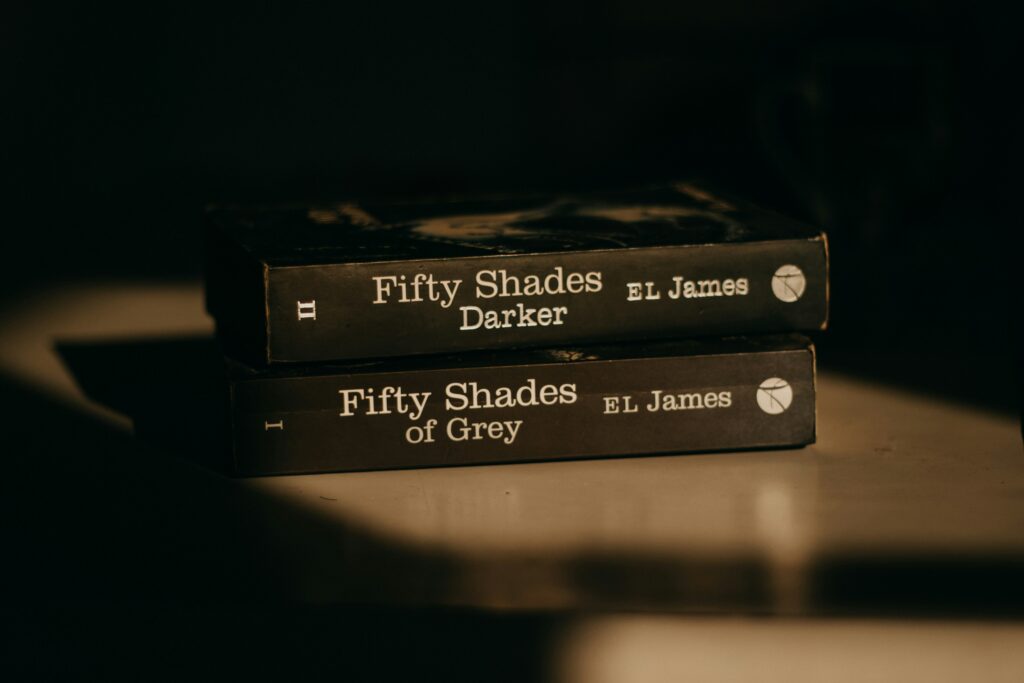
The Western counterparts are clear and well documented. Stephenie Meyer‘s Twilight series is the best equivalent — a teenage girl’s relationship with a vampire attracted millions of young readers while critics criticized its shallow language and weak characters. Nicholas Sparks writes novels “by template” following a fixed pattern — two lovers, an obstacle, a moving ending — designed precisely to draw out reader emotions. Fifty Shades of Grey began as fan fiction on the internet and became a global phenomenon built on explicit arousal as its main attraction. And Dan Brown‘s The Da Vinci Code designs its novels on cliffhangers at the end of every chapter to force the reader to continue, with deliberately simplified language.
All of these earn critical contempt — and all of them sold tens of millions of copies. This alone tells us something important: popular taste does not match critical judgment in any civilization in any era.
Part Three: Why Did the Novel Shrink? — A Comparison Table
The great classical novel was long for functional, not purely aesthetic, reasons: serial publication in weekly magazines paid writers by the word or by the line, so it was in their financial interest to extend dialogues and fill out descriptions. The absence of cinema and television made detailed description a necessity — readers needed to imagine the scene precisely. And the novel was the only platform for discussing philosophy, politics, and society in cultures with no free press.
Today, those functions have changed — and so has the size:
| Classic Novel | Pages | Contemporary Novel | Pages |
|---|---|---|---|
| Les Misérables — Victor Hugo | ~1,500 | The Alchemist — Paulo Coelho | ~170 |
| Anna Karenina — Tolstoy | ~900 | The Blue Elephant — Ahmed Mourad | ~380 |
| The Brothers Karamazov — Dostoevsky | ~800 | The Bamboo Stalk — al-Sanausi | ~400 |
| The Cairo Trilogy — Mahfouz | ~1,500 | The Girl on the Train — Paula Hawkins | ~320 |
| War and Peace — Tolstoy | ~1,200 | Memory in the Flesh — Mosteganemi | ~380 |
Reading Anna Karenina today is like “walking long distances through a forest” — a rich experience, but one that requires time, patience, and quiet. Reading modern commercial fiction is like “riding a fast car on a highway” — a quicker arrival, but the view through the window is different from the walker’s view. Both are arrivals, and the comparison is between two different experiences, not between right and wrong.
Part Four: The Attention Economy — The Deeper Enemy
The real problem is not commercial fiction itself — it is what lies behind it and what produced it: the attention economy.
A contemporary person consumes in a single day the amount of information that a person in the nineteenth century would have consumed in a month. The human brain gradually conditions itself to “fast dopamine” — immediate reception, instant reward. TikTok and Reels and Shorts built a model that is the opposite of what reading requires: fifteen seconds is enough for a decision. A novel asks you to reach page one hundred before “the real events” begin.
In this context, the long classical novel has not become “boring” because the new generation is inferior — it is because the structure of attention has genuinely changed. This is a real civilizational challenge facing serious literature in every language, not only Arabic. The difference is that civilizations with a strong reading heritage (Germany, Japan, the Scandinavian countries) resist this shift with established educational and cultural institutions that protect reading. Many parts of the Arab world did not build those institutions sufficiently before the opportunity narrowed.
Language itself is affected. Languages always evolve toward economy and compression. Classical formal Arabic competes in people’s daily lives with multiple dialects and a strange digital hybrid. Literature written in the language of everyday people — even if lower than classical Arabic — reaches more readers than literature that carefully locks its doors with linguistic keys most of the audience does not hold.

Part Five: The Collapse of Cultural Capitalism — Culture as Product
When the Soviet Union collapsed and socialist ideologies retreated, the model of “state-supported culture” ended with them. That model — despite its obvious censorship problems — produced literature removed from direct market pressure. The Soviet writer sometimes wrote out of fear of authority, but not out of fear of the audience. The writer in a world of full cultural capitalism faces a different pressure: sell or disappear.
Large commercial publishers do not run charitable operations. They look for a book that is “sellable” — and this standard gradually shapes what gets written. The talented writer who realizes their novel will sell better if they add an erotic scene or a more provocative title faces a real temptation. Some resist it and some do not.
Two exceptions worth noting: Russia and China still manage cultures with non-commercial dimensions — but even they have not escaped the product. The difference is that their culture is commodified by the state rather than by the market — a different form of the same problem.
Part Six: Prizes and Commercial Fiction — A Closed Circle
We discussed in the article on the prize economy how prizes like the Arabic Booker shape writers’ tastes and push them toward specific models. What we did not say there — and say here — is that prizes and commercial fiction appear to be opposites but share one thing: both shape writing from the outside rather than from inside the writer.
The novel written toward a prize offers “acceptable boldness” in a form targeting a judging committee. The novel written toward the market offers “acceptable excitement” in a form targeting the average mass reader. Both rob the writer of the same thing: the ability to write with complete freedom without calculating the other.
The novels that lasted are the ones whose authors wrote them without asking “will it sell?” or “will it win?” — but only asking: “Is it honest?”

Part Seven: A Legitimate Defense of “Light” Fiction
Before we end with a harsh judgment on commercial fiction, there is a counterargument that deserves respect:
The child who read Ahmed Khaled Tawfik’s horror series in the 1990s did not stay at that level — many of them later moved to Dostoevsky and Mahfouz and Kundera. “Light” fiction performed a function that serious literature cannot perform: it convinced the hesitant reader that reading is enjoyable. That is a genuine achievement that should not be dismissed.
The problem is not the existence of commercial fiction — it is the absence of an accessible alternative. When a young reader cannot find good literature within reach — at an affordable price and in non-intimidating language — they cannot be blamed for choosing the easier option. The responsibility here falls on the entire cultural environment: education, publishing, criticism, and translation — not on the reader alone.
Plato complained about generational decline in 375 BCE. And the world continued. Every generation carries its own problems and its own solutions. Good literature did not die in any era — it only changed its proportions in the cultural scene. The task is not to mourn what was, but to understand what is, and work toward what can be.
Next in the series: The Prize Economy: Shaping the Novel — how Arabic literary prizes redraw the map of what gets written.
References
- Plato, The Republic, Book Eight, trans. G.M.A. Grube, Hackett Publishing, 1992.
- Neil Postman, Amusing Ourselves to Death, Penguin, 1985.
- Tim Wu, The Attention Merchants, Knopf, 2016.
- Nicholas Carr, The Shallows: What the Internet Is Doing to Our Brains, Norton, 2010.
- (See our article: The 100 Arab Novelists Guide)
- (See our article: The Prize Economy: Shaping the Novel)
- (See our article: Edge Literature: Prisons and Exile)