Egyptian Arabic | The Dialect Everyone Understands

Egyptian Arabic dominates the Arab world not because it is the most beautiful dialect, but because Egypt produced the art that made it live in every Arab home for a century.
In the city of Tunis, in 2009, Khaled was flipping through satellite channels when an old Egyptian series caught his eye. He sat down intending to watch ten minutes and spent the entire night in front of the screen. The next day he described what he had watched to his friends — and discovered they all knew the series. Some could recite scenes from memory.
This was not strange. It was entirely ordinary.
What is genuinely worth pausing over is the opposite question: had Khaled ever studied Egyptian Arabic? Had he attended a class, opened a textbook, or listened to lessons? No. The dialect had not come to him — he had gone to it, without noticing, through songs heard in childhood, films watched in adolescence, and series that had filled his home his whole life.
That is the real question this article sets out to answer: why Egyptian Arabic, specifically?
Art Is the Answer — Not Geography, Not Politics
Consider this: is there a single English-language film or TV series you are certain every English speaker has seen? There is not. But some come close — Friends, The Lion King, Star Wars — works where someone who has not seen them feels, in conversations with other English speakers, that they are missing a shared reference. When you quote a line from Friends to an American friend, you need no explanation — the reference lives in collective memory.
This phenomenon is not unique to English. It applies to every language and every culture. And in the Arab world, the near-unanimous answer to the question “what has every Arab seen and knows?” leads, in the vast majority of cases, to an Egyptian work — a song by Umm Kulthum, a film starring Adel Imam, a series produced in Cairo.
This is the real reason Egyptian Arabic dominates. Not because Egyptians have a superior accent or a more beautiful dialect — but because Egypt produced, over an entire century, an enormous body of literature, art, cinema, and music. Its dialect became the vessel into which all that culture was poured, and the dialect then moved into every Arab ear before anyone had noticed they were learning it.
A dialect does not spread because it is sweeter — it spreads because the art written in it is wider, deeper, and more present in the rooms and kitchens and cars and hours before sleep.
118 Million — When Numbers Multiply Effect
If the hypothesis holds — that art is what spreads a dialect — then what made Egypt the largest producer? This is where numbers enter the picture.
Egypt’s population in 2025 stands at approximately 118 million people, making it the most populous Arab country and the thirteenth largest in the world. Syria, by comparison, has a population of around 25.6 million — meaning Egypt alone is roughly four and a half times the size of Syria. If you add Syria, Lebanon, Jordan, and Palestine together — the entire Levantine bloc — their combined population still falls short of half of Egypt’s.
The entire Arab world numbers approximately 400 million people — and Egypt alone represents more than a quarter of that total.
| Country | Population (approx.) | Share of Arab World |
|---|---|---|
| Egypt | ~118 million | ~29% |
| Algeria | ~47 million | ~12% |
| Sudan | ~47 million | ~12% |
| Iraq | ~43 million | ~11% |
| Morocco | ~38 million | ~9% |
| Saudi Arabia | ~36 million | ~9% |
| Syria | ~25.6 million | ~6% |
| Arab World (total) | ~400 million | 100% |
What this number means in practice: a larger domestic audience generates more production. More production generates wider reach. Wider reach means the Egyptian dialect arrives in every Arab home, given enough time. Quantity produced quality, and quality produced reach.
But — and this is what many overlook — numbers alone are not sufficient. Morocco and Algeria and Sudan each have populations in the tens of millions, and their dialects have not achieved the same pan-Arab presence. The reason circles back to the first point: artistic output. Egypt combined a large population with early, sustained, and accumulated cultural production — and the effect was compounded.
(See our article: Arabic Is Twenty Languages Inside One — At Least) — for how dialects compete and coexist in the Arab cultural space.
Where Did Egyptian Arabic Come From? — Layers upon Layers
Egyptian Arabic is not pure Arabic — it is Arabic that absorbed thousands of years of history predating Islam. When the Islamic conquest reached Egypt in the seventh century CE, it found a land that spoke Coptic — the last living descendant of the ancient Egyptian and hieroglyphic language. Over centuries of contact, the two languages blended, and the traces of that blend are still visible today:
- “aywa” (yes) — derived from Coptic aio — absent in Classical Arabic and most other dialects in this form
- “ēh” (what) — also Coptic in origin — while Classical Arabic uses mādhā and Levantine uses shū
- “khāliṣ” meaning “completely” or “finished” — used in Egyptian with an intensity and frequency found nowhere else
- Many village and region names in Upper Egypt and the Delta carry Pharaonic-Coptic roots, embedded permanently in the geographic vocabulary
Beyond that, Egypt lived through a long modern period of European presence — Greek, Italian, French, and British — and foreign words entered the dialect and became so thoroughly Egyptianised that their origins are invisible at first glance:
- “ōtōbīs” — from French autobus
- “kūbrī” (bridge) — from Italian copri
- “bēh” and “bāshā” — Ottoman titles repurposed as everyday address terms
-

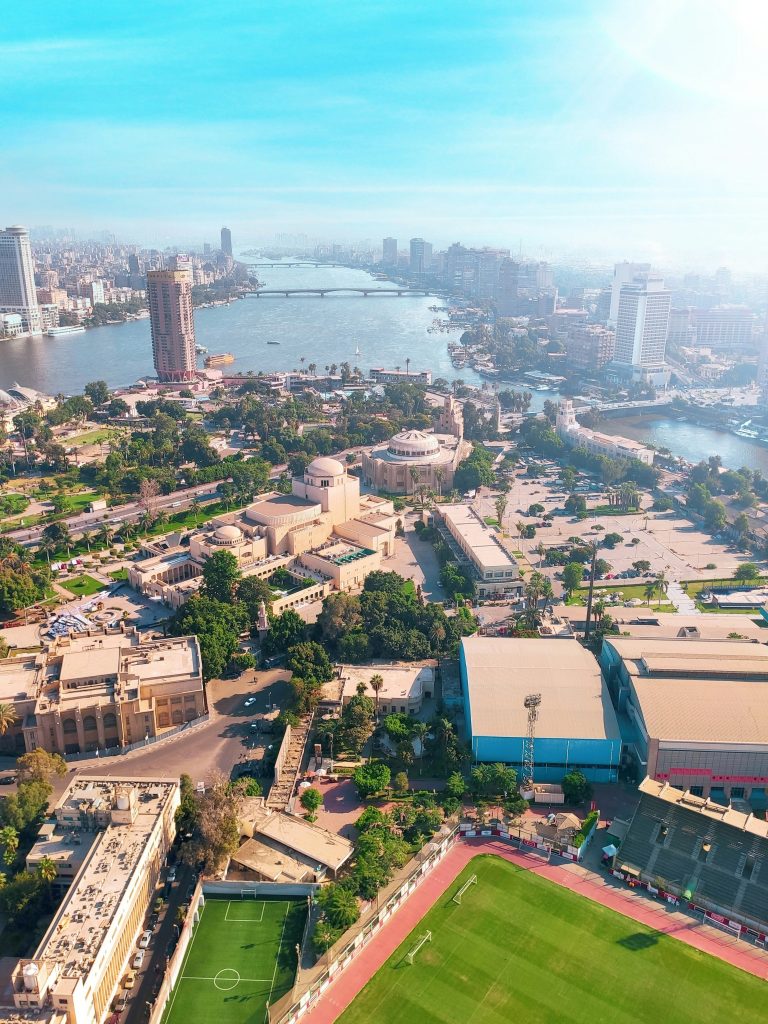
Cairo, Egypt
The Sound of Egyptian Arabic — What Makes It Instantly Recognisable
Even with no knowledge of Arabic at all, you would know an Egyptian speaker the moment they open their mouth. Egyptian Arabic has a sonic signature unlike any other dialect, and its most prominent features are:
The Qāf That Became a Glottal Stop
In Classical Arabic and many dialects, the letter qāf is pronounced as a deep velar stop (q from the back of the throat). In urban Cairene Arabic, the qāf becomes a glottal stop — a soft pause in the airstream. So qalb (heart) becomes ʾalb; qāl (he said) becomes ʾāl; qahwa (coffee) becomes ʾahwa. This single phonetic shift changes the entire texture of the dialect and gives Egyptian Arabic its characteristic softness.
The Hard Jīm — Egypt’s Exception
While the letter jīm softens into a y or zh sound in many Levantine and Gulf dialects, Egyptian Arabic preserves the hard classical j: “jāmiʿa” not “yāmiʿa”, “jamīl” not “yamīl”. This is precisely what gives Egyptian Arabic its decisive, grounded sonic character compared to the more liquid sound of Levantine.
The Rising Intonation
Egyptian sentence melody tends to rise at the end of questions and exclamations — giving Egyptian speakers their characteristic expressive, animated quality that every foreigner who has dealt with Egyptians immediately notices.
Egyptian Arabic in the Table — A Comparison
| Meaning | Classical | Egyptian | Levantine | Gulf |
|---|---|---|---|---|
| How are you? | kayfa ḥāluk? | izzayyak? / ʿāmil ēh? | kīfak? | kayf al-ḥāl? |
| Yes | naʿam | aywa | ī / āh | ēh / āh |
| What? | mādhā? | ēh? | shū? | ēsh? |
| Now | al-āna | dilwaʾti | hallaʾ | al-ḥīn |
| Tomorrow | ghadan | bukra | bukra | bāker |
| Thank you | shukran | shukran / mashkūr | yislamu | yiʿṭīk aṣ-ṣiḥḥa |
| Good morning | ṣabāḥ al-khayr | ṣabāḥ al-fūl | ṣabāḥ an-nūr | ṣabāḥ an-nūr |
| Good / Fine | jayyid | kuwayyes / tamām | mnīḥ / tamām | zayn |
| This | hādhā | da | hād / heyda | hādhā |
What this table reveals is that Egyptian Arabic occupies a curious position: it is phonetically further from Classical Arabic than Levantine in some vocabulary (like da for “this” instead of hādhā, or ēh for “what”), yet it remains the most widely understood. The explanation is familiarity — not linguistic proximity.
When Levantine Is Subtitled for Egyptians — but Not the Other Way Around
There is a paradox that reveals the scale of Egyptian dominance beyond any argument: when Bab al-Hara — the Syrian series that became one of the most-watched in Arab television history — was broadcast and re-run, some versions required explanatory notes or adaptations to ease comprehension for Egyptian viewers less familiar with Levantine Arabic. But when Egyptian productions air in Syria, Lebanon, and Jordan, no one needs any assistance — Levantine audiences understand Egyptian Arabic the way they understand their second language.
This is not a statement about quality. It is a statement about asymmetric familiarity — and the cause is time. Egyptian works came first, multiplied, and accumulated.
The deeper current runs the same way: when a Gulf or Moroccan creator wants to reach a pan-Arab audience, they frequently choose to write in Egyptian Arabic or approximate it — not because they find it the most beautiful, but because it travels furthest.
Egyptian Arabic was never imposed — it spread. And the difference between those two things is what makes its dominance a cultural phenomenon, not a political one.
Umm Kulthum and Abdel Halim — When a Dialect Becomes Memory
No account of Egyptian Arabic’s reach can avoid the two largest forces behind it: the voice and the screen.
Umm Kulthum — whom musicians have described as the greatest voice in Arab history — was not simply a singer. She was a social phenomenon. Her monthly concerts on the first Thursday of each month stopped life in Egypt, Syria, Iraq, the Gulf, and Morocco. The radio carried her voice into every home, and with it the words of her songs in Egyptian Arabic. When a Moroccan or Kuwaiti or Lebanese child hears Umm Kulthum’s voice ten times, a hundred times, a thousand times, the Egyptian dialect seeps into their sonic memory before they have learned to read.
Abdel Halim Hafez added a different dimension: youth. His romantic songs reached a generation not yet moved by Umm Kulthum. And Adel Imam came after both of them to make Egyptian Arabic a vehicle for comedy and social criticism — a form of art that crosses borders faster than any other, because laughter requires no translation.
A Century at the Top
Egyptian cinema began in the 1920s and reached its peak in the 1950s and 60s with films that have become cultural references requiring no introduction for any Arab: works by Farid Shawqi, Salah Zulfikar, and Soad Hosny. These films are still re-shared, quoted, and clipped on social media today — seventy years after their production.
When linguists write about the spread of Egyptian Arabic, they always return to this fact: people acquire the language they hear when they are happy, moved, or entertained — not the language they study in a textbook. Cinema and music are where people learn without knowing they are learning.
(See our article: Dialect Prompting | How to Force AI to Respect Egyptian, Levantine, and Gulf Arabic) — if you work with Arabic content and need to navigate dialect distinctions in AI writing.
Six Words That Open a Door
If you are travelling to Egypt or working with Egyptian partners, these six words will make you liked before you finish your first sentence:
- “aywa” — yes. Say it with warmth and you will surprise your companion.
- “tamām” — great, all good. Works in every situation.
- “ṣabāḥ al-fūl” — the morning greeting response. Fūl is the jasmine flower — and that alone tells you something about the spirit of the language.
- “māshi” — OK, agreed. The most flexible word in Egyptian Arabic.
- “yalla” — let’s go. Used for encouragement, hurrying, and farewell all at once.
- “boṣṣ” — look / listen. Egyptians say this before making an important point.
Pair these words with a smile and you will discover that Egyptians are among the most welcoming people on earth toward anyone who tries to speak their language, even in two words.
What Comes After Egyptian?
If Egyptian Arabic is the dialect of the masses — broad, joyful, and universally familiar — there is another dialect that occupies a different place in the Arab heart: Levantine. The language of psychologically deep drama, of romantic poetry, and of the voice that is recognised by its softness even by those who do not understand a single word being spoken.
In the next article we will ask: why is it that when a love poem or a deeply moving scene is written in Levantine Arabic, Arabs across the Gulf and Morocco feel something touch their heart before it reaches their mind?
📽️ The School of Mischief — The Play Every Arab Has Seen
Written by Ali Salem and first performed in 1973, starring Adel Imam, Saeed Saleh, Younes Shalaby, Ahmed Zaki, and Sohair El-Babyy. Five incorrigible students have driven every headmaster to resignation — until a new teacher arrives with a different approach. Loosely adapted from the British film To Sir, with Love, the Egyptian play became a far bigger cultural phenomenon in the Arab world than its source material ever was in the West. It is still broadcast every Ramadan and on public holidays, as if it were produced yesterday. If you want to understand why Egyptian Arabic travels so far, watch ten minutes of this.
💡 To watch with subtitles: click the ⚙️ settings icon at the bottom of the video → Subtitles/CC → Auto-translate → select your language. The automatic translation is imperfect but captures enough of the humour to make it worthwhile.
🎬 The play is also available on Netflix as The School of Mischief — better quality and with official subtitles.