
Hundred Years of Mishima — Why Does the World Read Him More Today Than When He Was Alive?

One hundred and fourteen works across twenty-six years — novels, plays, poetry, criticism. Then, on the same day he delivered the final page of his tetralogy, he ended his life. Yukio Mishima did not merely write about impermanence — he made his life his final manuscript. In the year of his centenary, the world seems more ready than ever to understand the questions he was asking.
In the year of his centenary, Yukio Mishima returns to prominence in ways he never knew in his lifetime. Not because the world has changed — but because it has finally come to understand the questions he was asking.
One Writer, One Hundred Works, a Voice That Resembles No One
I’ll begin with a simple question: how many writers do you know who produced, in twenty-six years of active writing — between the age of eighteen and his mid-forties — more than a hundred works: novels, plays, poetry, short stories, criticism, and essays?
The number alone is difficult to absorb. But what is more difficult still is that these hundred works do not read as if they come from the same writer. To read Confessions of a Mask, then The Temple of the Golden Pavilion, then open the first volume of The Sea of Fertility is to stand before three voices radically different in style, narrative voice, and structure — held together by something one cannot easily name.
That something is Mishima.
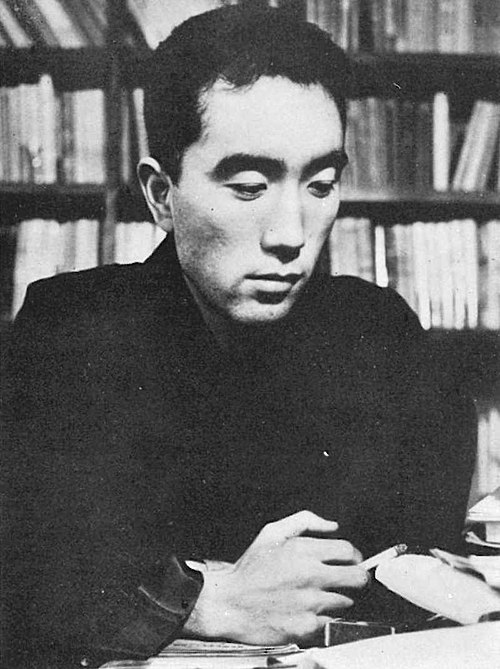
Yukio Mishima was born in 1925 in Tokyo under the name Kimitake Hiraoka. His early literary maturity was such that his teacher carried his first pages secretly to a literary magazine when he was sixteen, fearing the reaction of his conservative father. Kawabata Yasunari — the first Japanese writer to receive the Nobel Prize — was the man who opened the door to publication for him, and said of him what he said of no one else:
“A writer of this weight does not appear more than once every two or three centuries.”
Three Styles, One Soul
When I return to reading Confessions of a Mask, published in 1949, I find myself before a text that resembles a genuine confession more than a novel. The narrator speaks in first person directly — a young man discovering his nature in a society that offers him no space for it. But what makes this text literature rather than mere memoir is its central question, which unsettles the ground beneath the reader: is what I feel what I actually feel — or is it what I have learned to feel?
The boundary between mask and face in Mishima was never clear — and he never intended it to be.
Then comes The Temple of the Golden Pavilion in 1956, as though from another writer entirely. The novel is built on a true incident — a Buddhist monk burned Kinkaku-ji, Japan’s most beautiful temple, in 1950. Mishima does not ask: why did he do it? He asks a deeper and harder question: what does absolute beauty do to you? Does it liberate you, or does it paralyze you? He writes through his narrator:
“The longer I looked at beauty, the more I felt it was imprisoning me. As if the beautiful thing were saying: you cannot live beside me, and you cannot walk away from me.”
The burning at the end is not a crime — it is a liberation.
Then comes The Sea of Fertility to gather everything and surpass it. Four novels written between 1965 and 1970 with different narrators, multiple voices, and distant time periods — yet all circling a single question about repetition, meaning, and impermanence. As though the hundred previous works had been practice for this.
The Writer Who Wrote in Every Grammatical Person
What strikes any attentive reader of Mishima’s work is his exceptional ability to shift narrative voice without losing his own. In a single work he will move from first person to third person to collective first — not as a stylistic error but as a deliberate technique.
In Confessions of a Mask he writes:
“I kept wondering whether my feelings were real, or whether I was playing a role in a play I had not chosen to be in — but could not leave.”
In The Temple of the Golden Pavilion he writes in third person about his protagonist:
“He did not hate beauty. He hated that beauty existed, and he could not become it.”
And in The Sea of Fertility, certain passages are written in “we” — a collective voice that includes the reader without asking permission. This movement between grammatical persons is not formal experimentation for its own sake. It is a philosophical position: the self is not fixed, the narrator is not to be trusted, and truth always lives somewhere between what the text says and what it withholds.

One Hundred Works: Numbers That Defy Belief
I write this paragraph while trying to absorb a single figure: one hundred and fourteen published works. Long novels, short stories, stage plays, poetry, critical essays, screenplays, political articles — all of this across twenty-six years. Which means he produced, on average, more than four works per year, without a single pause.
But the number most worth contemplating is this: most great writers master a single form. Dostoevsky wrote the novel. Chekhov wrote the short story and the play. Mishima excelled at everything — and his plays, built on the classical Japanese Noh tradition, left a mark on world theatre no smaller than his novels. All this while managing his private militia, building his body as a project parallel to his writing, acting in films, and conducting a very public social life in Tokyo.
Who was doing the writing?
The Japan That Produced Him: Defeat as Inspiration
Mishima cannot be understood apart from a single moment: September 2, 1945, when Emperor Hirohito signed the formal surrender. For the first time in its history, Japan was defeated. Not only militarily — but in the collapse of an entire idea about itself. The divine emperor became human by the stroke of a pen. The samurai who had died for honor became mere casualties of a lost war. The civilizational superiority Japan had believed in turned to ash over Hiroshima and Nagasaki.
From that ash emerged three writers representing three different responses to the fall:
Dazai Osamu chose to accept the collapse — he wrote about dissolution, loss, and shame as an honest response to a defeat beyond dispute, and killed himself in 1948.
Kawabata Yasunari chose nostalgia — he wrote about the fading beauty of an older Japan, received the Nobel Prize in 1968, and killed himself in 1972, two years after Mishima’s death, leaving no explanation.
Mishima chose refusal — he refused the defeat, refused the soft American occupation, refused the postwar Japan that had betrayed its own soul in exchange for economic prosperity.
All three killed themselves. This alone says something about the sharpness of the questions their era placed before those who lived it with full awareness.
From Tokyo to Seoul: The Hidden Inheritance
When I watch a Korean series today — and South Korea now leads the global cultural scene in ways no one anticipated — I wonder how many viewers know they are consuming, in some part, a Japanese inheritance reimagined.
The full picture begins with China, which gave Japan its writing system in the fifth century CE through Korean immigrants. Japan then developed its own script and wrote the first novel in human history — The Tale of Genji, in 1008 — written by a woman. Then came the twentieth century with its defeat and its writers: Dazai and Kawabata and Mishima and everything they produced.
Then came Japanese manga to carry these values across all of East Asia — family, loyalty, loss, honor, relationships between generations. These are not purely Japanese values; they are shared Eastern ones that found in manga a form ready for export.
South Korea exports to the world today, but it builds on this foundation. The film Oldboy, directed by Park Chan-wook and winner of the Grand Prix at Cannes in 2004, is in its origins an adaptation of a Japanese manga of the same name, published between 1996 and 1998. The Korean film surpassed its source and became one of the greatest films in cinematic history. The American remake directed by Spike Lee in 2013, under the same title, failed to produce a fraction of the original’s impact — further evidence that major works have a homeland that cannot be relocated.
And Squid Game is another example — a globally resonant series whose structural foundations trace back to the survival and social conflict themes that postwar Japanese literature first mapped and claimed.
But if you want the origin — the unnamed father — postwar Japan is the place. And Mishima is the one who gave that era its loudest and most enduring voice.
Why the West Ignored Him — and Reads Him Today
The answer to the headline’s question is not complicated: the West ignored Mishima because it could not place him in a category. He was not only a novelist. Not only a political thinker. His writing was not entertainment, not protest, not a clean autobiography. He wrote about beauty and death and honor and the body in a way that required the reader to surrender their certainties — and this is not what the average Western reader does willingly.
Today — in the year of his centenary — the world reads him because the questions he asked have become everyone’s questions. What does the body mean? Is identity a mask or a face? What does beauty do to the one who sees it? How do you continue building meaning inside a world that announces its own meaninglessness?
These are the questions of 2025 as much as they were questions of 1950. And Mishima — who answered them across one hundred and fourteen works before answering them with his life — looks more contemporary today than he did in his own time.
Closing: The Morning of November Twenty-Fifth
On the morning of that day in 1970, Mishima delivered the manuscript of the fourth and final volume of The Sea of Fertility to his publisher — the last pages of a work he had begun in 1965, five years of writing that carried everything he had lived and thought.
Then he left his home with four members of his private militia — the Shield Society — heading for the headquarters of the Japan Ground Self-Defense Force in the Ichigaya district of Tokyo. He and his followers overpowered the base commandant and took him hostage. Mishima stepped out onto the balcony and addressed approximately a thousand soldiers assembled below him, calling on them to rise and reclaim the true spirit of Japan. They answered with jeers and heckling. He ended his speech in seven minutes, having planned for thirty. He returned inside, apologized to the captive commandant, and ended his life through seppuku — the samurai’s ritual of honorable death — at forty-five years old, at the peak of his creative and physical powers.
That same night, when police searched his home, they found on his desk a note in his own handwriting:
“Human life is limited — but I would like to live forever.”
The man who wrote a hundred works about impermanence, repetition, beauty, and death — completed his text himself. And left the note.
A hundred years after his birth, his works are still read with pleasure and astonishment — as though they were written today.
Glossary
Yukio Mishima — pen name; born Kimitake Hiraoka, Japanese novelist, 1925–1970. Nominated five times for the Nobel Prize in Literature.
(三島由紀夫)
Kawabata Yasunari — Japanese novelist, first Japanese writer to receive the Nobel Prize in Literature, 1968. Died by suicide in 1972.
(川端康成)
Dazai Osamu — Japanese novelist, one of the leading voices of postwar Japanese literature. Died in 1948.
(太宰治)
Seppuku — a historical Japanese ritual of honorable death by sword, practiced by the samurai class; abolished in the modern era. Mishima’s death in 1970 was the last known instance.
(切腹 — also known in the West as harakiri)
The Sea of Fertility — the name of a real region on the lunar surface containing neither water nor life, chosen by Mishima as the title of his final tetralogy.
(Mare Foecunditatis — 豊饒の海)
Noh Theatre — one of the oldest forms of classical Japanese theatre, built on masks, slow movement, and poetry.
(能楽)
Park Chan-wook — South Korean film director, winner of the Grand Prix at Cannes 2004 for Oldboy.
(박찬욱)
Oldboy — 2003 Korean film directed by Park Chan-wook, adapted from a Japanese manga of the same name (1996–1998). Considered one of the greatest films in world cinema. The 2013 American remake directed by Spike Lee failed to replicate its impact.
(올드보이)