Poem | “She Came, My Tormentor” — Lisan al-Din Ibn al-Khatib
From a medieval Andalusian court to the algorithms of 2025 — the classic Arabic poem “She Came, My Tormentor” has been sung by Fairuz, Kazem Al-Saher, and now an AI virtual singer named Dunya Amir. A literary and philosophical reading.
She Came, My Tormentor
A Meeting Across the Veil of Time: From the Shadows of Andalusia to the Light of Algorithms
Some poems are written to mock time itself. They are born in one era, sung in another, and then reshaped by machines in a third — living creatures that breathe across the centuries. This is precisely what happens when we listen today to the poem “She came, my tormentor, through the twilight’s deep” performed by the virtual singer “Dunya Amir.” We are not simply hearing a piece of ambient digital music; we are witnessing a dialogue that spans centuries — one in which the anguish of medieval Andalusian love poetry collides with the cool, bodiless precision of modern technology.
Let us dive into the details of this artistic and historical canvas, tracing the journey of these words from the poet’s manuscript to Fairuz’s voice, and onward into the age of generative AI.
The Full Poem: A Dialogue of Night and Daring
This poem reads like a compressed short story wrapped in the formal metres of classical Arabic prosody. It moves dynamically through direct dialogue between two lovers who defy the darkness and the night guards together. Below is a verse-by-verse English rendering, with end-rhymes preserved throughout:
She came, my tormentor, gliding through the twilight’s deep,Like a radiant star that the horizon could not keep.I said: “You have lit my darkness, finest guest of night —”“Did you not fear the guards who haunt the road’s dim sweep?”She answered, her tender eyes arriving before her speech:“Those who sail the sea have no cause to weep.”I said: “These are pretty words — a tale too well arranged,”“Invented lines rehearsed, from a story planted steep.”She said: “By my eyes — the noblest oath that I can swear —”“And by the pearl of sweat that crowns my brow in sleep:”“I love you with a love that shall know no end,”“As long as in my heart there lives one last heartbeat’s leap.”I rose, consumed with longing, and went to her to kiss —I drew aside the veil, and saw the moon in my arms to keep.I kissed her; she kissed me; and still upon my lips she said:“You’ve kissed my face — now don’t let my neck be cheap.”I said: “Embracing is forbidden by our law, my dear.”She said: “My lord — then place that sin on my neck to reap.”
The Historical Dispute Over Authorship
Despite the poem’s apparent simplicity and sweetness, historians and literary critics have long disputed its true authorship. The majority of sources attribute these verses to the celebrated Andalusian poet and statesman Lisan al-Din Ibn al-Khatib (also the author of the immortal muwashshah “Jadaka al-Ghayth”), whose language is known for its delicate sensory imagery — the hallmark of the refined courts of Granada and Córdoba. Other sources, however, attribute the poem to the Abbasid-era poet Al-Hajari Al-Irbili. This uncertainty between the Abbasid East and the Andalusian West lends the poem an almost magical aura, making it a traveler across the full geography of the classical Arabic literary tradition.
The Musical Journey: From Fairuz’s Dignity to Al-Saher’s Drama
Long before these verses reached the algorithms of the twenty-first century, they passed through human voices that shaped the soul of modern Arabic song:
- Fairuz (Classical Authenticity): In the 1960s, the Syrian composer Muhammad Muhsin selected the poem’s first three couplets and arranged them for a full orchestra with Fairuz’s voice. Her performance was marked by solemn classical restraint — she focused on the scene of the nocturnal visit and the lover’s defiant reply (“those who sail the sea have no cause to weep”), setting aside the poem’s more sensory dialogue to suit the formal aesthetic of the Rahbani theatrical tradition of that era.
- Kazem Al-Saher (Emotional Drama): The Iraqi “Emperor of Arabic Song” later revived the poem in his signature dramatic style, exploiting its inherently theatrical dialogue structure. He highlighted the tension between the lover’s apprehension and the beloved’s audacity through rich vocal shading that restored the poem’s kinetic pulse.
- Masters of the Muwashshah Tradition: Singers of classical Arab maqam music — including the late Sabah Fakhri — incorporated these verses into improvised sessions of tarab, drawn by the poem’s flexible metre and its natural suitability for melodic ornamentation and maqam improvisation.
“Place That Sin Upon My Neck”: The Peak of Poetic Wit
The poem’s narrative and rhetorical genius reaches its height in the transition from an atmosphere of social and political tension — embodied in the guards and the night’s darkness — to the pure realm of courtly flirtation and linguistic sleight-of-hand. The final couplet stands as the poem’s masterstroke:
“I said: Embracing is forbidden by our law, my dear —
She said: My lord, then place that sin upon my neck to bear.”
This closing exchange is built on a perfect pun layered with wordplay and concealed rhetorical paradox, centered on the Arabic word (ʿunuqī), which carries two entirely distinct meanings:
- The Physical, Sensory Meaning: In the line that precedes it, the beloved asks him not to deny her neck (the physical body part) his embrace.
- The Figurative, Legal Meaning: When the lover hides behind a moral or religious scruple — “embracing is forbidden by our law” — she disarms him with a linguistically razor-sharp rejoinder: “place it upon my neck.” This is a classical Arabic idiom meaning I take full responsibility; let the sin and its consequences rest with me on the Day of Reckoning.
The beloved here is no passive figure. She leads the adventure, commands the argument, and uses the very language of moral accountability to dissolve her hesitant lover’s fears — turning a supposed “transgression” into a nimble exercise in rhetoric.
The “Dunya Amir” Phenomenon: When a Machine Sings Human Longing
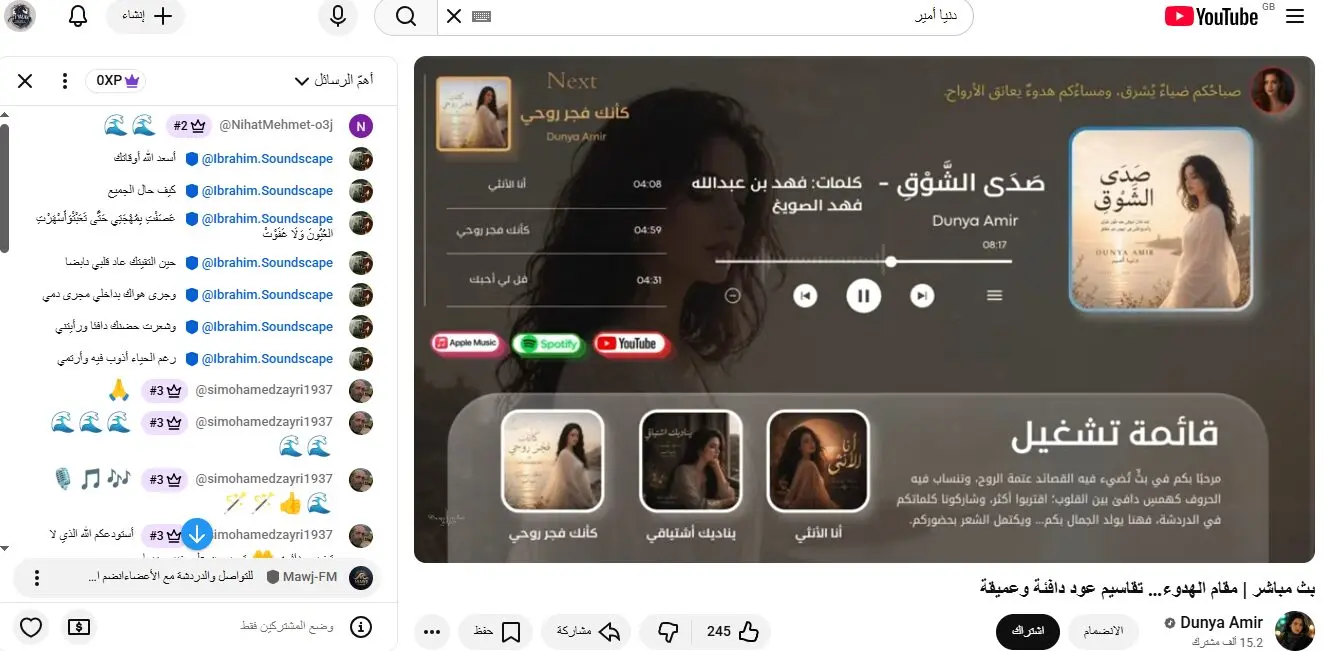
Around 2025 and 2026, a mysterious artistic persona named “Dunya Amir” began appearing across digital streaming platforms — YouTube, Spotify, and others. She stood out for a prolific output of lyrical and Sufi-tinged sung poetry delivered in a quiet Lo-Fi style, blended with classical Eastern instruments such as the oud and the ney.
The technical truth that may unsettle the traditional listener is this: Dunya Amir is not a human singer at all. She is a fully virtual persona — an AI avatar — with a voice generated entirely through contemporary generative AI technology.
Behind this project stands a digital Arabic production studio (comprising developers and musicians from the Gulf and Egypt), whose stated goal is to recycle the classical Arabic poetic heritage into modern musical formats that speak to internet-native generations seeking calm, ambient music for relaxation and study.
The production process involves feeding locally-developed voice models the verses of classical Arabic poetry — with full diacritical marks added to guarantee accurate pronunciation — and then layering the resulting voice with low-beat musical arrangements. The absence of a human body here does not cancel the emotion; instead, it raises a profound philosophical question: If algorithms can move us with the words of Ibn al-Khatib, does creativity reside in the throat that performs — or in the word that has endured for seven centuries?
Listen to the Song
We leave you with this unique digital experience — where the authenticity of Andalusian verse, the elegance of a modern arrangement, and the virtual voice of Dunya Amir converge:
She Came, My Tormentor — Dunya Amir
(See our article: جاءت معذبتي — النسخة العربية)