Project Hail Mary: How Science Saved Humanity from the Sun’s Extinction

A comprehensive analysis of the sci-fi epic “Project Hail Mary,” exploring how Ryland Grace uses the laws of physics and an unexpected cosmic friendship to save Earth from a solar disaster.
Word Count: Approx. 1,320 words · Estimated Reading Time: 11 minutes
Project Hail Mary: How Science Saved Humanity from the Sun’s Extinction
From Page to Screen: Ryland Grace’s Journey into the Deep Reaches of Space

1. Introduction: The Return of the Science Whisperer, Andy Weir
In the landscape of modern literature, few authors possess the uncanny ability to transform a complex chemical equation into a heart-stopping moment of suspense. Andy Weir is the undisputed master of this craft. Following the stratospheric success of The Martian, which became a global cinematic icon, Weir faced the “sophomore” challenge of surpassing a story about a lone man surviving the Red Planet. The answer arrived in the form of Project Hail Mary.
Rather than merely repeating the survival formula, Weir raised the stakes to encompass the potential extinction of the entire human race. Today, Project Hail Mary stands as a cornerstone of science fiction in the last decade, seamlessly blending rigorous “Hard Sci-Fi” with a deeply moving human narrative. It is a story that rejects traditional brawn-based heroism, instead sanctifying the scientific method as humanity’s ultimate tool for salvation. This article explores the odyssey that began as ink on a page and culminated in breathtaking visual effects on Hollywood screens in 2026.
2. The Plot: Waking Up in a Cosmic Nightmare
The narrative begins with an existential jolt. The protagonist, Ryland Grace, awakens in a sterile, white medical bay, surrounded by automated machinery and the mummified remains of two crewmates. The primary obstacle isn’t just the isolation—it is that Grace has no memory of who he is, where he is, or why he is aboard a spaceship in the first place.
As fragments of his memory resurface, the magnitude of the catastrophe is revealed: Earth is dying. A microscopic extraterrestrial organism known as “Astrophage” has begun feeding on the Sun’s energy, dimming its output at a rate that will trigger a global ice age and total societal collapse within decades.
The project was dubbed “Hail Mary”—a term borrowed from American football referring to a desperate, last-second long pass. Grace is humanity’s final, yoked effort; a man sent on a suicide mission to a distant star system that holds the only clue to stopping the solar parasite.

3. Andy Weir’s Genius: The “Science” of Survival
“I’m a scientist! I’m going to science the snot out of this!”
In Project Hail Mary, science is not mere window dressing; it is the protagonist. While most Hollywood space heroes survive through combat or supernatural luck, Ryland Grace uses physics, chemistry, and biology as his primary weapons. Weir’s brilliance lies in his ability to make the audience feel a rush of adrenaline when a complex equation is solved or a biological property is discovered.
The commitment to real-world physics makes the story incredibly grounded, echoing the realism found in The Expanse, where inertia and gravity are central to the tension. Yet, Weir adds his signature flavor: biting sarcasm. This balance between the gravity of looming death and the protagonist’s snarky resilience creates a narrative rhythm that makes even the most dense theoretical physics feel like a high-stakes thriller.
4. Characters and Connections: The Emotional Heart
Ryland Grace is an unconventional hero. Originally a middle-school science teacher who left a career in molecular biology, his evolution from a man who fears responsibility to the savior of billions is a profound psychological arc.
However, the beating heart of the story lies in “The Unexpected Companionship.” Mid-mission, Grace discovers he is not the only intelligent life form seeking a solution to the Astrophage crisis. Without venturing into spoilers, the bond that forms between Grace and an alien entity redefines the concept of friendship. This element evokes the thematic depth of Arrival, where understanding “The Other” through linguistics and empathy becomes the only path to survival. It serves as a reminder that intelligence and compassion are universal constants.
5. From Page to Screen: The Lord and Miller Vision
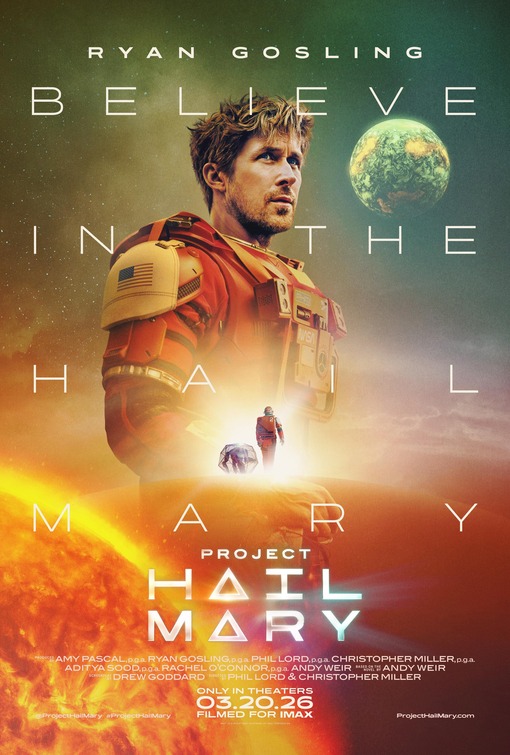
When the film adaptation was announced, fans were skeptical: how could the intricate technical monologues of a 600-page book translate to a visual medium? The selection of directing duo Phil Lord and Christopher Miller—known for their kinetic energy and visual innovation—proved to be a stroke of genius.
Ryan Gosling delivers a performance of remarkable nuance as Ryland Grace. He captures the essence of a “quirky scientist” while grounding the film with moments of raw, heart-wrenching despair. Released in March 2026, the film became a critical and commercial phenomenon. Its depiction of claustrophobic space environments and high-pressure technical repairs rivals the immersive tension of Gravity.
6. Thematic Analysis: Global Cooperation in the Face of Extinction
The work addresses massive human and cosmic values:
- Global Cooperation: Flashbacks depict a world where traditional rivals—the U.S., China, and Russia—surrender their sovereignty to a single, unified mission to save Earth.
- Innovation Under Pressure: The story reinforces that the human spirit is at its most creative when it faces total annihilation.
- Transcendental Bonds: Much like Interstellar, love and commitment transcend the boundaries of space and time. Grace’s ultimate motivation remains the life and the students he left behind.
7. Artistic and Literary Evaluation
I. Literary Review (The Novel)
Rating: 9/10
Weir’s ability to turn physics into a page-turner is unmatched. The pacing is relentless, thanks to the clever toggling between the past (the discovery of the crisis) and the present (the mission). The only minor critique is that Grace’s voice is remarkably similar to Mark Watney’s, which may feel repetitive to some of Weir’s long-term readers.
II. Technical Review (The Film)
Rating: 8.5/10
The film successfully condensed a massive amount of science into a 150-minute experience without losing its soul. Gosling’s performance is a career-high, and the sound design used to represent alien communication was a technical triumph that allowed the audience to experience the “learning curve” of first contact.
Conclusion: Why It Is a Modern Classic
Project Hail Mary is a modern classic because it restores our faith in the human intellect. It invites us to be optimistic about our capacity to solve existential threats through logic, science, and cross-species cooperation. If you are looking for a story that challenges your mind while touching your heart, there is no better vessel than this.
Question for the readers: If you were in Ryland Grace’s shoes, waking up alone with the fate of billions in your hands—would you have chosen to stay on that mission?
References:
- Project Hail Mary (Novel) – Andy Weir (2021).
- Hollywood Reporter: Project Hail Mary Film Review (March 2026).
- Science Daily: The Hard Sci-Fi Influence of Andy Weir.