
Sham Cash and Syria’s Digital Payment Puzzle | What Are the Real Options?

A factual overview of Syria’s current digital payment landscape — from Sham Cash and the Haram network to international transfer routes via stablecoins — with attention to what cybersecurity researchers recently flagged about the country’s most widely adopted financial application.
When Opening a Bank Account Becomes a Burden
Being skilled at your work is not enough when you live in Syria today. Even if you find the client, deliver the project, and invoice on time — the same old question resurfaces: how do you actually get paid? This is not only a problem for Syrian freelancers working with international clients. It is a question for every member of the Syrian diaspora trying to support family back home, and for every civil servant whose salary now arrives through a mobile application. Syria’s digital financial landscape is moving fast — but it is moving over fragile ground, and a recent technical analysis by cybersecurity researchers has given us reason to look more carefully at what that ground is made of.
The Local Options: Who Is Filling the Gap?
Inside Syria, cash remains king, but traditional remittance companies have found themselves at the center of a quiet digital transformation. The main options currently available are:
Haram Pyramid (Al-Haram)
One of Syria’s oldest and most established remittance networks, operating over two hundred branches across the country. Haram today offers domestic transfers in Syrian pounds, incoming international remittances, and integration with several local banks including Bemo Saudi Français Bank, Baraka Syria Bank, and Sham Bank. It has also entered a partnership with the Sham Cash application, allowing users to withdraw their app balances in cash from Haram branches.
Al-Fouad and Other Operators
Alongside Haram, operators such as Al-Fouad, Al-Fadel, Al-Muttaheda, and Al-Qadmus continue to serve domestic and incoming international transfers. A newer entity, the Syrian International Company — formed through a merger of several northern Syria-based firms — distinguishes itself by delivering remittances in foreign currencies (dollars, euros, and Turkish lira) at open-market rates.
Sham Cash Application
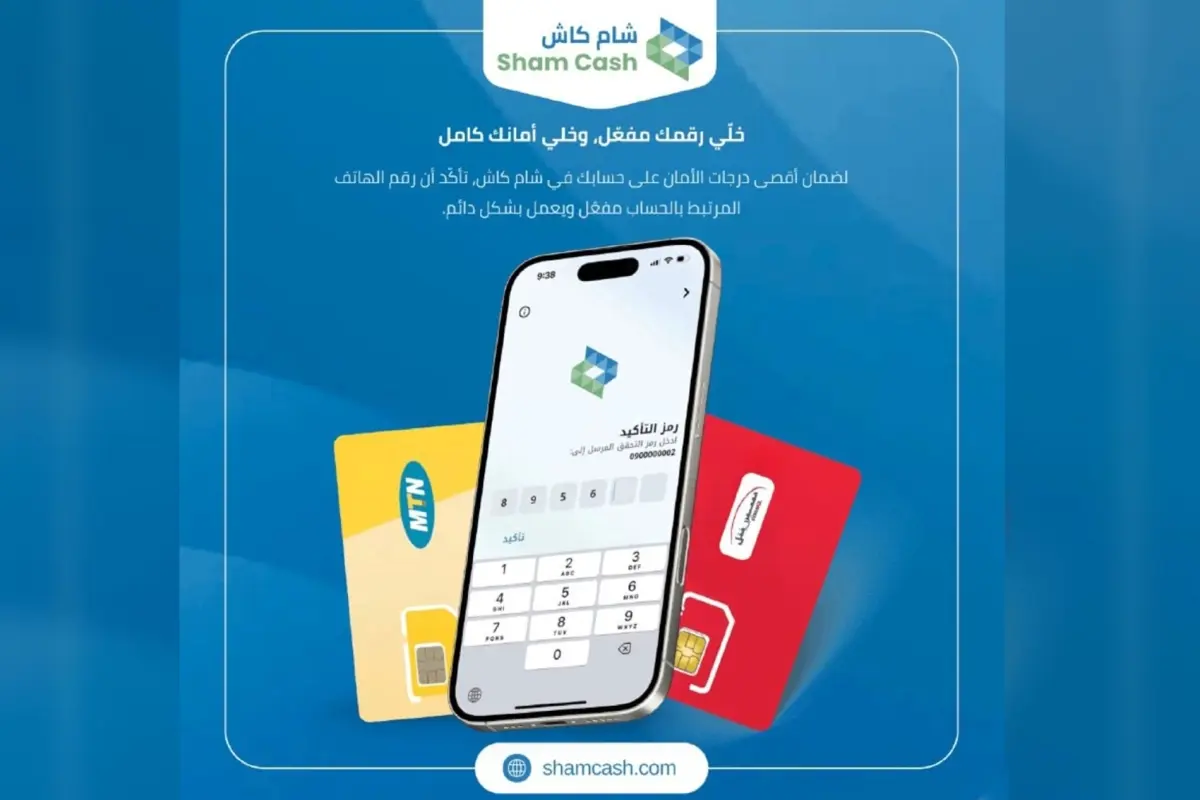
The most prominent digital wallet in the current landscape, linked to Sham Bank — a financial institution based in Idlib, formerly known as “Al-Waseet Remittance Company.” The application enables peer-to-peer transfers within Syria with no domestic transfer fees, bill payments, and university fee settlements. Recent updates have added biometric login, balance privacy options, multiple language support, and a night/day display mode.
The application is not available on the Google Play Store or Apple App Store, and must be downloaded directly from its own website. Security researchers have flagged this as significant, since distribution outside official stores means bypassing the security review processes those platforms enforce.
The app now handles salary payments for tens of thousands of Syrian public sector employees — yet it has not passed through the security verification that any mainstream app store would require as a baseline condition.
International Transfers: The Sanctions Wall Is Still There
This is where the picture gets considerably harder. Contrary to common assumption, Western Union does not operate in Syria due to international sanctions. Neither do most mainstream international banking channels. What currently exists for sending money from abroad into Syria falls into three main tracks:
Specialized Remittance Services
A number of diaspora-focused remittance companies operate in major Syrian expat hubs — Canada, Germany, Saudi Arabia, the UAE, and others — partnering with domestic networks like Haram and Al-Fouad. Senders typically pay via e-transfer, credit card, or PayPal from their country, and recipients collect the funds in Syria within one business day, either from a branch or via home delivery. Delivery can be in Syrian pounds or US dollars depending on the provider and recipient preference.
Stablecoins (USDT / USDC)
Stable digital currencies pegged to the dollar have quietly become the most flexible bridge between the outside world and Syria. The mechanics are straightforward: a sender abroad purchases a stablecoin like USDT through a licensed exchange, transfers it to a wallet accessible inside Syria, and the recipient converts it to cash through local intermediaries or compatible applications. This method is legally permissible for personal and humanitarian purposes under US Treasury Department guidelines, provided the recipient is not on international sanctions lists.
Binance and Its Limits
Binance remains the world’s largest cryptocurrency exchange and is technically accessible to Syrian users. However, it functions as a crypto asset platform rather than a remittance service in the conventional sense. It also faces its own regulatory pressures in the United States, which introduces instability as a single-point solution. In practical terms, Binance is an access point rather than a destination — users typically still need an additional layer to convert holdings into spendable local currency.
The Syrian Diaspora: Sending Money Should Not Be an Ordeal
Approximately 5.5 million Syrians are registered as refugees internationally, alongside hundreds of thousands of workers and professionals in Gulf countries, Europe, and North America. Many send regular financial support to family in Syria — and many find the process unreasonably complicated. Direct international bank transfers are largely unavailable due to sanctions. Alternative channels vary widely in reliability and transparency. Fees on some routes are high enough to meaningfully reduce the amount that arrives. And the exchange rate applied by some domestic applications has drawn user complaints for falling noticeably below the open market rate.
The most practical path today for most diaspora Syrians runs through specialized remittance companies that operate in their country of residence and deliver through Haram or similar networks inside Syria. But this remains a fragmented, trust-dependent system with no unified regulatory framework protecting the rights of either sender or recipient.
In 2025, sending two hundred dollars to Damascus still resembles submitting an application: documents, waiting, and uncertainty about the exchange rate at which the amount will actually arrive.
The Syrian Freelancer: The Weakest Link in the Payment Chain
A Syrian translator delivering work for a British client, or a content writer submitting articles to a Canadian agency — both face the payment equation from its most difficult angle. Major international payment platforms such as PayPal, Payoneer, and Wise either do not officially support Syria or impose substantial restrictions on Syrian accounts.
Many Syrian freelancers have turned to workarounds: accounts held in neighboring countries, transfers facilitated by contacts abroad, or — increasingly — stablecoins like USDT, which have effectively become the unofficial common currency of digital professional work in Syria. These solutions carry their own risks: price volatility in some tokens, the complexity of conversion to cash, and the absence of legal protection in disputes.
Sham Cash does not resolve this core problem. Its primary function remains domestic: transfers between individuals within Syria and payment of local services. Even if future updates expand its capacity for incoming international transfers, the security concerns raised by researchers in recent months make that evolution dependent on getting the technical foundations right first.
What the Recent Security Report Found
In March 2026, cybersecurity specialist Dalshad Othman published a technical analysis of the Sham Cash infrastructure following the application’s migration to a new domain, shamcash.sy. The findings identified three documented vulnerabilities in the hosting server — two from 2020 (CVE-2020-35886 and CVE-2020-35888) and one more recent (CVE-2024-56) — all catalogued in international cybersecurity vulnerability databases.
More structurally significant was the finding that the server hosting Sham Cash — an IP address belonging to the National Network Services Authority — also hosts several government websites under a shared Plesk control panel. In security terms, a vulnerability in any one of these sites creates the theoretical possibility of lateral movement: an attacker who gains a foothold in one site could potentially reach others on the same server. The analysis also identified open network ports (including FTP, MSSQL, and email ports) exposed to the public internet — a configuration inconsistent with standard security practice.
The application’s management responded by attributing the recent downtime not to a breach but to a campaign of targeted domain-abuse reports, and affirmed that user account data remains secure.
A separate field observation, reported by Al-Madina in February 2026, documented a different but equally telling vulnerability: a user was able to create a verified account on the application without providing her correct father’s name or national identification number — entering her mother’s ID instead due to having lost her own. The account was activated without issue. This gap in identity verification is significant in a platform handling government salary disbursements, and becomes more so as the application’s active user base has exceeded one million by early 2026 estimates.
These findings align with an earlier independent assessment by SMEX, a digital rights organization, which assigned the application a risk score of 17 out of 22 — where 22 represents the highest risk — and recommended against its use in its current form, while calling for the withdrawal of any government mandate requiring public sector employees to install it pending security and data protection improvements.
The Question Worth Asking
Syria today faces a rare opportunity: the chance to build a digital financial infrastructure largely from scratch, without the accumulated technical debt of legacy banking systems. That is genuinely valuable — but it comes with a condition. Standards must precede adoption, not follow it. Any government mandate linking civil servant salaries to a specific application should be accompanied by transparent, independent security auditing. And the structural problem of international financial exclusion deserves engagement at the same level of urgency as domestic digitization, because solving the local payment equation — however elegantly — will not help the Syrian content writer still waiting for payment from a client in London.
The question worth asking is not whether Sham Cash is a good or bad application. The more productive question is: what technical and legal framework should precede the national-scale adoption of any digital financial platform — and are we building that framework now, or are we skipping past it toward the launch?