Socotra: The Alien Archipelago at the Gateway of the Indian Ocean
An in-depth exploration of Socotra’s unique geography, its position near the Bab al-Mandab strait, and the extraordinary animal and plant life that exists nowhere else on Earth.

The Kingdom of Unique Creatures: Animals Never Seen Before
The isolation imposed by vast distances from the mainland has made Socotra home to an animal system no less strange than its plants. Here, large mammals do not rule the scene; instead, the stage is left to creatures that evolved in silence, far from the bustle of the continents. The archipelago hosts bird species found nowhere else on Earth, such as the Socotra Sparrow, the Socotra Sunbird, and the Socotra Bunting. The island is also a sanctuary for the “Egyptian Vulture,” locally known as “the cleaner” for its vital ecological role—birds that exhibit a surprising familiarity with the humans there.
In the world of reptiles, Socotra is a living laboratory; 90% of the island’s reptiles are endemic species. These include the Socotran Skink and unique types of geckos and chameleons that have taken on the colors of the island’s rocky and scaly environment. Beneath the water’s surface, the scene is no less dazzling, as the archipelago hosts more than 250 species of reef-building corals and massive schools of colorful fish, making the island’s surroundings an unparalleled marine production system.
Socotra represents the missing link in biology; every small creature, from flightless insects to land crabs, carries a genetic code untouched by the noise of the great migrations that occurred on the surrounding continents.
The Biological Fortress: A Stand Against Evolution
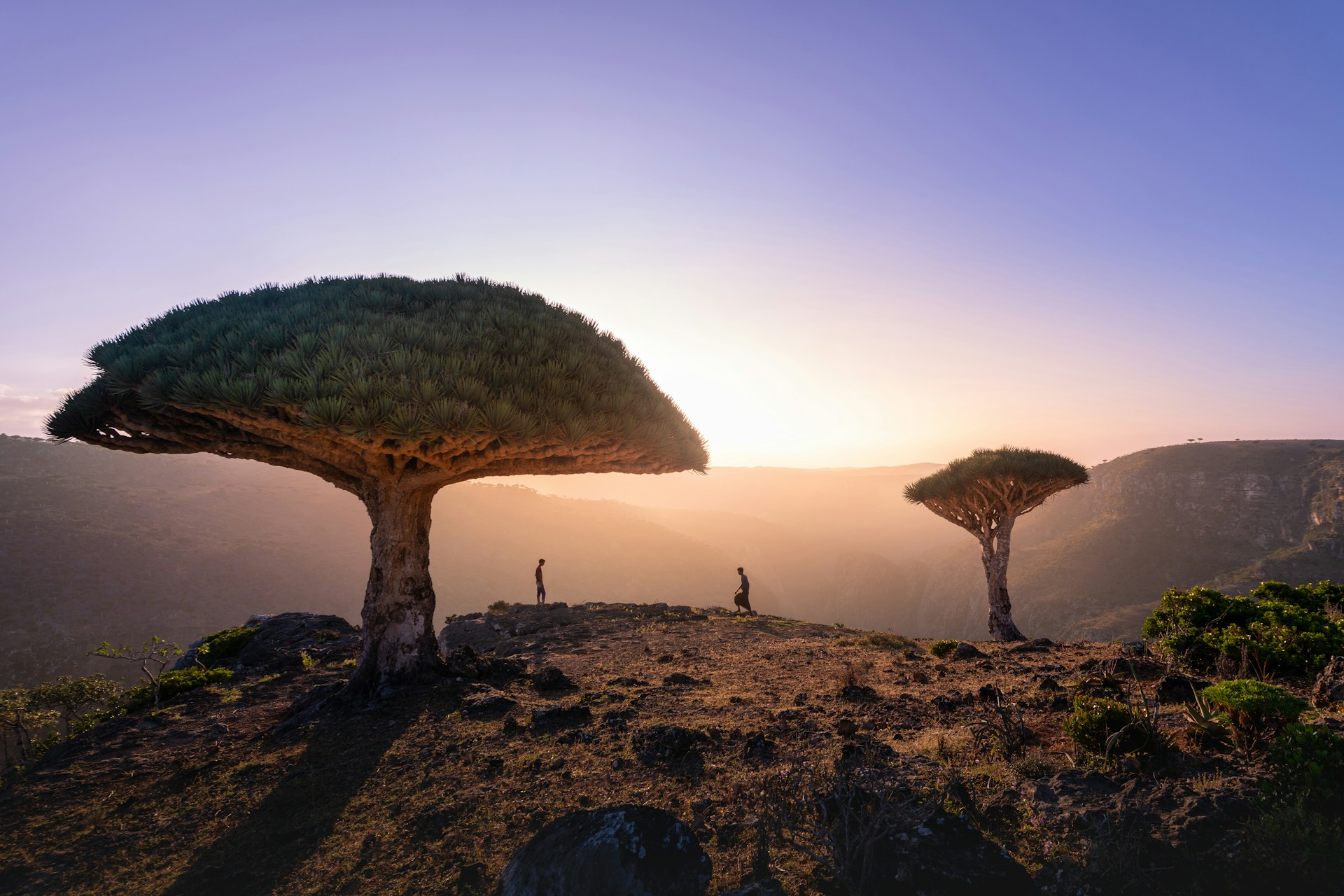
Socotra’s isolation is its greatest architect; by separating from the African continent millions of years ago, the island turned into a biological “pressure cooker,” forcing life to adapt in ways found nowhere else. More than 30% of its plants are “endemic,” meaning if they vanish from Socotra, they vanish from existence entirely. Among these plants, the Dragon’s Blood Tree (Dracaena cinnabari) stands as an iconic guardian of the island. With its umbrella-like canopies and tangled branches reaching toward the sky, it does not look like a plant so much as a geometric calculation for survival.

Echoes of Hoq Cave: A Sumerian Mystery
While Socotra’s terrain catches the eye, its depths preserve the island’s memory. Hoq Cave, along with Gineiba Shahan Cave (which extends 7.5 km), are among the most important archaeological sites in the region. Hoq is a limestone cathedral, decorated with stalactites and stalagmites that have grown undisturbed for eons, but its true value lies in the human fingerprints left on its walls. A Belgian archaeological mission that delved 3 km into the cave uncovered a treasure of inscriptions and artifacts. One of the most puzzling discoveries is a tablet dating back to 500 BCE, bearing a message from a man named Abgar the Sumerian, who wrote: “I am Abgar the Sumerian. I ask whoever finds this tablet to read it and keep it in its place in the cave.”
“This simple request reveals a startling historical awareness; 2,500 years ago, travelers recognized the sanctity of this place. Abgar was not a conqueror, but a witness who possessed the consciousness to preserve the cave’s contents thousands of years ago.”

The Crossroads of Ancient Mariners
The presence of the Musnad script (the Ancient South Arabian alphabet) alongside Semitic and African inscriptions inside Hoq Cave proves that Socotra was never “isolated” from the movement of human trade. It was a vital hub for the “Incense Route.” Mariners from all over the then-known world would stop here to seek protection from the gods or to trade for Socotra’s most valuable exports: frankincense, myrrh, and the legendary Dragon’s Blood resin, which was held in immense esteem in Rome and Egypt for its medicinal and ritual uses.
The Burden of Human History
The act of recording one’s presence—whether through the grand inscriptions of “Abgar” or the modern desire to document travel—speaks to a fundamental human anxiety: Are we merely passing through, or are we part of a larger narrative? Between considering the recording of memories a trivial act for some, and the reality of documentation as part of the human concern to pass the experience of ancestors to descendants, people have lost their way. Socotra reminds us of the importance of this documentation; every stone, every endemic bird, and every scratch of Musnad script is a piece of a puzzle that explains our planet’s resilience.

Conclusion: Preserving the Irreplaceable
Socotra stands today at a crossroads. While its designation as a UNESCO World Heritage site offers some protection, the pressures of climate change and regional instability loom on the horizon. To visit or study Socotra is to accept the responsibility of preserving its silence and privacy. Socotra remains one of the few places where you can stand in a cave and read the words of a Sumerian traveler, then step outside to stand under a tree that looks as if it were planted by beings from another world. It is a reminder that the world is still full of wonders, provided we have the wisdom—like Abgar—to leave things “in their place.”
A quick visual tour
You can view our suggestions in the Solo Traveler Guide, 3 articles:
The Fear that Binds and the Fear that Protects | Solo Traveler Guide
Seven Spots for the Solo Arrival | 2026 Destination Map
Two Words that Open a Heart | Small Language for the Big Traveler
References
- UNESCO World Heritage Centre. “Socotra Archipelago.”
- Strauch, I. (2012). Foreign Sailors on Socotra: The Inscriptions from the Cave Hoq.
- Environment Protection Authority (EPA) – Socotra Branch.