The 100-Day Secret: How Koreans Celebrate Their Newborns
Baek-il is a Korean tradition centuries old and still very much alive. The baby is usually asleep or crying throughout — but the ritual runs deeper than it looks.
When my son was born, I found myself quietly cataloguing newborn celebrations from around the world: the Arab Sabou with its noise and ululations, the Aqiqah, the infinite regional variations.
But what caught my attention later — as I moved deeper into Korean dramas and culture — was a celebration unlike any of those: the hundredth day, Baek-il (백일).
One hundred days. Not ninety-nine, not a hundred and one. And it has a story worth telling.

Why Exactly One Hundred Days? The History Behind the Number
The answer isn’t merely symbolic — it’s rooted in a stark historical reality.
In premodern Korea, infant mortality rates were heartbreakingly high. Disease, harsh living conditions, and limited medical knowledge meant that many babies didn’t survive their first weeks. A child who made it to the hundredth day had genuinely passed through the most dangerous window. The celebration wasn’t decorative — it was an announcement: this child survived. Their life has properly begun.
The number itself carries cultural weight. In Korean tradition, as in several other East Asian cultures, 100 represents completion and fullness — the sense of having arrived at something whole. This explains why the number appears in other Korean life contexts too: the “100-day anniversary” that young Korean couples celebrate marking the start of their relationship, or the milestone markers used by new businesses.
One hundred means: we’re here. And we trust that what has begun will continue.
Celebrating survival isn’t pessimism — it’s a particular form of gratitude that comes from having looked directly at life’s fragility.
The Table the Baby Doesn’t Notice
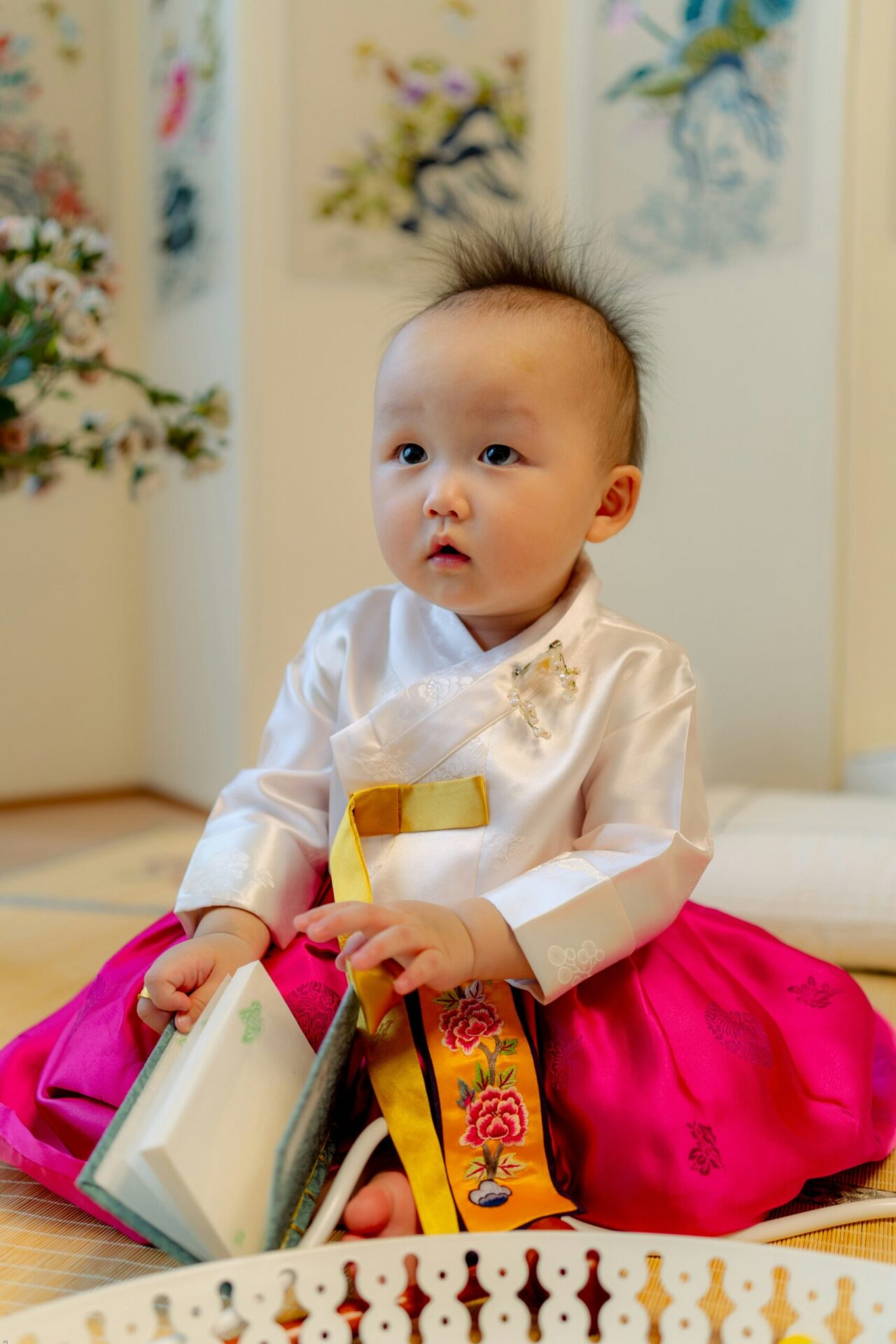
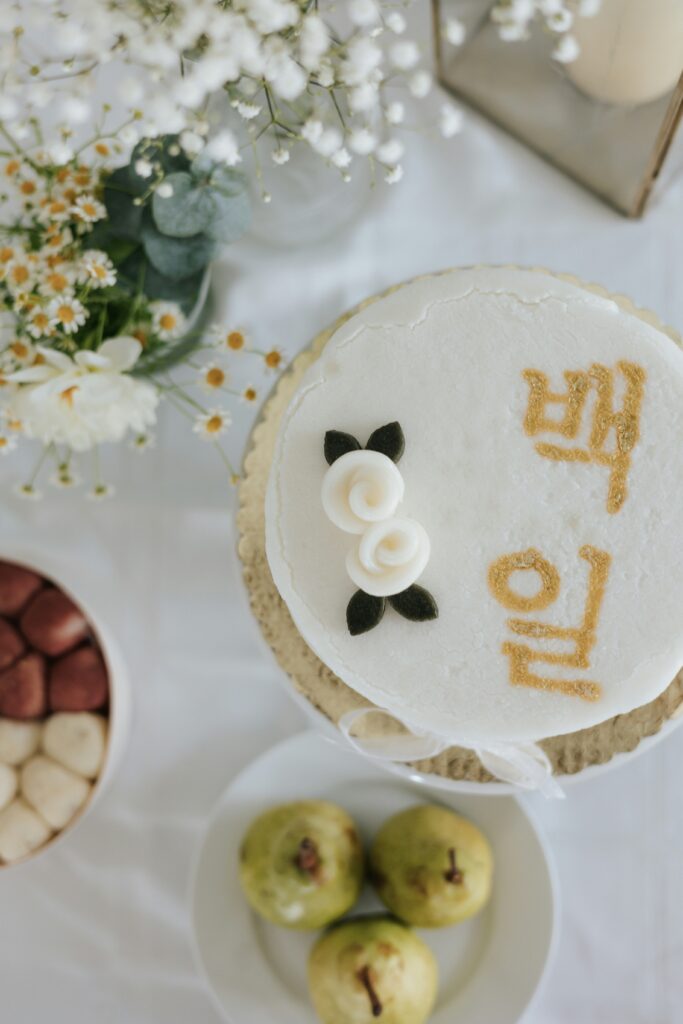
On the day of Baek-il, the baby is dressed in a Hanbok — the traditional Korean silk garment, vivid in color and layered with meaning — and placed before the “hundredth-day table.” This table holds rice, fruit, the ceremonial white rice cake called Baek-seolgi (백설기), and sometimes long cotton threads placed alongside the food as a wish for a long life.
Then there is the fact every Korean knows well and finds endearing: the baby has absolutely no idea what is happening. At this age, the infant will almost certainly fall asleep mid-ceremony, or choose the precise moment of the family portrait to begin crying urgently, or simply stare at the lights with profound confusion. The embarrassing, chaotic photos this produces — baby wailing in the middle of the beautifully arranged table, baby asleep while relatives beam behind him — are among the most treasured family photos Koreans hold onto for decades.
The Rice Cake That Extends a Life — and the 100 Strangers
One of the most fascinatingly specific details of Baek-il: tradition holds that the white rice cake must be shared with exactly one hundred people. The folk belief is that the more people who eat the cake, the longer the child’s life will be.
In earlier times, this meant distributing it across the entire neighborhood. Today, Korean families send boxes to coworkers, neighbors, and social media acquaintances — sometimes to people who know the mother only digitally, never in person. The communal spirit of the ritual has adapted seamlessly to contemporary life without losing its essential meaning. The hundredth person eating a piece of rice cake is still, somewhere, extending a wish toward a child they’ve never met.
The Evil Spirits — and What They Tell Us About the Ritual
There’s a dimension of Baek-il that the cheerful social media posts don’t usually mention: if the baby was ill on the hundredth day, tradition dictated that the celebration be canceled entirely. The reasoning: a large, joyful celebration might draw the attention of malevolent spirits toward a child who was already vulnerable.
This logic — protecting fragile good fortune from unwanted notice — echoes across cultures in ways that feel immediately familiar. The Arabic concept of the evil eye, the cultural caution about celebrating too loudly before something is secure, the instinct not to call attention to a blessing that feels precarious. Folk wisdom finds remarkably similar solutions to remarkably similar fears, regardless of where it originates.
Both Koreas — Yes, North Korea Too
A question that comes up: does North Korea practice Baek-il? The answer is yes — with an important distinction. Both Koreas share the same ancient cultural heritage; the folk traditions predate the division. But in North Korea, the celebration is practiced more quietly, within immediate family, and with considerably more modest means. It tends to be overshadowed by the first-birthday celebration, Doljanchi (돌잔치), which receives more state cultural attention there. In South Korea, Baek-il has evolved into a major social event — restaurant bookings, professional photography sessions, elaborate themed decorations — while retaining its traditional core.
What This Celebration Says About the Mother — Not Just the Baby
The angle I find most quietly human in all of this: Baek-il isn’t only a celebration of the baby. It is also, implicitly, a recognition of the mother.
One hundred days of nursing and sleeplessness and learning and physical recovery and constructing a new identity from the inside out. The celebration, in its deeper register, says: you also survived. Your body and your mind and your relationship with this small strange person — all of it has reached a hundred days. And that deserves to be seen.
In a culture that often photographs the baby and forgets to photograph the woman who produced him, Baek-il is a quiet corrective. (See our article: Happiness Across Languages: From Hygge to Ikigai)

What Any Family Can Take From This
The suggestion isn’t to import a Korean ceremony wholesale. But the core idea behind Baek-il is portable across any culture: designate a specific moment to say “we made it.” Not because the danger is over, but because getting here was real effort and it deserves to be acknowledged.
Rituals give time a shape. And time that has a shape is lived with more awareness. And awareness is what turns passing moments into memories that last.
See also: Preserving Arab Traditions in American Life | Japanese School Lunches: Building Society in a Child’s Lunchbox | Ubuntu Philosophy and the Family: Living With the Spirit of Community
References:
- Korea.net — Official Korean Culture Portal. Baek-il and Doljanchi
- Korean Cultural Center. Traditional and Contemporary Korean Newborn Celebrations. koreanculture.org
- Janelli, R. L., & Janelli, D. W. (1982). Ancestor Worship and Korean Society. Stanford University Press.
- Kendall, L. (1985). Shamans, Housewives, and Other Restless Spirits: Women in Korean Ritual Life. University of Hawaii Press.