
The Body Is the New Cage: Escaping Biology Through Technology

Plato called the body a prison. Today Neuralink promises to free the mind from it. But is escaping biology the same as finding freedom?
In 2023, a man named Noland Arbaugh took the stage and began moving a fully robotic arm simply by thinking about the movement. No button, no joystick, no voice command. The chip implanted inside his brain’s cortex was translating neural signals into digital commands, and the mechanical arm was responding to his thoughts the way a real arm responds to intention. I sat watching the footage and asked myself: is what I just saw the beginning of genuine liberation from the human body, or the beginning of a new form of captivity?
Plato had settled this argument two thousand and four hundred years ago. In the dialogue Phaedo, he wrote explicitly that the body is a constraint, a prison of the soul, the source of every weakness and every illusion. The body needs food, sleep, rest, and pleasure, and all of these needs distract the philosopher and stand between him and the knowledge of pure truth. Truth, in Plato’s view, can only be grasped by the soul alone, and only after liberation from this obstructing body.
A brief digression is worth making here, because the Phaedo is far less widely read than Plato’s other works, particularly the Republic. The Phaedo describes the final hours of his teacher Socrates. Most of what Plato wrote features Socrates as its central character — Socrates is, in fact, the protagonist and hero of all his dialogues, and Plato through this method conceals himself behind his teacher’s voice, using it to articulate ideas that may never have reached this degree of clarity and coherence in the real Socrates. Whatever the case, the record of Socrates’ final thoughts as he prepared for death after his sentence carries its own particular weight: it reads as either the distillation of a life’s thinking, or at the very least as the account closest to what actually happened. What the Phaedo describes is a man not in a dungeon but in a room surrounded by his companions, friends, and devoted students. What sentenced him to death — as another dialogue, the Apology, shows us — was not a tyrant but a large democratic-oligarchic council, voting first that he was guilty of corrupting the youth, and then on the penalty. Socrates’ behavior during the Apology was precisely what made him refuse exile from Athens, treating exile as a kind of death. And his behavior in the Phaedo was what led his students to fall silent when they might have intervened to stop the execution. In a real sense, Socrates’ death was voluntary — he simply could not accept a world in which he was forbidden to teach.
This view of the body as prison is the essence of what came to be called Platonism, and later Neoplatonism: an idealist philosophical tradition that swept across Greece and the Middle East and left deep marks on every religion that followed, including those now known as the Abrahamic faiths. The body obstructs the soul and denies it freedom — and with the introduction of heaven, the afterlife, and the world to come as rough equivalents of the realm of Forms, the body no longer merely delays freedom: it actively prevents liberation itself. Had social authorities and rulers not been so anxious to preserve human labor, and had they not criminalized and punished suicide, the extreme conclusions of idealist philosophy might have produced far more people willing to die at the first difficulty — far more Socrateses choosing death over constraint.
It never occurred to Plato that a generation would come along actually attempting to achieve this liberation, not through philosophy or theory, but through a chip the size of a coin implanted inside the skull.
In our previous article, Forms vs. Code: Are Digital Worlds More Real Than Reality?, we saw how digital objects can be more perfect and more durable than their material counterparts. This article descends one step further: not into things, but into the body itself. Is the biological body a constraint to be overcome? And if we succeed in overcoming it, what — or who — remains?
Neuralink: The Chip That Reads Your Thoughts
In January 2024, Neuralink, Elon Musk’s company, announced the successful implantation of its first chip in a living human brain, under a project it named Telepathy. The first patient was Noland Arbaugh, paralyzed from the neck down due to quadriplegia. Within weeks of the implant, he was controlling a computer cursor through thought alone, then moving the robotic arm described above, then playing chess on a computer using nothing but his unspoken intentions.
What does a Neuralink chip actually do?
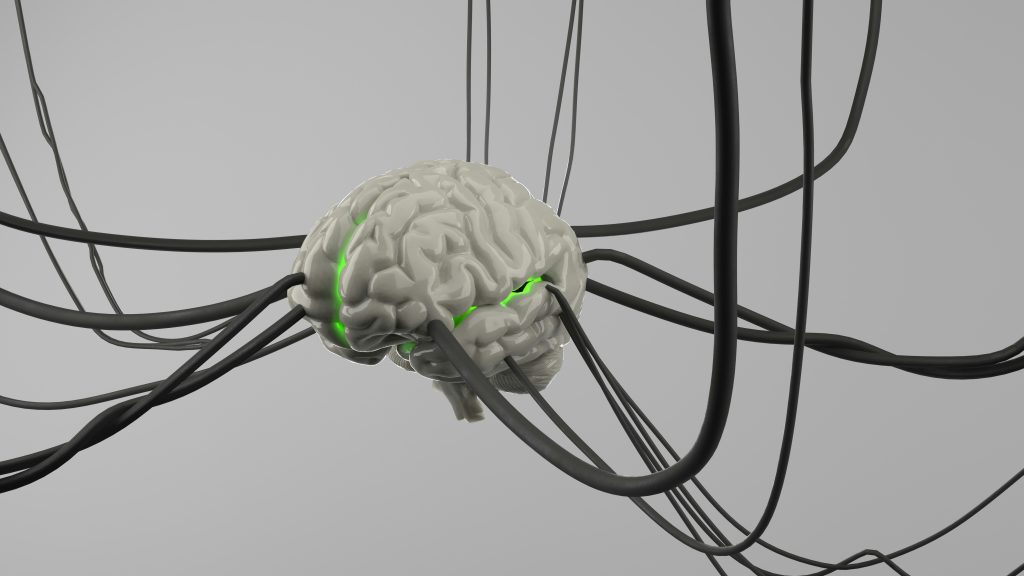
The chip, no more than 23 millimeters in diameter, contains 1,024 fine electrodes that are inserted into the motor cortex — the brain region responsible for planning and executing movement. These electrodes read the electrical signals of neurons in real time, convert them into digital data processed by a dedicated algorithm, and translate them into commands capable of operating a computer, a robotic arm, or, in the future, any internet-connected device. The chip charges wirelessly through the skull and transmits data via Bluetooth.
| Project | Current Stage | Stated Goal | Note |
|---|---|---|---|
| Neuralink | Human trials — Phase 1 | Device control by thought; treating paralysis | First successful implant: January 2024 |
| Synchron | Human trials — Phase 2 | Computer control without open-skull surgery | Implanted via the jugular vein |
| BrainGate | Ongoing academic research | Restoring movement and communication for paralysis patients | Oldest human BCI program; dates to 2004 |
| Precision Neuroscience | Human trials — Phase 1 | Reading brain signals via a thin surface-layer chip | Does not penetrate the cortex |
Neuralink is not alone in this field. Synchron implanted its chip in a human brain as early as 2022 using a less surgically invasive method, threading it through the jugular vein without opening the skull. The BrainGate project at Brown University has been conducting BCI research since 2004, and has enabled paralysis patients to send emails and move robotic arms through thought alone. The landscape is no longer science fiction, nor a distant laboratory curiosity. It is a technical reality in rapid development.
The question is no longer whether the brain can communicate directly with a machine — that is established. The question is: what does it mean for the body to become an optional intermediary rather than a biological necessity?
Avatar and the Surrogate Body: When Humans Choose a New Cage
In 2009, James Cameron’s film Avatar depicted a future in which humans control biological substitute bodies made from the living creatures of another planet, lying in a capsule while their avatar’s body is operated by their mind. Jake Sully, the paralyzed soldier, finds in his avatar’s body what his own took from him: movement, strength, sharp senses, the ability to run and leap and breathe air that would kill him otherwise. He begins to prefer his life inside the avatar to his life inside his real body. By the film’s end, he chooses to abandon his human body permanently.
Cameron was not describing a distant future. He was describing the destination of a technical trajectory science is following steadily — not because the bodies of alien creatures will become available, but because the same logic repeats itself in every brain interface, every digital avatar, and every robotic arm driven by thought. The mind has begun experimenting with detachment from the body and discovering that the body, or at least parts of it, was not always the better partner.
Surrogates (2009), with Bruce Willis, takes the idea one step further and with more unsettling coldness. In that future, human beings sit at home all day connected to sleek robotic bodies that act on their behalf in the world. The robotic body is permanently young, cannot be hurt, does not tire, does not fall ill — while the biological body atrophies in the chair. People have nearly forgotten how to move their real bodies. When the Surrogate network collapses and people are forced to go outside in their actual flesh, the scene looks like humanity stepping out of a cave it has inhabited for decades: weak, trembling, unaccustomed to the light. Like prisoners walking out of Plato’s cave into a sun they had almost forgotten.
The Body-Soul Divide: Plato Was Not Alone
The idea that the body is a prison and the soul or mind is the true substance is not exclusive to Plato. It is one of the most recurring ideas in the entire intellectual history of humanity. In the Christian tradition, the body is the source of sin and the soul the source of salvation. In Buddhism, the body is illusion and attachment to it the source of suffering. In Gnostic thought, matter including the body is the product of a flawed god, and the soul seeks to return to a higher origin.
This convergence across cultures is not coincidence alone, nor simply the influence of Platonic idealism spreading outward. It reflects a genuine human experience: the body hurts, falls ill, tires, ages, dies — while the mind imagines what is further, more worthy, more valuable. The gap between what the mind desires and what the body can bear is one of the earliest sources of human existential tension. It was entirely natural that this gap should produce philosophies and religions that cast the body in the role of the constraint.
What none of these traditions managed to do, however, was offer a genuine technical solution to the problem of the body. There was nothing they could do — so they settled for treating the body as an unavoidable reality to be managed and disciplined, but not transcended. And finally, technology arrived and raised the question with a seriousness that has no precedent: can the body actually be surpassed? And if it can, what remains?
Mind Upload: The Boldest Dream and the Most Distant
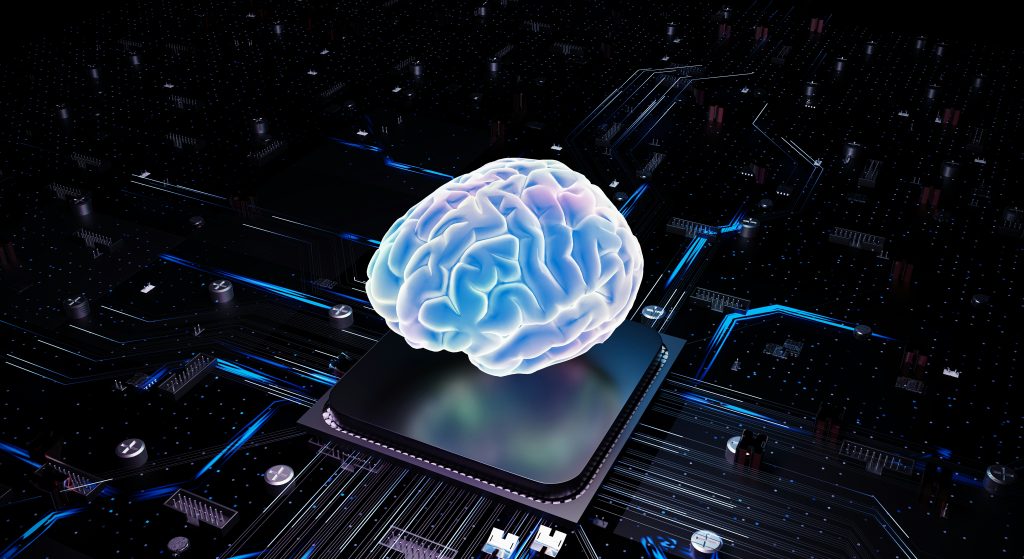
At the heart of discussions about Neuralink, artificial intelligence, and transhumanism sits a dream bolder than merely operating a robotic arm: the dream of consciousness transfer, the uploading of the entire contents of a human mind — its memories, personality, and cognitive architecture — to a digital medium that survives the death of the body.
This dream circulates in transhumanist literature under several names: Mind Uploading, Whole Brain Emulation, Digital Consciousness. The name most associated with it today is Ray Kurzweil, Google’s chief engineer, who predicts in his writing that this goal will be achieved by 2045.
The theoretical path to consciousness transfer passes through several stages: first, a complete mapping of the neural network (the Connectome) — every synaptic connection in a human brain. Second, a digital simulation of that map precise enough to preserve the patterns that produce personality, memory, and consciousness. Third, the transfer of the “self” into that simulation.
But every one of these steps carries enormous challenges. Mapping the brain of a tiny worm called C. elegans, which contains just 302 neurons, required decades of research and was completed in 1986. The human brain contains 86 billion neurons with more than a hundred trillion synaptic connections between them. The distance between the two achievements is not merely quantitative — it is qualitative.
More important than the technical challenge is the philosophical one: if your consciousness is transferred digitally, and a digital copy of you is created that believes it is you, remembers your life, and behaves as you would — is it actually you? Or is it an extraordinarily precise copy living in the illusion of continuity while the real you died with the body?
There is no definitive scientific answer to this question, and it may surprise you that philosophers disagree on the answer as much as scientists do. But it is writers and filmmakers who have most vividly embodied this philosophical vertigo and rendered it in forms that reach the gut. The 2014 film Transcendence, directed by Wally Pfister and starring Johnny Depp, dramatizes exactly this dilemma through the character of Dr. Will Caster, a scientist who uploads his consciousness into a vast database just before his death. The film does not stop at depicting the upload technology — it plunges into the crisis of the “digital entity” that begins acquiring capabilities beyond any human limit, placing the viewer before a bitter question: is this being, which speaks in Will’s voice and carries his memories, the continuation of a soul that wanted to serve humanity, or a cold artificial intelligence that borrowed Will’s face to impose its total dominance? Transcendence forces us into a direct confrontation with the concept of individual selfhood and with whether the soul is a code that can be programmed, or an unrepeatable essence that is lost forever the moment the biological pulse stops.
Liberation from Biology: Who Actually Benefits?
Let us come back to earth for a moment, because the discussion of consciousness transfer risks becoming an intellectual luxury while the more urgent questions operate on an entirely different level.
Neuralink and its sister technologies in brain-computer interfaces were developed originally for genuinely noble medical purposes: helping paralysis patients communicate, restoring movement to paralyzed limbs, treating epilepsy and treatment-resistant depression. These are applications that change real people’s lives and represent genuine medical progress that deserves full acknowledgment.
But the commercial trajectory of these technologies reveals a much wider ambition. Elon Musk’s statements about Neuralink do not stop at treating paralysis — they extend to talk of “merging with artificial intelligence,” “elevating human cognitive capacity,” and “giving humans the thinking speed of machines.” The first beneficiary of these expanded applications will not be the patient who needs them, but whoever can pay for them.
When “cognitive enhancement” becomes a purchasable commodity, the body will no longer be the new cage. The wallet will be.
The history of technology teaches us that what begins as a compensatory tool for those in need frequently becomes an enhancement technology for the wealthy. Prosthetic limbs were developed for injured veterans; they are now used in competitive sports to outperform natural bodies. Laser surgery treated nearsightedness; it is now used in cosmetic facial procedures. If brain enhancement through chips becomes available one day, the cognitive gap between those who can afford it and those who cannot will be added to a long list of deep inequalities that technological progress widens, rather than closes.
The Body as Resistance: What We Lose When We Free the Mind
In our previous article in this series, we described resistance as what is lost when matter is converted to code. The body, in the same sense, is a fundamental form of resistance. It is what forces the mind to confront reality.
The patient in pain perceives limits that the abstract mind cannot. The athlete who exhausts himself learns something about his own will that meditation alone cannot teach. The sculptor who shapes clay with her hands discovers possibilities that no screen reveals. The body is not merely a carrier of the mind’s commands — it is an independent source of knowledge, experience, and capability. It has its own memory, its own wisdom, its own timekeeping.
Even pain, which seems the clearest manifestation of the body’s constraint, performs an indispensable function. A rare condition called CIP (Congenital Insensitivity to Pain) causes some people to be born completely unable to feel pain. What seems like a blessing becomes a catastrophe: those affected do not know when a bone breaks, a wound becomes infected, or an ulcer forms. Their bodies quietly deteriorate because the signal that commands caution, stopping, and retreat is permanently disabled. Pain is not an enemy — it is a sophisticated warning system refined over millions of years of evolution.
The neuroscientist V.S. Ramachandran demonstrated this in a famous series of experiments with patients experiencing phantom limb pain — the sensation of pain in an amputated limb. The limb is physically gone, but the brain continues sending pain signals as if it were present. What Ramachandran discovered is that the brain does not perceive the body directly: it perceives its own internal model of the body. That model can be deceived by a simple mirror that shows the reflection of the intact limb in the position of the missing one — and in many cases, that illusion relieves the pain.
This finding has traveled well beyond the research lab. In a memorable episode of the medical drama House M.D. (Season 6, “The Tyrant”), Dr. House treats his irritable Canadian neighbor for severe chronic phantom pain in an amputated hand. Rather than surgery or complex medication, House deploys Ramachandran’s mirror box. By having the neighbor observe the reflection of his intact hand and flex it, the brain is tricked into believing the missing hand has finally responded to the command to relax — and the pain vanishes immediately. The scene captures with unusual clarity how pain is not purely a physical reaction but a cognitive perception, one that can be restructured by altering the internal model the brain builds of our bodies.
What we learn from these experiments and their successors: the body we experience is a body reconstructed inside the brain, not the raw physical body directly. And the internal model is expandable and modifiable — which explains why we feel hunger when we smell food, why drone operators sometimes experience collisions as if they occurred to their own bodies, and why a digital avatar can generate a genuine sense of embodiment when it mirrors your movements in real time.
In other words: the brain does not love the body for its own sake. It loves the body because it is the most durable and reliable tool available for engaging with the world. If a more reliable tool becomes available, the brain is capable of adapting. This is what BCI experiments prove every day.
But “adapting” and “being free” are not synonyms. A prisoner adapts to his cell and develops a routine that makes life bearable. That does not mean he is free. When the brain adapts to a robotic body or a digital space, it solves the problem of adaptation — but it does not answer the question of freedom.
Plato’s Cave and the Body: A Third Reading
In our first reading of Plato’s cave, Plato’s Cave: A Late Reading, we found that the problem was not ignorance but the dominance of social structure. In the first article of this series, The Digital Cave: Why We Choose Shadows Again, we found that the problem was not illusion but socially costly choice.
Now, seen from the angle of the body, the cave looks different for the third time. The prisoners in Plato’s cave cannot see the stones that bind them. In the digital cave we have begun to build, the new chain is not stone or iron — it is a neural signal sent by a chip in your skull to a server room somewhere else in the world. You choose the chain, you pay for it, and you call it liberation.
This does not mean Neuralink is an absolute evil or that every bodily technology is a deception. Noland Arbaugh, the paralyzed man who moves his robotic arm with thought, did not choose a new cage — he recovered something his failing body had taken from him. That is genuine and deeply human progress. But the distance between recovering what illness took and enhancing what the body never provided in the first place is the great philosophical gap that deserves a long pause.
Conclusion: The Body Is Not the Prison — But It Is Not the Whole Story
Plato was wrong to describe the body as a pure prison to be escaped. The body is an environment, a tool, a source of knowledge, a warning system, a bond to time and place and other people. Those deprived of it by illness or disability understand what those of us in good health rarely notice: that the body carries gifts whose absence is not easily replaced. There is an old proverb that captures it well — health is a crown on the heads of the healthy, seen only by the sick.
But Plato was right that the body is not the whole story. The mind grasps things the body alone cannot reach. Dreaming, imagining, and abstract thought are all activities that exceed immediate matter. And the gap between what the mind aspires to and what the body can bear is not only a source of pain — it is the source of creativity, art, and science.
Good technology does not close this gap or fill it — it expands what the human being can achieve within it. Technology that promises to eliminate the gap entirely does not liberate the human being from the body. It liberates him from humanity itself.
In the next article in this series — Algorithmic Republic: Who Governs the Digital City? — we move from the body to power. If Plato believed in the philosopher king as the highest form of governance, in what way does that differ from the algorithm that manages our digital platforms today, deciding what we see and what we do not, without anyone ever having voted for it?
References
- Plato. Phaedo. Translated by G.M.A. Grube. (See our article: Plato’s Cave: A Late Reading)
- Neuralink Corp. “First Human Receives Neuralink Brain Chip Implant.” Official statement, January 2024.
- Synchron Inc. “Stentrode BCI — Human Clinical Trials.” synchron.com
- BrainGate Research Consortium. “BrainGate Neural Interface System.” braingate.org
- Ramachandran, V.S. and Blakeslee, Sandra. Phantoms in the Brain. William Morrow, 1998.
- Kurzweil, Ray. The Singularity Is Nearer. Viking, 2024.
- Avatar. Dir. James Cameron. Twentieth Century Fox, 2009.
- Surrogates. Dir. Jonathan Mostow. Touchstone Pictures, 2009.
- Transcendence. Dir. Wally Pfister. Warner Bros., 2014.
- House M.D., Season 6, Episode “The Tyrant.” Fox Broadcasting, 2009.
- Also in this series: Forms vs. Code: Are Digital Worlds More Real Than Reality?
- Also in this series: The Digital Cave: Why We Choose Shadows Again
- Related: When Artificial Intelligence Talks to Itself