
Learn Spanish in a Week (1) Introduction and Pronunciation: The Golden Key

Start your exciting journey to learn Spanish in a week. Discover the 21 countries where it is spoken, and unlock the secrets to correct pronunciation and reading from the very first try to travel with confidence like a pro.
Learn Spanish in a Week: Your Practical Zero-to-Hero Guide
Day One: Introduction and the Golden Pronunciation Key
Welcome! Driven by a passion for language learning, culture, and travel, my journey has taken me through the vibrant streets of the world. I am thrilled to accompany you on this series via the Zy Yazan Platform. Together, we will break the barrier of one of the most mesmerizing and energetic languages on Earth. If you are planning your next trip or looking for a cultural passport to connect with millions without getting bogged down by boring academic jargon, you are in the right place. Here, we focus on what actually works in the street, at cafes, and while packing your bags—delivered in a direct, practical, and casual style.
Spanish: A Whole Planet, Not Just One Country!
When most people think of Spanish, football stadiums in Barcelona or historic avenues in Madrid immediately come to mind. However, the astonishing truth is that Spain is just a tiny drop in a massive linguistic ocean! There are twenty-one official countries where Spanish is spoken as a native language. They form a magnificent cultural chain stretching from the Iberian Peninsula in Europe, covering almost all of Central and South America, and reaching deep into the heart of Africa in Equatorial Guinea.
Imagine that by mastering this language, you will not only communicate with locals in Spain but also unlock doors to chat with vendors in Mexico’s bustling markets, dance enthusiasts in Argentina, adventurers in the highlands of Colombia and Peru, and beachgoers in Cuba, Costa Rica, and Chile. It is the native tongue of over 500 million people and the second most spoken native language globally! As a traveler, always remember: you are not just learning the language of a country; you are gaining access to an entire continent where dialects vary but the warmth of hospitality remains identical.
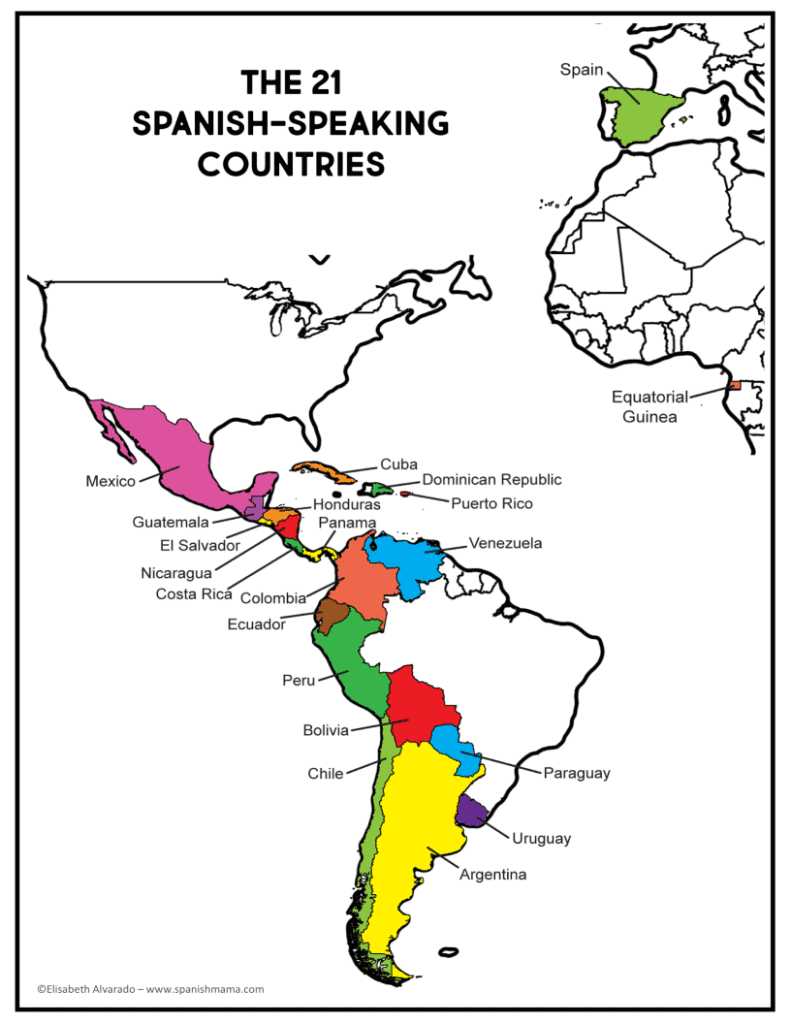 Map highlighting the 21 Spanish-speaking countries globally[/caption>
The Full Spanish Alphabet: Complete Pronunciation Guide
Before we dive into our six golden rules, here is the complete Spanish alphabet (27 letters). Use this comprehensive table as your lifelong reference to confidently sound out any word you encounter on your travels:
| Letter | Letter Name & Phonetic Sound | Spanish Example | English Approximation | English Meaning |
|---|---|---|---|---|
| A | Ah (open “ah” sound) | Agua | AH-gwah | Water |
| B | Beh | Buenos | BWEH-nos | Good |
| C | Theh / Seh (depends on vowel) | Casa | KAH-sah | House |
| D | Deh | Día | DEE-ah | Day |
| E | Eh (short “e” like in ‘met’) | En | Ehn | In / On |
| F | Eh-feh | Fiesta | FYEHS-tah | Party / Festival |
| G | Heh / Geh (throaty H or hard G) | Gracias | GRAH-syahs | Thank you |
| H | Ah-cheh (completely silent) | Hola | OH-lah | Hello |
| I | Ee (long “e” like in ‘see’) | Isla | EES-lah | Island |
| J | Hota (strongly aspirated ‘H’) | Jugo | HOO-goh | Juice |
| K | Kah | Kilo | KEE-loh | Kilo |
| L | Eh-leh | Luna | LOO-nah | Moon |
| M | Eh-meh | Mano | MAH-noh | Hand |
| N | Eh-neh | Noche | NOH-cheh | Night |
| Ñ | Eh-nyeh (like ‘ny’ in ‘canyon’) | Niño | NEE-nyoh | Child / Boy |
| O | Oh | Oro | OH-roh | Gold |
| P | Peh (crisp, less aspirated than English) | Padre | PAH-dreh | Father |
| Q | Koo (always followed by silent ‘u’) | Qué | Keh | What |
| R | Eh-reh (tapped or rolled) | Rey | Rey | King |
| S | Eh-seh | Sol | Sol | Sun |
| T | Teh (tongue against teeth) | Tren | Trehn | Train |
| U | Oo (like ‘oo’ in ‘boot’) | Uva | OO-bah | Grape |
| V | Oo-beh (pronounced like a soft ‘B’) | Viaje | BYAH-heh | Trip / Journey |
| W | Oo-beh doble (only in foreign words) | Web | Web | Web / Internet |
| X | Eh-kees (sounds like ‘ks’ or ‘s’) | Éxito | EK-see-toh | Success |
| Y | Ee grye-gah (sounds like English ‘Y’) | Yo | Yoh | I |
| Z | Theh-tah / Seh-tah | Zapato | thah-PAH-toh / sah-PAH-toh | Shoe |
The Golden Key: How to Read and Pronounce Spanish Instantly?
Great news for any traveler wanting quick results: Spanish is written exactly as it is pronounced! Unlike English or French, there are no confusing hidden rules or silent letters (except for just one, which we will unpack right now). Once you grasp these six essential rules, you can effortlessly decipher any directional sign in Mexico or menu in Buenos Aires:
- The Letter (H): This letter is completely passive and always silent. It is never voiced! The word (Hola), meaning hello, is pronounced “OH-lah”, not “ho-lah”. Similarly, (Hotel) is pronounced “oh-TEL”.
- The Letter (J): This always sounds like a strongly aspirated, throaty “H” (resembling the ‘ch’ in the Scottish word ‘loch’). The name (José) sounds like “hoh-SEH”, and the word (Jugo), meaning juice, sounds like “HOO-goh”.
- The Letter (G): It plays a smart double role. It sounds like a throaty “H” if followed by (E) or (I), such as (Gente), pronounced “HEN-teh” (people). However, it sounds like a hard “G” (as in ‘gas’) with all other letters, like (Gracias), pronounced “GRAH-syahs” (thank you).
- The Double L (LL): When you see two Ls together, forget the ‘L’ sound entirely and pronounce it like an English “Y” (though in some parts of Latin America, like Argentina, they voice it as a soft ‘sh’ or ‘zh’). The word (Calle), meaning street, is pronounced “KAH-yeh”, and the famous dish (Paella) is pronounced “pah-EH-yah”.
- The Letter (Ñ): This unique character with a wavy tilde on top sounds like the “ny” blend in ‘canyon’ or ‘onion’. The word (España) is pronounced “ehs-PAH-nyah”, and (Señor) is pronounced “seh-NYOR”.
- The Letter (C): This sounds like a “th” (in mainland Spain) or an “S” (in Latin America) when followed by (E) or (I), as in (Gracias). It reverts to a hard “K” sound with other letters, like (Casa), pronounced “KAH-sah” (house).
Consonant Blends and Special Character Reference Table
| Letter / Combination | Pronunciation Key | Spanish Example | Phonetic Guide | English Meaning |
|---|---|---|---|---|
| H | Completely Silent | Hablar | ah-BLAR | To speak |
| J | Aspirated, Throaty ‘H’ | Jugo | HOO-goh | Juice |
| LL | Sounds like English ‘Y’ | Llegar | yeh-GAR | To arrive |
| Ñ | Sounds like ‘ny’ blend | Niño | NEE-nyoh | Child / Boy |
| CH | Sounds like ‘ch’ in ‘chair’ | Chico | CHEE-koh | Boy / Young man |
| V | Soft ‘B’ sound (no friction) | Viaje | BYAH-heh | Trip / Journey |
Smart Travel Tip: Do not stress about minor regional accents at this stage. Whether you pronounce the ‘C’ or ‘Z’ as an ‘S’ or a ‘Th’, locals in Mexico, Colombia, or Spain will easily understand you and warmly appreciate your effort to speak their language!
Listen and Practice: Ultimate Pronunciation Video
Now, let us listen to the correct pronunciation of these letters and words together to cement this knowledge before moving on to tomorrow’s lesson:
Essential pronunciation guidelines for beginners and travelers
A Linguistic and World Cup Secret: My Identity is in My Cup!
Did you know that the word “Mate” is a lifelong companion of the Spanish language, borrowed from indigenous tongues? Language here is far deeper than mere words. When fans furious with Lionel Messi criticized him for not scoring goals, he did not spark a loud verbal war or issue an official statement. Instead, he simply posted a silent picture of himself coolly sipping his “Mate” herbal drink, as if saying in standard Spanish: “Calm down, my identity is in my cup!” The word and the drink instantly transformed into a silent diplomatic weapon that completely silenced the critics.
With this, we have successfully laid down your golden foundation. You have officially eliminated the fear of reading Spanish text and are ready to impress others with accurate pronunciation right out of the gate. In our next article, we hit the ground running to learn how to greet people, say hello, and introduces ourselves at hotels or cafes quickly and confidently. Stay tuned!
— Learn Spanish in a Week Series —
Current Article: 1- Introduction and the Golden Pronunciation Key
Next Article: 2- Greetings and Self-Introduction
Similar Series: Learn Indonesian in a Week | Learn Turkish in a Week
- Instituto Cervantes – Common European Framework of Reference for Languages (CEFR), Beginner Level A1.
- Real Academia Española (RAE) – Standardized Phonetic and Orthographic Guide for Global Spanish.