Learn Spanish in a Week (2): Greetings and Self-Introduction in the Street and Cafe

Take the practical step on the second day of the Learn Spanish in a Week series. Learn morning and evening greetings, how to introduce yourself and your nationality, and how to interact politely in hotels and cafes without complication.
Learn Spanish in a Week Series: Your Practical Guide from Scratch
Day Two: Greetings, Welcoming, and Smart Self-Introduction
Welcome back to our exciting linguistic journey! After breaking the pronunciation barrier on day one and confirming that Spanish is written exactly as it is pronounced, it’s time to take our first practical step into the European or Latin American streets. Today, we won’t just look at signs; we will start speaking.
Imagine walking into a hotel in Madrid, or a vibrant cafe in Bogotá. The first step to break the ice and win the hearts of locals is delivering the right greeting at the right time and introducing yourself with simple, direct phrases that save you from tedious grammar complexities. In this lesson, we will learn the language of daily practice that makes your travels more enjoyable and seamless via Zy Yazan Platform.

1. Time-Based Greetings: How to Start a Conversation Smartly
People of Spanish and Latin American cultures are known for their warmth and love for communication; thus, greeting someone is not just a linguistic duty, but an essential key to their hearts. Spanish is rich with greetings tied to the time of day. Here is a comprehensive table to start your day like a pro:
| Spanish Phrase | Approximate Pronunciation | English Meaning | Preferred Context of Use |
|---|---|---|---|
| Hola | Oh-lah (Remember: the H is always silent!) | Hello / Hi | At any time and with everyone (formal and informal) |
| Buenos días | Bweh-nos dee-as | Good morning | From early morning until noon |
| Buenas tardes | Bweh-nas tar-des | Good afternoon | From noon until sunset |
| Buenas noches | Bweh-nas noh-ches | Good evening / Good night | After dark or when going to bed |
2. Asking How Someone Is and Quick Diplomatic Responses
Immediately after greeting, the conversation naturally shifts to asking how someone is doing. As a traveler, you don’t need a lengthy explanation of your circumstances; all you need are quick, polite words that show you are in control of the situation:
- ¿Cómo estás?: How are you? (Said to friends and peers).
- ¿Cómo está usted?: How are you? (Formal/respectful form, preferred with older adults, hotel staff, or police officers).
- ¿Qué tal?: What’s up? or How’s it going? (A quick, common casual phrase used in streets and cafes).
The most common and safe responses for a traveler are:
- Bien, gracias: Fine, thank you.
- Muy bien: Very well / Excellent.
- ¿Y tú?: And you? (Informal) / ¿Y usted?: And you? (Formal) (To politely return the question).
-

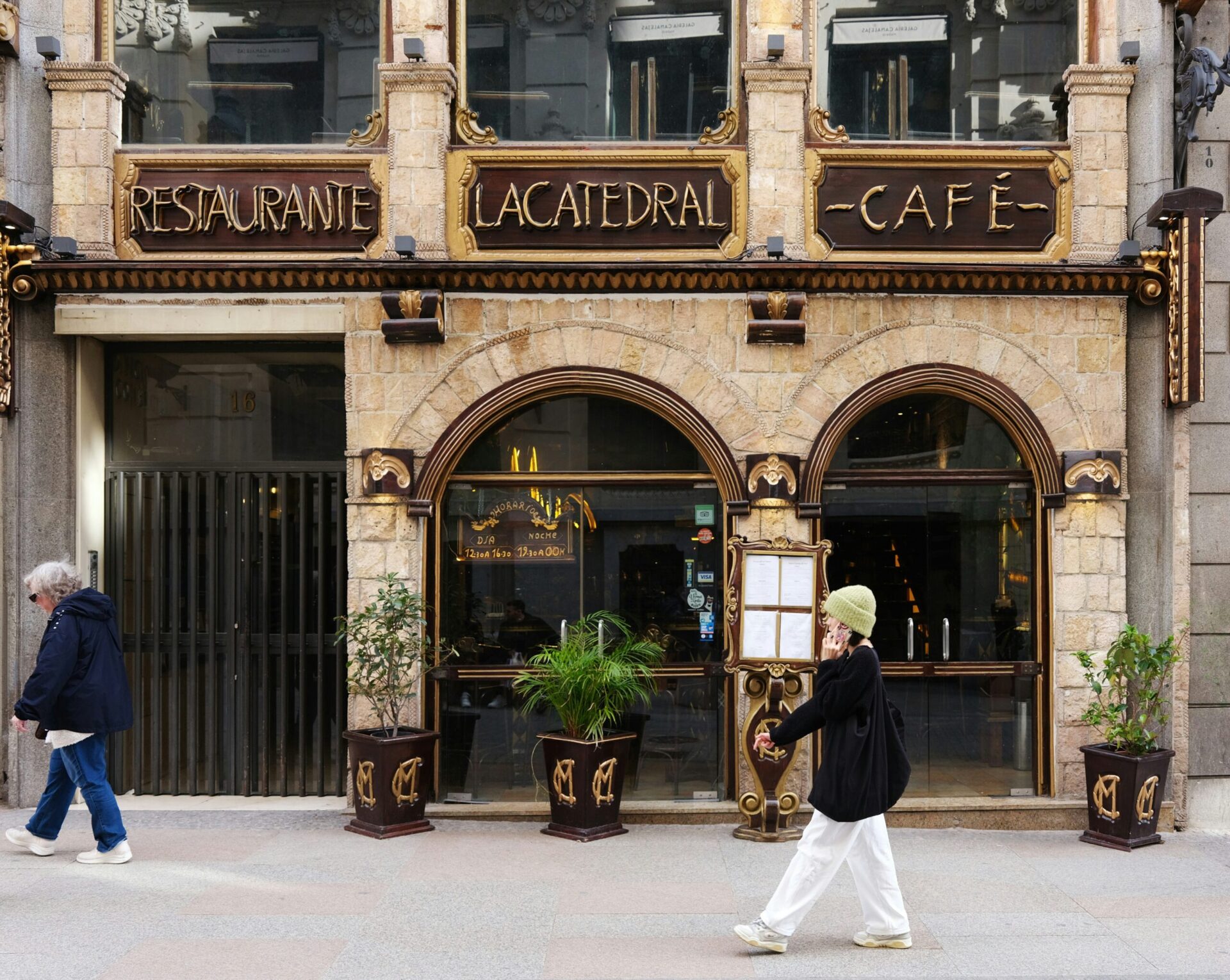
Spain, Madrid / Exchanging greetings and friendly conversation opens the doors to the local culture.
3. Your ID Card: Self-Introduction and Nationality
Now we reach the most crucial moment: a hotel receptionist asks for your name, or a seatmate on a train inquires about your homeland. Here are ready-to-use linguistic templates that allow you to structure your first introductory sentence correctly:
| Phrase Objective | Spanish Formula | Approximate Pronunciation | Meaning and English Translation |
|---|---|---|---|
| Stating Name (Option 1) | Me llamo Rakan | Meh yah-moh Rakan (Remember: LL is pronounced like Y) | My name is Rakan |
| Stating Name (Option 2) | Mi nombre es… | Mee nom-breh es… | My name is… |
| Specifying Homeland | Soy de Kuwait | Soy deh Kuwait | I am from Kuwait |
| Explaining Presence | Soy turista | Soy too-rees-tah | I am a tourist |
| Expressing Pleasure | Mucho gusto | Moo-choh goos-toh | Nice to meet you / Pleasure |
Cultural note for the traveler: Telling the other party that you are a tourist (Soy turista) doesn’t just explain your visit; it automatically prompts them to simplify their language level and speech speed out of empathy, often leading them to guide you to the best non-traditional spots in their city.
4. The Dictionary of Politeness and Smooth Departures
The biggest secret to winning the hearts of Spanish speakers is using polite words frequently in daily interactions, whether ordering a cup of coffee or asking for metro directions. Here are the essential vocabulary words along with the most common farewell phrases:
- Por favor: Please.
- Gracias: Thank you.
- De nada: You’re welcome.
- Perdón: Excuse me / Sorry (when interrupting or for a minor apology).
- Adiós: Goodbye (used for long-term separation).
- Hasta luego: See you later (the most common on the street and in shops because it leaves the door open for a near meeting).
- Hasta mañana: See you tomorrow.
Listen and Practice: Live Conversation and Greetings Video
To confirm word pronunciation and hear the native accent, watch this short video attentively and practice repeating the phrases aloud:
Live conversation to exchange greetings and introduce oneself for beginners
Linguistic and Historical Secret: “Ojalá” and the Magic of Andalusian Influence
One of the finest linguistic secrets that provides a sense of familiarity is the word “Ojalá”. When a Spanish or Latin American speaker wishes for something to happen in the future, they spontaneously say: “Ojalá!” This word is historically derived from the famous Andalusian Arabic phrase: “Law sha’a Allah” or “In sha’a Allah” (If God wills). Spanish borrowed it and preserved its exact emotional and semantic context, remaining a living testament to how languages migrate across seas to inhabit the daily lives of other cultures.
With this, we have covered excellent ground on our second day. Now you can walk into any Spanish-speaking place, offer the appropriate greeting for the time of day, and introduce yourself and your country with confidence. In the next article, we will move to another vital step every traveler needs: how to handle numbers, ask for prices, and manage financial transactions in markets and restaurants smartly to avoid exploitation. Follow along with tomorrow’s lesson!
— Learn Spanish in a Week Series —
Previous Article: 1- Introduction and Pronunciation: The Golden Key
Current Article: 2- Greetings, Welcoming, and Self-Introduction
Next Article: 3- Transportation, Directions, and Taxis
Similar Series: Learn Indonesian in a Week | Learn Turkish in a Week
- Instituto Cervantes – Direct communication curricula for beginners and tourists (Level A1).
- Real Academia Española – Dictionary of daily phrases and expressions used in the Spanish-speaking world.