Moroccan Arabic | When Even Other Arabs Get Lost

Moroccans understand you but you cannot understand them. Darija is Arabic layered with Phoenician, Amazigh, French, and Spanish — a language that sounds like its own world.
← Previous: Gulf Arabic | The Most Ancient Arabic Still Spoken
An Egyptian journalist covering a conference in Rabat sat beside a Moroccan colleague who took a phone call and spoke for a few minutes. The journalist caught scattered words — “wāsh”, “mzīyan”, “bzzāf” — but the sentences as a whole slipped past before he could hold them. The call ended and the Moroccan smiled: “Sorry, I was speaking Darija.” The Egyptian replied: “I could tell it was Arabic — but…”
The Moroccan said quietly: “You understand everything I’m saying right now, correct?” The Egyptian nodded. “That’s the difference. I’ve understood you since childhood. You’re hearing me for the first time.”
This exchange describes a real linguistic phenomenon: one-directional comprehension. And it has nothing to do with intelligence — only with exposure. But before we reach that, we need to understand why Moroccan Arabic is the furthest Arabic dialect from the Eastern Arab ear, and what made it so.
A Coast That Once Spoke Phoenician
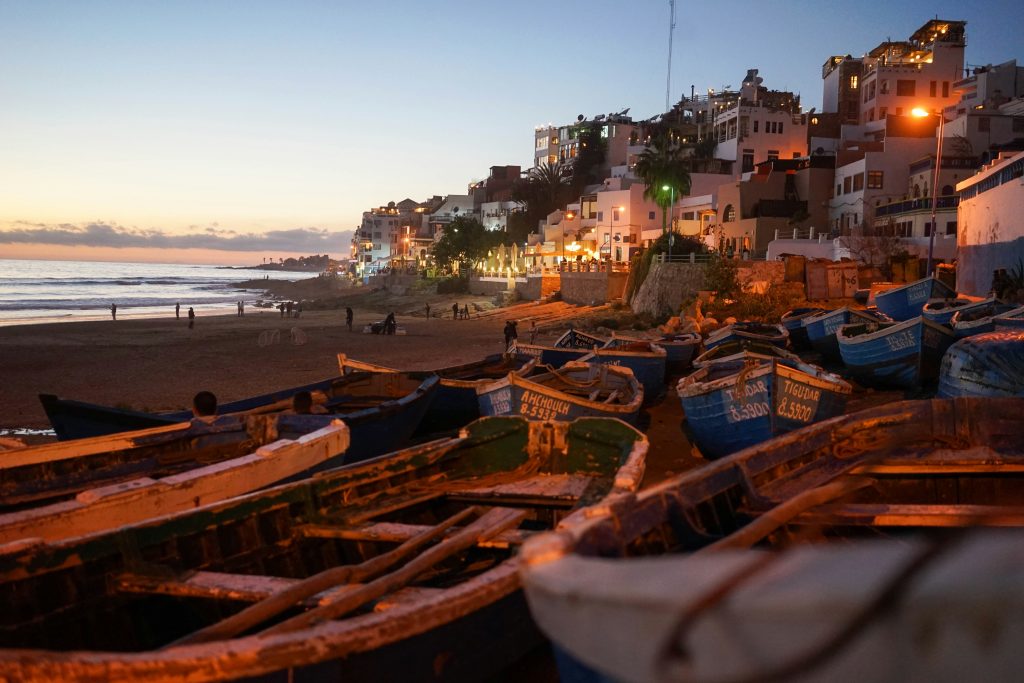
Before Arabic reached North Africa, the Mediterranean coast of Morocco spoke Phoenician — the language of the traders and sailors who founded Carthage and extended across the Mediterranean. Before that, Berber languages were the masters of the interior.
This places Morocco in its correct context: not an exception to the Arab world, but an intensified version of the rule that runs through all of it — every region spoke something before Arabic arrived, and Arabic, when it came, did not erase what was there but layered over it and absorbed it.
For a vivid nearby example: Malta — the European island in the middle of the Mediterranean — speaks an official language called Maltese, which is in essence a Sicilian Arabic dialect that crystallised from the eleventh century CE when Arabs governed the island. Maltese people are European Christians who write in Latin script, and their language is at its core Arabic. Language does not mean identity — and language does not die even when everything else around it changes.
What happened in Morocco is no stranger than this — it is entirely logical when you know that the same land received Arabic in the seventh century CE with thousands of years of linguistic layers already beneath it.
Al-Andalus — The Memory That Never Left
In 711 CE, Tariq ibn Ziyad crossed the strait that bears his name with an army of Arabs and Berbers from Morocco, and entered what would be called al-Andalus for centuries. In 1492, its last stronghold fell when Granada surrendered to Ferdinand and Isabella, and its last king Muhammad XII — “Boabdil” — wept as he looked back at the city from a hill now known as “El Suspiro del Moro,” the Moor’s Last Sigh.
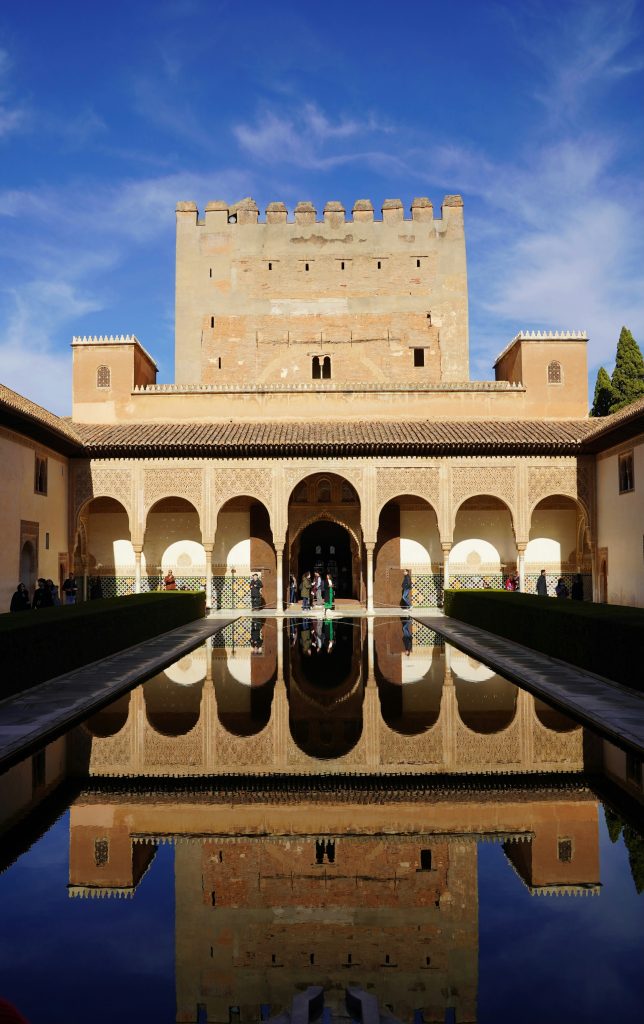
Many of those who left settled in Morocco. Their descendants remain — in Fes there is a neighbourhood called “al-Andalus” to this day, and families carrying the names of Spanish cities: al-Gharnāṭī (Granadan), al-Ishbīlī (Sevillian), al-Qurṭubī (Córdoban). In Tangier and Tétouan and the entire northern coast, Spanish is not merely a colonial inheritance — it is the memory of a return that never happened.
And al-Andalus stayed in Morocco more deeply than in names: Andalusian music — known in Morocco as “al-Āla” and “al-Gharnāṭī” — is preserved in Morocco today more completely and authentically than it is in Spain. When a Spanish musicologist wants to hear what twelfth-century Andalusian song actually sounded like, they go to Fes, not Seville.
Morocco carried al-Andalus when it could no longer be carried — and this alone explains why Moroccan Darija is a dialect that cannot be read at its surface only.
The Four Layers — Why Darija Sounds Like a Code
Moroccan Arabic is not difficult to understand because its speakers want it that way — it is because every sentence potentially carries four historical layers simultaneously:
Layer One: Arabic — the Load-Bearing Structure
Arabic is the spine of Darija — the grammar and core vocabulary are Arabic, and the sentence in its structure is an Arabic sentence. But the Arabic here is phonetically compressed and blended until it becomes unrecognisable from the outside.
Layer Two: Berber — The Phonetics and Daily Vocabulary
The ancient Berber languages — which dominated North Africa before Islam — left their mark primarily in phonetics: the accumulation of consonants and the systematic dropping of short vowels, making pronunciation rapid in a way that makes the speech hard to parse for an unaccustomed ear. Words like “bzzāf” (a lot) and “wāsh” (is it? / are you?) entered Darija from this heritage and became among its most-used words. This is no different in nature from Coptic “aywa” in Egyptian or Aramaic “hallaʾ” in Levantine — a prior linguistic layer that left its mark before receding.
Layer Three: French — Not a Guest but a Resident
Morocco was a French protectorate from 1912 to 1956. Forty-four years was enough for French to seep into the daily language organically, in a way the speaker does not consciously register:
- “al-frīzhīdīr” — the refrigerator, from frigidaire
- “al-bāsūr” — passport, from passeport
- “al-ṭūmūbīl” — the car, from automobile
More significantly: an educated Moroccan switches naturally within a single sentence between Darija and French — what linguists call code-switching — adding a further layer of difficulty for those who do not speak French.
Layer Four: Spanish — Especially in the North
In northern Morocco — Tangier, Tétouan, and the Rif — the occupation was Spanish, not French. Spanish is strongly present there, and the ear that listens to a northern Moroccan accent catches something not found in the Darija of Rabat or Marrakesh.
The Speed — The Biggest Secret of the Difficulty
But the primary reason Darija is hard to understand is not unfamiliar vocabulary — it is speed and vowel dropping.
In Classical Arabic and in most Eastern dialects, words are pronounced with their vowels, or with shortened vowels. In Moroccan Darija, short vowels are systematically dropped — consonants accumulate and the word compresses until it becomes almost a single sound. The result: a Moroccan sentence is phonetically ground before it reaches the ear of someone not raised on it.
| Meaning | Classical | Moroccan | Egyptian | Levantine |
|---|---|---|---|---|
| How are you? | kayfa ḥāluk? | kīf rāk? / lābās? | izzayyak? | kīfak? |
| Fine / Good | bikhāyr | lābās / mzīyan | kuwayyes / tamām | mnīḥ |
| What do you want? | mādhā turīd? | shnu bghīti? | ʿāyiz ēh? | shū biddak? |
| There isn’t / nothing | lā yūjad | mā kāynsh | mafīsh | mā fī |
| A lot | kathīran | bzzāf | ktīr / awi | ktīr |
| Now | al-āna | dāba | dilwaʾti | hallaʾ |
Mohamed Choukri — The Book the World Read Before the Arabs
If every Arabic dialect has a literary name that represents it in modern literature, the name for Moroccan Arabic is Mohamed Choukri.
Choukri was born in 1935 in the Rif mountains of northern Morocco and lived an exceptionally harsh childhood — poverty, famine, and violence on the streets of Tangier. He did not learn to read and write until he was twenty. When he wrote, he wrote in Classical Arabic — but in the spirit of the raw Moroccan street, without beautification or apology.
The remarkable detail: his novel Al-Khubz al-Ḥāfī (For Bread Alone) was translated into English by the American writer Paul Bowles in 1973 and published — and the world read it. But the Arabic edition was not published until 1982, because the novel was considered too frank in its depictions of poverty, sexuality, and violence. Morocco’s most internationally famous literary work appeared in global translation before it could be read in Arabic in its own country — and this alone says much about the complex relationship between literature, censorship, and identity.
Choukri wrote in Classical Arabic because it was the literary tool — but what he wrote was the voice of Moroccan Darija and the city of Tangier and every street he had lived. Fusha was the language; Morocco was the soul.
Gnawa — When Music Says What Words Cannot
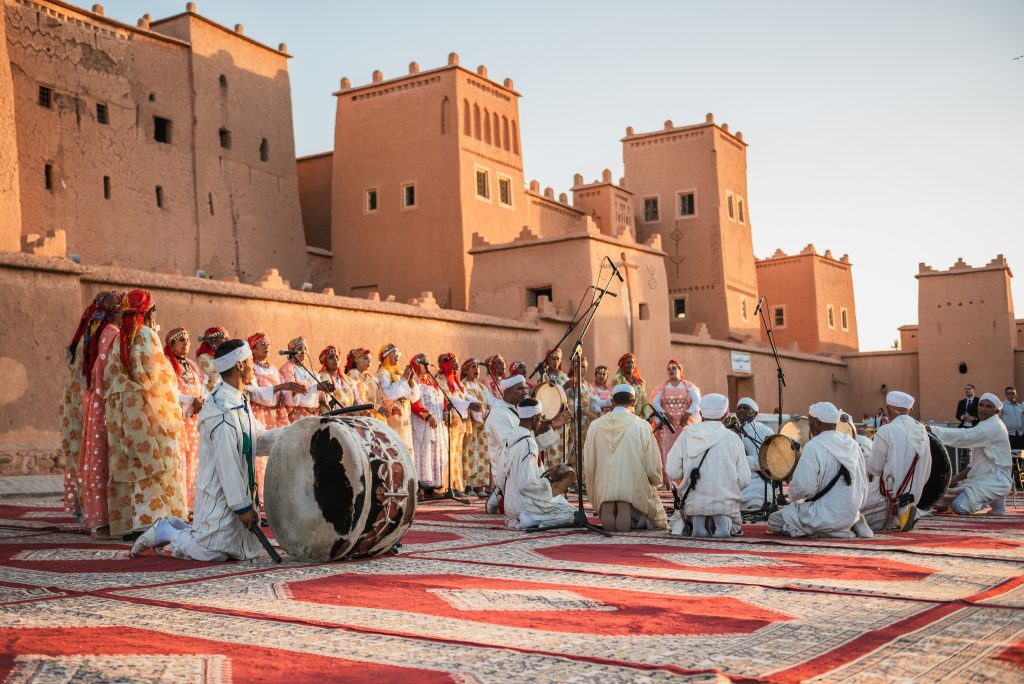
Morocco carries in its musical heritage something rare: Gnawa music — the African spiritual tradition that arrived with enslaved Africans who reached Morocco via the Saharan trade routes over the centuries. Its rhythms are repetitive and trance-inducing, its performance originally ceremonial and spiritual, and it is today one of the most internationally present Moroccan musical forms.
Gnawa differs from the Leiwah of the Gulf — which also arrived via trade routes, but across the Indian Ocean rather than the Sahara. Both are daughters of different trade corridors that connected sub-Saharan Africa to the Arab world by two parallel paths.
The Moroccan Understands You — and the Internet Is Changing the Rest
We return to the phenomenon we opened with: one-directional comprehension. Moroccans are exposed from childhood to Eastern Arab content — Egyptian, Levantine, and Gulf — through satellite television and the internet. This sustained exposure builds genuine linguistic familiarity. The reverse was not true — the Eastern Arab rarely encountered Darija.
But something has changed. Saad Lamjarred — the Moroccan singer who rose to the top of Arab charts with songs in near-pure Darija — achieved hundreds of millions of YouTube views across the entire Arab market. Eastern audiences did not understand every word, but they loved the song. This was the largest spread of Moroccan Arabic in history — not through official television but through a YouTube algorithm.
What Saad Lamjarred began, a generation of Moroccan content creators on TikTok and Instagram continues. Every clip an Eastern Arab watches in Darija is a language lesson that was never taught in any classroom.
Words That Open Moroccan Doors
- “lābās” — fine, no problem. The most common greeting exchange — “wāsh lābās ʿlīk?” means “how are you?” and the answer is “lābās, al-ḥamdu lillāh.”
- “mzīyan” — good / excellent. Say it warmly and a Moroccan will understand everything about you.
- “bzzāf” — a lot. “Shukran bzzāf” — you will smile when you hear the response.
- “wāsh” — is it? / are you? / right? — the functional word that opens every question.
- “dāba” — now / in a moment. Short, comfortable, unlike any equivalent in any other dialect.
The final article in this series: The Traveller’s Language Guide | If You’re in an Arab Country. Now that you know Egyptian, Levantine, Iraqi, Gulf, and Moroccan — what do you actually do when you land at Cairo airport, or Dubai, or Casablanca? What words open doors everywhere? And what do you do when you simply do not understand?
← Previous: Gulf Arabic | The Most Ancient Arabic Still Spoken | Next: The Traveller’s Language Guide →