
Walter Stace | The Philosopher Who Crossed All Borders

Religion is no longer a matter of private faith or spiritual need. Today it is shaped by geopolitics, packaged as a consumer product, and sold on social media. Walter Stace, a British philosopher who died in 1967, spent his life asking the questions that might still save us from this confusion — if we are willing to listen.
Walter Stace and the Need for Perennial Philosophy in a World That Has Lost Its Way
Religion is no longer a matter of private faith or spiritual need. Today it is shaped by geopolitics, packaged as a consumer product, and sold on social media. Walter Stace, a British philosopher who died in 1967, spent his life asking the questions that might still save us from this confusion — if we are willing to listen.
I. Religion as a Political Tool
It is no longer a secret that religion is changing. It is moving away from being a deep human need and becoming a political tool that is reshaped according to the interests of the international order, not according to the needs of the human conscience.
Look at Afghanistan: in the early 2000s, Western powers went to war against the Taliban(1) using the language of human rights and women’s freedom. Then in 2021, those same powers left Kabul, and the Taliban returned to power without changing their ideas at all. The war was not about religion. Religion was just an excuse.
Iran(2) is described as a dangerous theocracy when it suits Western pressure, but becomes a “regional stability partner” when strategic interests require cooperation. And Saudi Arabia(3) exported a strict religious ideology around the world for decades, with comfortable Western silence. Religion here is not measured by what it actually says, but by what it offers to the table of interests.
We say this not to mock, but because pointing to this reality is necessary before we can talk about religion the way it should be understood: as a deep human need that comes before any political statement and goes beyond it. This is exactly what Walter Stace worked on throughout his life, and this is what makes introducing him again an urgent need today, not just an academic exercise.
Religion also has a third dangerous face today: it has become a consumer product. In the West, the “spirituality industry” is worth billions of dollars — from paid meditation apps, to yoga tourism, to self-awareness content on social media. In the Muslim world, religious content has become a digital product controlled by views and algorithms. Religion is being marketed, and the soul is being sold in installments. In this situation, Stace, that British philosopher who died sixty years ago, seems more relevant than he was in his own lifetime.
II. Philosophy and the Mid-Twentieth Century — An Age That Will Not Return
There is a truth that the history of philosophy does not always help us see: the mid-twentieth century produced philosophers who could speak across borders — across specializations, religions, and civilizations. This was not an accident. It was a response to a real question that World War II asked with great violence: if educated and religious Western civilization could produce such destruction, what went wrong, and where is the shared thread that connects humanity and stops it from collective suicide?
Henri Bergson(4) was not just a philosopher of evolution and vitality. In his last work,(5) he offered the concept of “open religion” — one whose spirit goes beyond its historical frame to touch the universal. When Bergson chose in 1941 to register himself as Jewish despite being offered an exemption from Vichy laws, he was living his philosophy, not just writing it. He died that year, and the era he represented seemed to close with him.
After the war, everything changed. The project of rebuilding Europe needed institutional language: international law, UN organizations, economic agreements. Philosophy was asked to give these structures legitimacy, not to question them from the height of spirit and meaning.
And so began the age we live in: the age of excessive specialization. In Western universities today, a specialist in medieval Christian mysticism may not feel required to read Ibn Arabi, and a specialist in Hindu Vedanta may consider approaching Christian mysticism a crossing of boundaries. Specialization is a gift in depth but a problem in breadth. And the philosophy concerned with what humans share finds itself in a zone that no one claims.
III. Walter Stace — Life and Project
Between Colombo and Princeton: A Life That Crossed Borders
Walter Terence Stace(8) was born in London in 1886 into a military British family that was expected to set his path in life. He graduated from Trinity College in Dublin with a solid philosophical background — studying Hegel,(9) Kant,(10) and others — then joined the British Civil Service and found himself on the island of Ceylon (now Sri Lanka), where he spent twenty-two years (1910–1932).
Those years in the East were not a colonial vacation. They were an unplanned laboratory for his greatest project. In the East, Stace discovered Hinduism and Buddhism, and saw in Indian and Sinhalese mystics experiences he recognized from his books about Western mysticism. He began to ask: is what the Buddhist monk describes in a moment of enlightenment the same as what Saint John of the Cross, Ibn Arabi, and Meister Eckhart described? If the answer is yes, this means something fundamental about human nature and consciousness. A street in Colombo still carries his name today.

In 1932 he moved to Princeton University(11) as a professor of philosophy. Among his students was John Rawls,(12) who became the author of the most famous political theory of the twentieth century. Stace died in August 1967 in California.
His Works: Three Stages, One Thread
Stace’s intellectual journey can be read across three separate stages that seem far apart at first, but in reality follow one thread toward one goal: understanding the nature of human consciousness when it goes beyond the limits of rational thinking.
Stage One: Building the Philosophical Foundation
Stace began with a history of Greek philosophy,(13) a book he wrote in the early mornings on Ceylon soil before his workday began. Then he gave a systematic explanation of Hegel’s philosophy,(14) which brought him to the attention of Princeton University. He followed this with a book on aesthetics,(15) arguing that true aesthetic experience touches what mystical experience touches: a feeling of unity that goes beyond logical description.
His most rigorous academic work is The Theory of Knowledge and Existence,(16) published by Oxford University Press. It is a key book because it shows why the empirical Stace arrived at mysticism rather than atheism: when he discovered that strict empirical method alone cannot prove the existence of an external world convincingly, he found that there is a face of reality that resists the empirical method without denying it. From there he opened the door to inner experience.
Stage Two: The Human Being Facing History
In The Concept of Morals(17) Stace argued that ethics are not simply a social custom or a random divine command, but are drawn from the nature of human consciousness itself. In The Destiny of Western Man,(18) written during the war, he argued that the West’s crisis is at its core a philosophical crisis: when civilization gave up the concept of stable human nature in favor of complete relativism, it opened the door to tyranny.
His most widely read piece in this stage was an essay published in The Atlantic(19) that created wide debate. He argued that modern science since Galileo(20) had produced a picture of the universe with no room for purpose, meaning, or God. Instead of calling people to comfortable religious illusion, he called them to face this darkness honestly.
Stage Three: Mysticism as Philosophy, Not Religion
His deepest book is Time and Eternity,(22) which deals with the relationship between the human moment in time and divine eternity. He uses the concept of the “timeless moment” that the mystic lives outside of linear time, and discusses both negative and positive concepts of God.
The summary of his great project came in two books published together in 1960: Mysticism and Philosophy(24) and The Teachings of the Mystics.(25) In the first, Stace built a philosophical method for comparing mystical experiences across civilizations, separating “extrovertive” mysticism (finding unity in external nature) from “introvertive” mysticism (reaching it through silent inner meditation). In the second, he collected documented selections from mystical texts across all major civilizations, creating a rare comparative archive.
IV. The Constructivist Objection — A Debate Not Yet Settled
Stace’s argument about a shared religious core did not pass without serious challenge. In the 1980s, philosopher Steven Katz(26) led a movement called Constructivism. Its argument: mystical experience is not the same across cultures as Stace claims. It is shaped in every part by the cultural, religious, and spiritual training context. In other words, what a Buddhist monk experiences in meditation is, in its actual content, a purely Buddhist experience, and does not really resemble a Christian mystic’s experience except on the surface when both are translated into English.
The argument is strong at the methodological level. But there is a real gap in it worth pointing to:
If mystical experience is completely shaped by culture, how do we explain that mystics who never met and were born in civilizations that never talked to each other describe what they describe with striking similarity? Ibn Arabi never read Meister Eckhart, and the Chinese mystic Lao Tzu never heard of Rumi. Is this a meeting of human imagination, or a meeting of experience?
Before today I used to reject my companionif his religion was not close to mine.
But now my heart has become able to hold all forms:
a meadow for deer, a monastery for monks,a temple for idols,
the Kaaba for pilgrims,the tablets of the Torah, the pages of the Quran.
— Ibn Arabi, The Interpreter of Desires
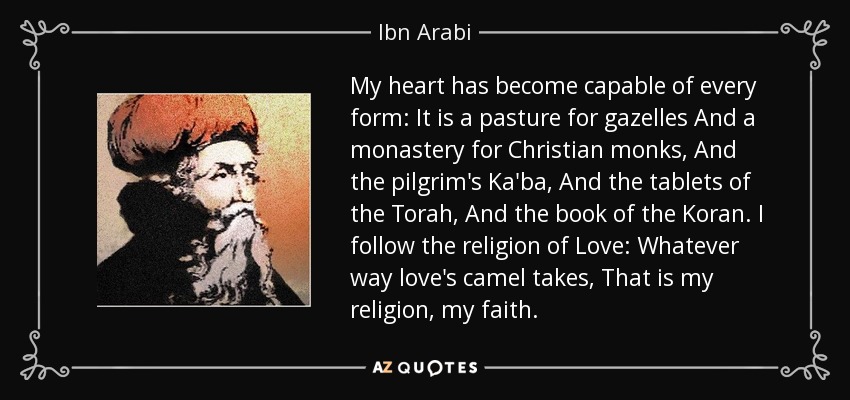
These lines are themselves evidence in the middle of this debate: a great Islamic mystic(27) describes in his own language — not in Stace’s language and not in Katz’s — an experience of crossing religious borders from the inside. Philosopher Robert Forman(28) noted that Katz proves what he claims through assumption rather than evidence: in his method it is impossible to prove a shared experience, because he sends every description back to its cultural context, making the question untestable.
Ralph Hood(29) presented experimental psychological studies that supported the distinction Stace made between experience and interpretation: mystics in different cultures describe the same experience of unity, but interpret it using different cultural frameworks. And this separation between experience and its interpretation is exactly what Stace established.
V. Has the West Lost Its Soul? Three Angles
We cannot do justice to Stace and the importance of his project today without asking the uncomfortable question that Western academia usually avoids: is the West, which has won economically and technologically, also living through a real spiritual crisis? We ask this from three opposing angles.
Angle One: The West Is Fine — No Need for the Soul
Objective indicators say the West is doing well: life expectancy has risen, extreme poverty has fallen, wars between Western states have ended since 1945, and individual freedoms have grown. Some secular philosophers have argued that humanity does not need anything beyond the material to organize its moral life. Law, social contract, and shared interest are enough.
Angle Two: The Data Says Otherwise
But other data makes this picture more complicated. Britain created a Minister for Loneliness(30) because the epidemic of loneliness had become costly for health and the economy. Rates of depression, anxiety, and addiction are rising in the West alongside rising material prosperity, not instead of it. This is exactly what Abraham Maslow’s(31) theory of human needs predicts: when humans satisfy their lower needs, they do not stop but search for deeper meaning. Viktor Frankl,(32) who described this from inside Nazi concentration camps, called the result of missing spiritual direction “existential emptiness.”
Angle Three: Soul Without Philosophy
The most interesting angle is this: the West has not lost its soul so much as it has scattered it. The industry of yoga, meditation, and psychedelic experiences has grown enormously since the 1990s, now worth billions of dollars annually. But it is a soul without philosophy: experiences without a critical framework, feelings without a careful method.
The difference between soul with philosophy and soul without philosophy is exactly the difference that Stace represented. He was not asking us to abandon mystical experience because it cannot be scientifically tested, nor to accept it blindly. He was saying: let us put this great human experience in front of the same serious philosophical questions we put any other phenomenon in front of. The results will surprise you.

VI. A Note from the Arab Reader
We cannot introduce Stace to the Arabic reader without noting something that has appeared in more than one place: Stace is a writer with wide vision when it comes to Hindu, Buddhist, and Christian mysticism, but his knowledge of Islamic mysticism was narrower than it should have been given its depth and richness.
Perhaps the most striking thing is that when he deals with Islamic mysticism he usually cites Al-Ghazali and Rumi. Al-Ghazali, despite his greatness, represents in the history of Islamic mysticism a special case that belongs to the tradition of combining religious law and mysticism, and is not a typical example of pure mystical experience. As for Rumi, he reached the West in a poetic and aesthetic form controlled by specific translators, so in Western consciousness he became closer to an inspirational symbol than a mystic in the precise sense.
What reveals this gap clearly is reading the footnotes in the Arabic translations of his books: Arab translators quickly point out what needs to be corrected, noting that Stace often ignores Ibn Arabi despite the fact that Ibn Arabi built the deepest theoretical structure for Islamic mysticism and is the one who spoke of unity of existence in a way that challenges all categories. He also ignores Al-Niffari and Abu Yazid al-Bistami and Al-Hallaj, while giving space to less important names from Christian mysticism.
Despite this limitation, it did not stop the Arab reader familiar with the book from enjoying it and learning from it. It may even have opened an additional appetite: to return to his own mystical heritage armed with philosophical questions he would not have asked without Stace. And this alone counts in Stace’s favor.
Conclusion: The Soul Is Not a Product
We return to where we started: religion today faces two parallel dangers. The first is being turned into a political tool, where it gets its worth from the international order rather than from its own value. The second is being turned into a consumer product, sold every day in smaller packages, with faster experiences and shorter guarantees.
Against both dangers Stace’s project stands, even if he did not name them this way. In everything he wrote he was saying: real spiritual experience belongs to no single religion, cannot be claimed by any political system, and cannot be reduced to an entertainment product. At its core it is a crossing of borders: the borders of identity, of the self, of language. And this is exactly what a world needs that is being torn apart by wars where religious flags are raised to serve agendas that have nothing to do with God or the soul.
In a world where a people learns today to hate another people in the name of God, and in a world where people measure their spiritual experiences by the number of likes, Stace with his big questions and his patient method seems more necessary than ever. Not because he has the answers, but because he has the right questions.
And the Perennial Philosophy(33) that he represented remains an intellectual choice that has not been used up: not a call to merge religions or erase cultural identities, but the ability to listen to what humans share in their depths without canceling what makes each one different on the surface. And this exact balance is what the great ideologies today lack — the globalization that standardizes surfaces without touching depths, and the closed identities that hold on to depths and prevent any contact on the surface.
Notes and Index of Names
Footnotes
(1) Taliban: An Afghan Islamic movement that retook control of Afghanistan in 2021 following the US withdrawal. Source: UN documents and Reuters, 2021.
(2) Islamic Republic of Iran: The political system established after the 1979 revolution. Source: Human Rights Watch reports.
(3) On the export of religious ideology from the Gulf: Hegghammer, T. (2017). Jihad in Saudi Arabia. Cambridge University Press.
(4) Bergson, Henri (1859–1941): French-Jewish philosopher, Nobel Prize for Literature 1927. One of the leading philosophers of life and time in the modern West.
(5) Bergson. The Two Sources of Morality and Religion. Original: Les Deux Sources de la Morale et de la Religion, 1932.
(6) James, William (1842–1910): American philosopher and psychologist, founder of Pragmatism, the first to approach religious experience systematically.
(7) James, William. The Varieties of Religious Experience, 1902.
(8) Stace, Walter Terence (1886–1967): British philosopher. Professor of Philosophy at Princeton University 1932–1955. President of the Eastern Division of the American Philosophical Association 1949.
(9) Hegel, Georg Wilhelm Friedrich (1770–1831): German philosopher. Known for the dialectical method (thesis, antithesis, synthesis) and the concept of Absolute Spirit.
(10) Kant, Immanuel (1724–1804): German philosopher, author of Critique of Pure Reason. Distinguished between the world of appearances (Phenomenal) and the thing in itself (Noumenal).
(11) Princeton University: American university founded 1746, located in New Jersey.
(12) Rawls, John (1921–2002): American political philosopher, author of A Theory of Justice, 1971
(13) Stace. A Critical History of Greek Philosophy, 1920. Available free at Project Gutenberg.
(14) Stace. The Philosophy of Hegel: A Systematic Exposition, 1924.
(15) Stace. The Meaning of Beauty, 1929.
(16) Stace. The Theory of Knowledge and Existence, 1932. Oxford University Press.
(17) Stace. The Concept of Morals, 1937. Available in Arabic translation.
(18) Stace. The Destiny of Western Man, 1942.
(19) The Atlantic Monthly: American literary and intellectual magazine founded 1857. Published Stace’s essay “Man Against Darkness” in 1948.
(20) Galileo Galilei (1564–1642): Italian scientist, considered the founder of modern physics.
(21) Marius, Richard (1933–1999): American historian and novelist, professor at Harvard University.
(22) Stace. Time and Eternity: An Essay in the Philosophy of Religion, 1952. Princeton University Press.
(23) Stace. Religion and the Modern Mind, 1952.
(24) Stace. Mysticism and Philosophy, 1960.
(25) Stace. The Teachings of the Mystics, 1960.
(26) Katz, Steven: American academic philosopher. Edited Mysticism and Philosophical Analysis, 1978.
(27) Ibn Arabi, Muhyiddin (1165–1240): Andalusian philosopher and mystic. Author of the theory of Unity of Being. His major works: The Meccan Revelations and The Bezels of Wisdom.
(28) Forman, Robert: American philosopher and researcher in religious experience. Edited The Problem of Pure Consciousness, 1990.
(29) Hood, Ralph: American religious psychologist at the University of Tennessee. Developed the Mysticism Scale supporting Stace’s distinction between experience and interpretation.
(30) The United Kingdom created the role of Minister for Loneliness in 2018 under Prime Minister Theresa May, recognizing loneliness as a national health crisis.
(31) Maslow, Abraham (1908–1970): American psychologist. Creator of the famous hierarchy of human needs.
(32) Frankl, Viktor (1905–1997): Austrian psychiatrist and Holocaust survivor. Creator of Logotherapy. His book Man’s Search for Meaning is one of the most widely read books of the twentieth century.
(33) Perennial Philosophy: A philosophical spiritual current arguing that one essence runs through all major religions and spiritual traditions. The term was used by Leibniz, revived by Aldous Huxley in The Perennial Philosophy (1945), and given its strongest philosophical foundation by Stace.