

Orientalism’s Mirror: Said & Translation

A balanced critical reading of Edward Said’s Orientalism — what he got right and where he fell short — and how the Orientalist system shapes the translation and reception of the Arabic novel in the West.
When Edward Said’s Orientalism appeared in 1978, it was not simply an academic study of European intellectual history. It was a bomb thrown by a Palestinian thinker from the heart of Columbia University in New York, and its tremors reached every university from Tokyo to Cairo. But — as bombs tend to do — it also burned some of what it had not intended to burn.
In this article — the fourth in the series The Arabic Novel: A Literary Map — we look at Said and Orientalism with balanced critical eyes: what he got right and where he fell short, who agreed with him and who pushed back, and why the idea of “the powerful drawing the image of the weak” is not a Western invention but a recurring civilizational pattern in every culture. And most importantly: how all of this reflects on the Arabic novel, on its translation, and on how it is received in the West.
Part One: Who Was Edward Said — Beyond the Familiar Portrait
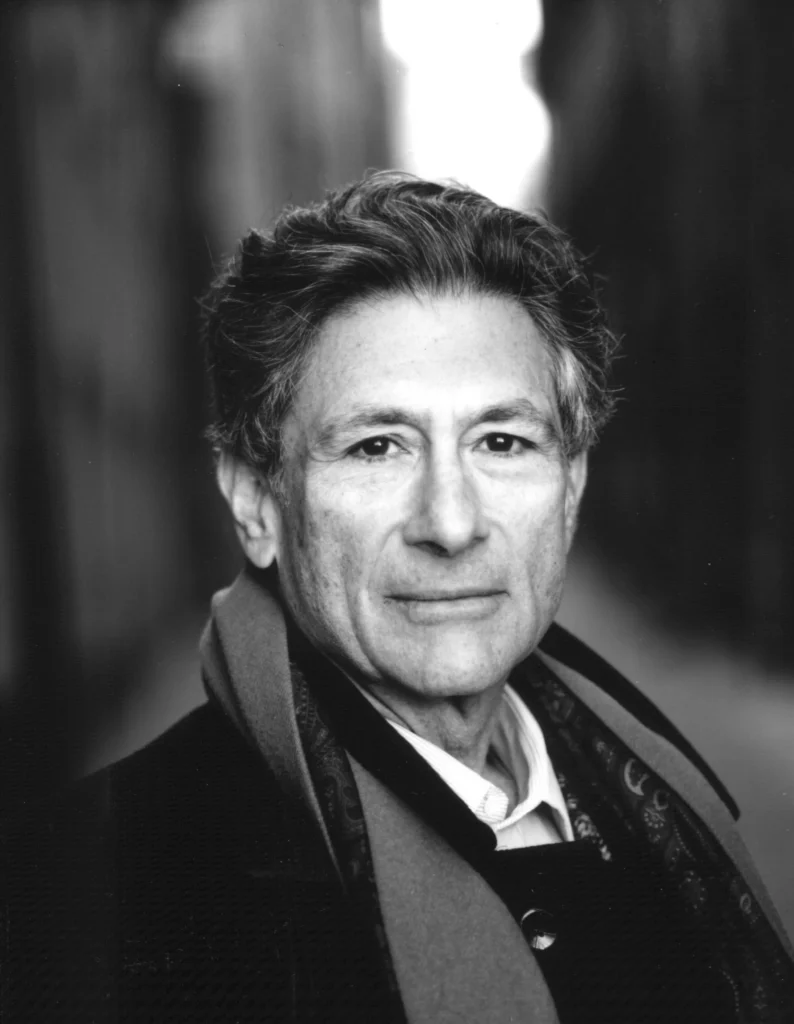
Many people know Said as the Palestinian thinker behind Orientalism theory. Fewer know the rest of the picture — which is far more complex and interesting than any ideological label.
The pianist: Edward Said was not a thinker who spent his life only in libraries. He was an accomplished classical pianist and a music critic for The Nation magazine for years. Together with Argentinian-Israeli pianist Daniel Barenboim, he founded the West-Eastern Divan Orchestra — a group of Arab and Israeli musicians who performed together. Said believed that music crosses political barriers where words fail. This man who wrote about cultural imperialism was, at the same time, building a shared culture through the oud and the violin.
The irony of the name: His father chose the name “Edward” in admiration of Edward, Prince of Wales, who visited the region in 1935 and made a favorable impression. Said noted this irony in his memoirs: a man who would spend his life dismantling British imperialism carried a name chosen in tribute to its beloved prince.
The break with Foucault: Michel Foucault influenced Orientalism deeply — the idea of discourse as power, the entanglement of knowledge and authority. But Said later criticized Foucault sharply, arguing that Foucault’s philosophy had become “sealed”: it described the mechanisms of power with brilliant precision but opened no door for exit or real political change. Said wanted a philosophy that liberates, not only one that diagnoses. The difference is subtle but decisive.
The double identity: Born in Jerusalem to a Christian family, raised in Egypt, educated in British-style schools, specializing in English literature at Harvard. He was the Palestinian who never lived in Palestine, the American who never felt American, the Arab who wrote Arab thought in English. The contradiction of his identity was precisely what made him more qualified than most to see “the Other” from inside and outside at the same time.
Part Two: What Said Actually Argued — A Fair Summary
Orientalism in Said’s sense is not simply “the study of the East.” It is a knowledge-power system produced by European civilization to understand, classify, and manage the East. Books, articles, novels, diplomatic reports — all are tools of this system — which produced “the Orient” as a place of strangeness, backwardness, and dangerous enchantment. Not because this was true, but because this image served the project of colonial domination.
The central idea: knowledge is not neutral. Whoever produces knowledge about “the Other” holds a degree of power over them. When a European Orientalist describes the “Oriental” as emotional, irrational, and incapable of self-governance — he is not describing reality. He is constructing a justification for colonialism.
The effect on Arabic literature is direct and sharp. The Arabic novel that reaches Western readers does not arrive unmediated. It passes through a chain of choices: the translator selects what to translate, the publisher selects what to accept, the rights agency selects what to market, and international literary prizes select whom to honor. This chain is not neutral. It carries a “taste” shaped largely by the Orientalist expectations Said described.
If we examine the Arabic novels most present in the West, we find that most of them circle around specific themes: authoritarianism, the condition of women, Islam and extremism, war. These are not all of the Arabic novel — but they are the portion that gets “read” over there.
Part Three: What Was Said Against Said — A Fair Critique
Acknowledging Said’s importance does not require accepting him uncritically. Several serious objections were raised against him:
Ignoring German Orientalism: Said focused on British and French Orientalism because of their direct link to military colonialism. But he largely ignored “German Orientalism,” which was primarily academic — Wilhelm Dilthey, Max Weber, Johann Fück — and produced enormous scholarship on the Arabic language, Islam, and Persian literature without Germany holding significant colonies in the East. Was this Orientalism also a tool of power? The answer is not simple.
Overgeneralizing the method: Critics including the historian Albert Hourani argued that Orientalism drew the figure of “the Orientalist” in lines too fixed: always biased, always serving power. But many European Orientalists were genuinely fascinated by Islamic civilization to the point of deep admiration, and some actively defended Arabs and Muslims against their own governments’ policies. Edward William Lane, Henri Massé, and others are examples of this complexity.
Reverse Orientalism: This later concept is the most thought-provoking: some Arab and Eastern intellectuals adopted the Orientalist’s view of themselves. Boasting that “the East is spiritual and the West is materialist,” or portraying Eastern identity as deep and authentic against Western shallowness — this falls into the same trap from the other door. Said himself warned against this, but many of his admirers fell into it.
The agency problem: Historian Niall Ferguson and others criticized Said for depicting colonized peoples as passive victims with no agency, no capacity to influence the image drawn about them. This portrayal — despite its liberatory intentions — reinforces in another way the idea of inherent weakness.
Part Four: Who Agreed With Him — The Alliances of Thought
Said was not a lone voice. Around him formed what might be called the “academic margins coalition.”
Noam Chomsky — despite radically different specializations (political linguistics versus literary studies), Chomsky supported Said’s view of the way knowledge is deployed to serve empire. Both saw the academic intellectual as someone carrying a political responsibility that cannot be evaded under the cover of “scientific neutrality.”
Gayatri Chakravorty Spivak — the Indian thinker who carried Said’s thought to a deeper level. Her famous essay “Can the Subaltern Speak?” extends Said’s critique to include the Eastern woman as doubly marginalized: Orientalized for being Eastern, silenced for being a woman. Spivak added gender to Said’s equation.
Aijaz Ahmad — the Indian Marxist who differed from Said on methodological details but agreed in essence that the structure of colonial discourse operates regardless of the intentions of its producers. His book In Theory is an extended argument with Said — the kind of disagreement that honors its subject.
Tzvetan Todorov — the Bulgarian-French philosopher who analyzed in The Conquest of America (1982) how the Spanish did not only conquer the indigenous peoples militarily but “conquered” their knowledge, their names, and their history too. This analysis walks alongside Said’s analysis of the East, though from a different geographical context.
Part Five: The Pattern Is Not Western — Orientalism in Every Civilization
Here we arrive at the most important and least commonly discussed point in debates about Said: what he described as Orientalism is not a European invention. It is a recurring civilizational pattern that appears in every time and place, whenever one civilization holds sufficient power to produce its “image” of others.
The historical fact that is too often avoided: civilizations influence each other by necessity, and the weaker being shaped by the stronger is a law with no exceptions. The real question is not “do we absorb influence?” but “how do we absorb it — as conscious selective engagement or as complete surrender?”
In the European Middle Ages — when Europe was in its relative “darkness” — ambitious young Europeans learned Arabic because it was the language of science, philosophy, and medicine. The medical school at Montpellier in France (twelfth century) taught Arabic medical texts — Ibn Sina and Ibn Rushd — directly in Arabic or in freshly made Latin translations. Arabic was what English is today: the language of access to universal knowledge. This is not an exception; it is the law of civilizational circulation.
By the same logic: “Japanese Orientalism” is less discussed in Arabic writing but is well documented. When Japan entered its modernization era (the Meiji period) and wanted to become a modern power, it first constructed an image of China and Korea that closely resembles the European image of the Arabs: peoples “ancient and incapable, in need of guidance.” This image was the ideological justification for Japanese imperial expansion. The Orientalist was not always white.

Part Six: China and After Said — Orientalism Deconstructs Itself
When Orientalism was translated into Chinese in the 1990s it caused an intellectual earthquake, but the Chinese used it in two contradictory ways that reveal the depth of the problem Said was diagnosing:
The nationalist use: Some Chinese intellectuals used Said’s ideas to argue that the West always portrays China as an “authoritarian dragon” or a “backward country” to justify political containment. This is a partially legitimate use, but dangerous when it becomes a shield against any self-criticism.
Self-Orientalism: Chinese studies emerged warning that Chinese people themselves were beginning to “Orientalize themselves”: presenting exotic traditional arts, the most dramatic cultural symbols, in film festivals and tourism programs — not because these best represent Chinese reality, but because they are the most “Orientalist,” meaning what the West expects to see. Said had specifically warned against this trap, yet the irony is that his book sometimes became a tool for falling into it rather than a way out.
The most mature Asian response to Said’s thought came from Taiwanese scholar Kuan-Hsing Chen in the concept of “Asia as Method”: instead of China always comparing itself to America, and India always comparing itself to Britain as the standard of progress or backwardness — Asian nations should compare themselves to each other. Asia should become its own cultural reference. This is exactly what Said wanted for the East: to stop seeing itself only through the other’s mirror.
In Japan, Said became the primary academic reference for understanding how an Eastern nation can practice “Orientalism” on other Eastern peoples. In South Korea, thinkers used him to dismantle “Japanese centrism” in the writing of history — deconstructing the colonizer’s narrative (whether Japanese or Western) using tools borrowed from another colonized person: the Palestinian Edward Said. These entanglements are remarkable and confirm that good ideas have no single homeland.
In India, Orientalism became the founding text of the Subaltern Studies movement, enabling Indian historians to write the history of the poor and the marginalized away from British colonial records. Said — the Palestinian who wrote in English from an American university — became the tool that the marginalized in South Asia used to reclaim their history from the colonizer.
Part Seven: Orientalism and the Arabic Novel — Translation as a Mirror
We return to the core question: what does all of this have to do with the Arabic novel and how it is read in the West?
The Arabic novel that reaches Western readers does not arrive directly. It passes through a chain of choices: the translator selects what to translate, the publisher selects what to accept, the rights agency selects what to market, and international literary prizes select whom to honor. This chain is not neutral. It carries a “taste” shaped largely by the Orientalist expectations Said described.
A pattern is hard to ignore: Arab writers who are most frequently translated and recognized by Western prizes tend to share one or more of the following: they write about their societies as a “problem” being explained to the West; they present characters embodying the conflict between “traditional East and Western modernity”; or they write about war, authoritarianism, and oppressed women in ways that feed pre-existing expectations.
This does not mean these novels are dishonest or without value. Azazeel, Gate of the Sun, and Celestial Bodies are serious works by any measure. But the question that a genuine Saidian awareness raises is: why did Cities of Salt by Abd al-Rahman Munif — perhaps the most ambitious Arabic novel ever written — not reach Western readers with the same force? Perhaps because it complicates the image instead of simplifying it.
The translator is not necessarily a traitor, and Western publishers are not necessarily conspiring. But the system that governs selection in translation reflects assumptions formed over two centuries of academic and literary Orientalism. Said did not ask us to hate this system — only to make it conscious of itself.

Part Eight: After Said — Civilizations Turn and Do Not Stop
When we place Said’s thought in its broader historical context, we arrive at a conclusion that may seem to contradict the spirit of his book but is in fact an extension of it:
The weaker being shaped by the stronger is not a conspiracy — it is a natural law in the history of civilizations. European students in the eleventh century learned Arabic in Toledo and Córdoba not necessarily out of love for “the Other” but because Arabic was the key to knowledge. Three centuries later, the balance shifted. The Japanese learned German and French in the nineteenth century. Koreans learned Japanese in the twentieth century against their will. Today everyone learns English. Tomorrow — no one knows.
What makes Said important is not his discovery that the powerful draw the image of the weak — that was already known. What makes him important is his insistence that this image can be deconstructed, and that peoples who are drawn about have the right and the capacity to draw their own image. The Arabic novel — at its highest levels — is precisely this act: drawing the self from the inside, in the language of the self, for the purposes of the self. Even if the West later reads it through other eyes.
And the Arabic novel that carries this awareness — and writes with full freedom regardless of Western expectations, neither courting them nor reflexively rejecting them — is the novel that deserves to be read. Not because it is “Eastern” or “different” or “a marginalized voice,” but because it is genuine human literature that happened to be written in Arabic.
Next in the series: East vs West: Identity and Conflict — from Tayeb Salih to Jabra Ibrahim Jabra: how the Arabic novel lived the identity conflict at its deepest literary levels.
References
- Edward Said, Orientalism, Pantheon Books, New York, 1978.
- Edward Said, Culture and Imperialism, Knopf, New York, 1993.
- Edward Said, Out of Place: A Memoir, Knopf, New York, 1999.
- Gayatri Chakravorty Spivak, “Can the Subaltern Speak?”, in Marxism and the Interpretation of Culture, University of Illinois Press, 1988.
- Aijaz Ahmad, In Theory: Classes, Nations, Literatures, Verso, London, 1992.
- Kuan-Hsing Chen, Asia as Method, Duke University Press, 2010.
- Tzvetan Todorov, The Conquest of America, Harper and Row, 1984.
- (See our article: The 100 Arab Novelists Guide)
- (See our article: The Narrative Mind: Philosophy and Tales)