
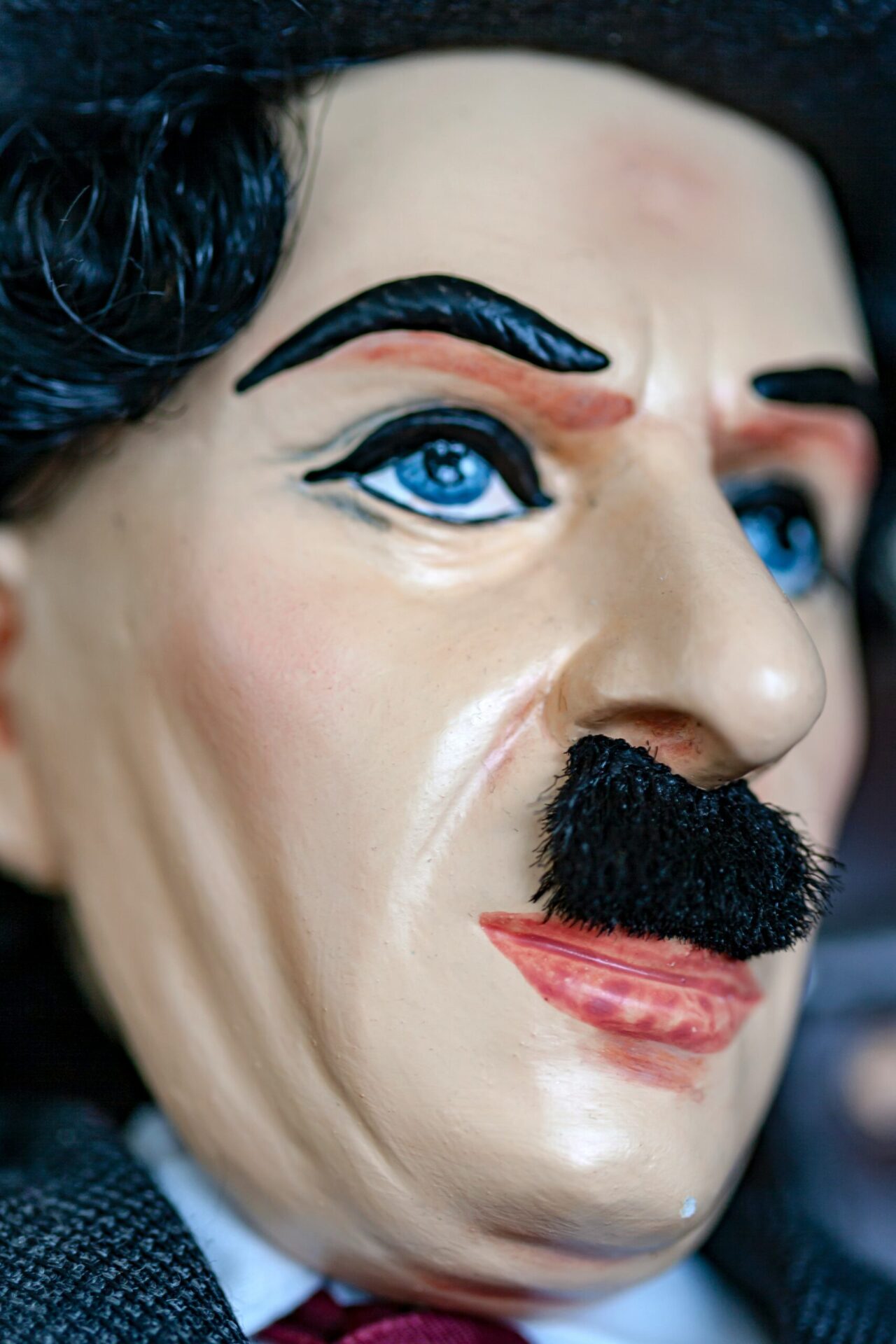
Charlie Chaplin | The Silence That Shook the World

Charlie Chaplin was more than a comedian. He spoke in the language of the body about hunger, dignity, and painful laughter. A read on the silence that shook the world.
I can’t remember exactly when I first saw Charlie Chaplin. Maybe it was in an old reel on a European television channel on a Sunday evening, or in the dim light of a small cinema in Tunis. But I remember clearly what I felt: that I was laughing and nearly crying at the same time, and that I was in the presence of someone who knew something precious about life that couldn’t be said with words.
That is the magic of silence.
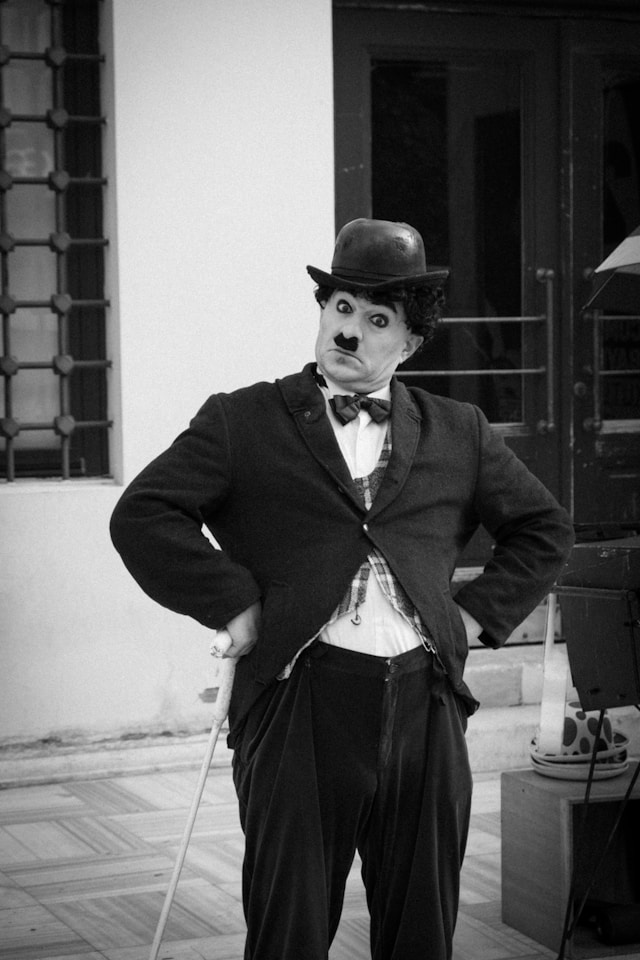
The Tramp Who Wasn’t Joking
Chaplin created an unforgettable character — The Tramp: a tight coat, baggy trousers, a bamboo cane, and a small moustache. Looked at today, the figure seems deliberately designed for someone living between two worlds, belonging fully to neither. Poor, yet walking with the dignity of a prince. Stumbling, but never falling completely. Insulted, yet tipping his hat and moving on. This character was a mirror for millions of people in the early twentieth century who had been pulled from their villages and thrown into the factories of growing cities.
Chaplin was not joking. He was diagnosing.
“Comedy is when you fall into a hole. Tragedy is when I do.” — Charlie Chaplin
Charles Spencer Chaplin was born in 1889 in London to music hall performers, and raised in severe poverty. He watched his mother admitted to a mental institution while he was still a child. He knew hunger in the literal sense of the word. And from that early fragility emerged the deepest comedy the cinema has ever produced.
This context doesn’t make his films mere social documents — it makes them a human pulse. Because what makes us laugh in them is also what hurts us at the same time, and that equation is rare in any art form.
A Language That Needs No Translation
I’ve spent years working in translation and cultural localisation, and I know well how much it costs to carry a joke from one language to another — how much of the humour evaporates in the crossing between cultures. Chaplin solved this problem in the simplest possible way: he didn’t speak. Or rather, he let the body speak.
Silent cinema wasn’t just a technical constraint — it was a universal language. Farmers in Anatolia watched The Tramp and understood. Coal miners in Pennsylvania laughed. Children in Cairo clapped. There was no language barrier, no culture requiring explanation, because the human body in hunger and fear and ambition speaks the same code everywhere.
This is why I return to him from time to time. In an age where artificial intelligence produces content in every language, and platforms overflow with every kind of image and sound, a person walking in a tight coat with a bamboo cane still says something that all that noise combined cannot say.
Perhaps because silence gives the viewer the space to complete the story themselves. And unfinished stories hold an irresistible pull — (See our article: The Attraction of Unfinished Stories).
Modern Times — or the Factory Prophecy
The factory machine scene from Modern Times (1936) — Official Charlie Chaplin Channel
In 1936, as the machinery of European war was slowly being loaded, Chaplin released Modern Times. The Tramp works in a factory that conditions him as a cog in a machine that never stops — he is literally sucked between the gears, recovered, and returned to the line. The scene is a silent visual satire, but it carries a critique that tolerates no ambiguity.
Chaplin had refused to move to talking pictures for precise artistic reasons: he believed that sound would confine the character to a specific nationality, class, and culture. The Tramp had to remain a human being, not a citizen. When he finally spoke in The Great Dictator (1940), his words were a direct speech on peace and dignity in the face of fascism — one of the greatest scenes in cinema history.
The body, in all its hunger and fear, speaks the same code everywhere — that was Chaplin’s cinematic philosophy.
What strikes me most, though, is that Modern Times doesn’t age. I’m forced today to see people staring at screens for hours on end, performing repetitive tasks with no clear horizon — and the film looks as though it was shot yesterday, not nine decades ago.
It’s worth noting how much this connects to the question of art and its capacity to reflect and reproduce reality. If Plato saw all art as imitation, what does it mean when AI now imitates that imitation? We explored this in our essay on (See our article: The Third Simulation: Art in the Age of Generative AI).
The Artist and the Exile
In 1952, as Chaplin was sailing back to Britain for the premiere of Limelight, American authorities informed him he would not be permitted to return. The McCarthy era was alight, and suspicion had fallen on everyone who dared critique capitalism. Chaplin — stateless, born in London, resident in America since childhood — found himself suddenly stripped of his imagined homeland.
He settled in Switzerland, continued working, and received an honorary Oscar in 1972. When he arrived on stage to collect it, the audience gave him the longest standing ovation in the ceremony’s history — twelve minutes. The crowd was offering him a collective, concentrated apology, even if in silence.
His story brings to mind what we once wrote about bodies that become display screens for others’ projects — (See our article: Sara Baartman: When the Body Becomes a Display Screen). The artist and the marginalised body intersect at one point: both return the world’s image back to it, and that is precisely what disturbs it.
Chaplin’s cultural journey across continents also raises questions that sit at the heart of our work here: what happens when a performance, a text, a persona crosses cultural boundaries? What is preserved, and what is lost? These are questions of adaptation — (See our article: The Audience Decides | Cultural Adaptation in Translation).
What Remains
I sometimes think about what will remain from our era — from all this cascading production. What remains is what carries genuine humanity: the thing that makes you laugh and nearly cry at the same time.
Chaplin achieved that with a tight coat, a small moustache, and not a single word. Perhaps because words constrain, and silence releases. Perhaps because he was speaking about something languages can’t describe: the small dignity of a human being living in a world far larger than himself, and walking through it with a step that rises above defeat.
The silence that shook the world was not really silence. It was speech in the language of bodies that do not lie.
If you enjoy this kind of reading — art, cinema, identity — you might also find value in our piece on (See our article: Hundred Years of Mishima | Why Does the World Read Him More Today Than When He Was Alive?) — both contemplate the legacy of an artist long after their passing.
And if you’re drawn to the question of silence as a language in its own right, in relationships rather than on film, our essay (See our article: The Art of Silence Between Spouses: When Words Are Unnecessary) offers a quieter but equally resonant read.
References & Further Reading
- Chaplin, C. (1964). My Autobiography. Simon & Schuster.
- Ackroyd, P. (2014). Charlie Chaplin: A Brief Life. Nan A. Talese.
- Kamin, D. (2011). Charlie Chaplin’s One-Man Show. Southern Illinois University Press.
- The Official Charlie Chaplin Website
- Criterion Collection — Chaplin at Mutual (1916–17)